How to Get ChatGPT to Recommend Your Local Business (and Show Up in Google AI Mode)
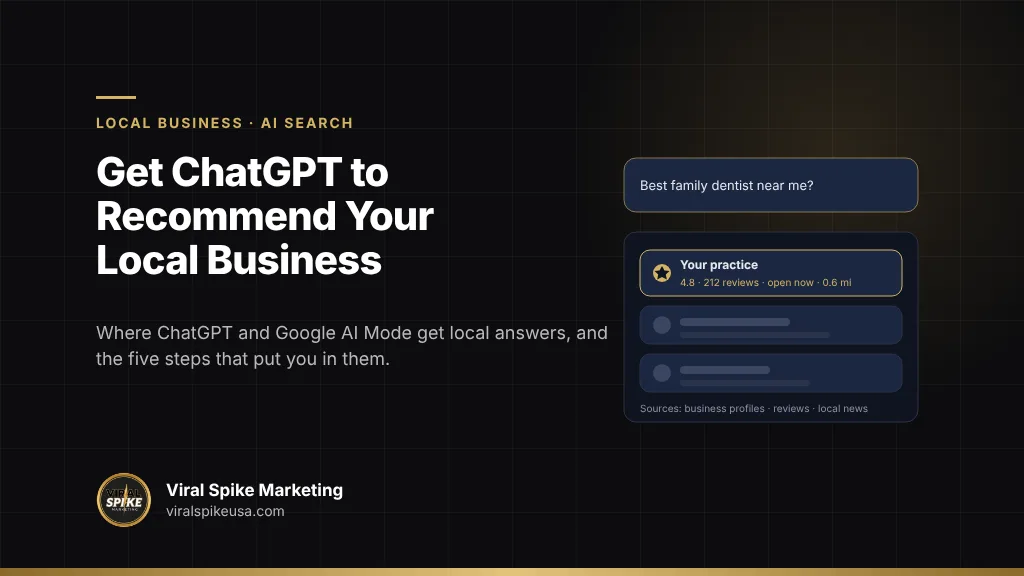
To get ChatGPT to recommend your local business, you have to be findable and well-reviewed in the sources ChatGPT searches, because ChatGPT does not keep its own directory of local businesses. OpenAI’s documentation says ChatGPT search “sometimes partners with other search providers,” names Microsoft’s privacy statement among them, uses your approximate location to return “nearby businesses, local news, and weather,” shows maps on mobile, and pulls restaurant availability from OpenTable, Resy and Yelp. Ahrefs describes Bing as ChatGPT’s built-in search provider, so a complete Bing Places listing matters as much as your Google Business Profile. Google’s AI Mode and AI Overviews run on the same Search systems as local results, and Google’s guidance says Business Profiles “can help your products and services to be visible in both AI responses and other Google Search results.” The work is five steps: complete and verify your Google Business Profile, claim Bing Places and your category’s directories, earn reviews within the platforms’ rules and answer them, get local press and third-party mentions that name you, and make your website state plainly who you serve, where, and for what. Consumers are already asking: BrightLocal’s 2026 survey found 45 percent of US consumers use AI tools for local business recommendations, up from 6 percent in 2025.
Key takeaways
- ChatGPT builds local answers from third-party search and data partners, not a private list; if your business is thin on Google, Bing, Yelp and the local web, it is thin in ChatGPT.
- Google says local ranking rests on relevance, distance and prominence, that more reviews and positive ratings can help, and that there is no way to request or pay for better local ranking.
- Reviews decide recommendations: 68 percent of consumers require four stars or more and 80 percent are more likely to use a business that answers all its reviews, per BrightLocal’s 2026 survey.
- Incentivized or insider reviews violate Google’s policy and the FTC’s 2024 rule on fake reviews; the right method is a review link, a reminder, and a reply to every review.
- A dated local news story or a named mention on a trusted third-party site is the corroboration an assistant needs to move you from “exists” to “recommended.”
How does ChatGPT decide which local businesses to recommend?
OpenAI has not published a ranking formula, but it has documented the inputs. According to the ChatGPT search help article:
- ChatGPT search “sometimes partners with other search providers,” sending them rewritten queries, and it links the privacy statements of Microsoft and Shopify as examples of those providers.
- It “may use an approximate location based on your IP address to provide relevant local results,” can use precise device location when the user allows it, and “on iOS and Android, relevant results may also include a map.”
- For restaurants, “it may show availability from OpenTable, Resy, or Yelp,” which means those platforms’ data on your business is feeding the answer.
- For a website to be eligible, OAI-SearchBot must be allowed to crawl it and the host or CDN must allow OpenAI’s published searchbot IP addresses. “Placement is not guaranteed.”
OpenAI’s launch announcement adds that ChatGPT search “leverages third-party search providers” as well as content provided directly by partners, and that it worked with data providers on visual designs for categories including maps. Ahrefs’ August 2025 study of 15,000 prompts states that ChatGPT’s built-in search provider is Bing, while noting its citations overlapped Google’s top ten and Bing’s top ten at similar low rates, about 8 percent each, per Ahrefs.
Put together: ChatGPT reads what Bing, and to some degree the wider web, says about businesses near the user, and it reads the structured listings of reservation and review partners where they apply. A business with a sparse Bing listing, no reviews and a website that never states its service area gives the model nothing to recommend. The general retrieval mechanics are in how ChatGPT and Perplexity choose their sources.
How do Google AI Mode and AI Overviews source local results?
Google is more specific. Its guide to optimizing for generative AI features says that “where appropriate, generative AI responses can include product listings, product information, and information about local businesses,” and that “Google Business Profiles can help your products and services to be visible in both AI responses and other Google Search results.” Its AI features documentation lists keeping Business Profile information current among the recommended practices and says AI Overviews and AI Mode use “query fan-out,” issuing multiple related searches to build a response.
Since the AI features are built on Search, Google’s local ranking guidance applies. Its help page on improving local ranking names three factors: relevance, “how well a Business Profile matches what someone is searching for”; distance, “how far each business is from the customer who’s searching”; and prominence, “how well-known a business is,” which includes links to the business and reviews: “more reviews and positive ratings can help your business’s local ranking.” The same page says “there’s no way to request or pay for a better local ranking on Google.” Practitioners who have tested AI Mode report answers that show star ratings, review counts, hours and map markers that appear to come from Business Profiles, alongside summaries of Yelp and other third-party reviews, per Whitespark’s guide to AI Mode for local businesses; that is observation, not a Google statement, but it matches the documentation.
The full checklist for Google’s AI features is in how to rank in Google AI Overviews and AI Mode. The local-specific version follows.
Step 1: Complete and verify your Google Business Profile
The profile is the record Google’s AI features read first and the one most competitors leave half-finished. Google’s Business Profile guidelines say “your name should reflect your business’s real-world name,” with no taglines, phone numbers or keywords added; a precise address or service area; and “as few categories as possible to describe your overall core business.” Virtual offices and unstaffed mailing addresses are not eligible. Google’s ranking page then lists what to complete.
| Field | What to enter | Why the AI features care |
|---|---|---|
| Verification | Complete it; Google says a verified business is “more likely to show up in search results” | Unverified profiles are discounted and cannot be managed |
| Name, address, phone | Exactly as on signage, your site, and every directory | Consistency is how engines confirm the entity is one business |
| Primary and secondary categories | The fewest that describe the core business | Relevance is matched on category before anything else |
| Hours, including special hours | Keep current; add holiday hours in advance | “Open now” is part of most local prompts |
| Description, services, attributes | Plain statements of what you do and for whom; attributes such as parking or accessibility | Fan-out queries match on specifics (“pediatric,” “emergency,” “wheelchair accessible”) |
| Photos and video | Current, real images of the premises and work | Google lists them among the completeness signals; they also feed Maps |
| Products or menu | Where eligible, list in-store products or menu items | Google says they may appear in local results with availability |
| Website link | The location page, not the home page for multi-location businesses | Gives the engine a page to cite for details the profile does not hold |
If the profile is suspended, nothing else in this guide works until it is reinstated; the appeal process is in how to get a suspended Google Business Profile reinstated.
Step 2: Claim Bing Places and the directories your category uses
Because ChatGPT’s search partner is Microsoft, your Bing listing is the one most local businesses have never touched and the one most directly feeding ChatGPT. Microsoft rebuilt Bing Places for Business in October 2025 as “a free online platform” with a recommendation tool that flags missing photos, website links, hours and category-specific items such as menus, and improved its Google import so the flow is “faster, more reliable, and better at preserving key attributes” such as name, hours and contact details, per Microsoft’s Bing Places announcement. Listings appear in Bing search results and Bing Maps; Microsoft describes deeper Copilot integration as a planned update rather than a current feature. Import from your completed Google profile, then review every field rather than trusting the import.
Beyond Bing, add the platforms OpenAI names and the ones your category relies on: Yelp, because ChatGPT shows Yelp reservation availability and testers have seen its review content summarized in Google’s AI Mode answers; OpenTable or Resy for restaurants; Apple Business Connect for Maps on iPhone; and the vertical directories a customer would check (Healthgrades, Avvo, Houzz, Angi, and so on). The rule for every one is the same: the name, address, phone and hours match the Google profile character for character, the categories match, and the description says the same thing.
This is entity consistency applied to a storefront. A knowledge panel for the business, where one appears, is the visible sign the records have resolved; how that happens is in how to get a Google knowledge panel for a business, and the structured-data side is in entity SEO for brands and executives.
Step 3: Earn reviews the right way and answer every one
Reviews are the main evidence an assistant has about quality, and the thresholds are rising. BrightLocal’s Local Consumer Review Survey 2026, a panel of 1,002 US adults, found that 97 percent read reviews for local businesses, 68 percent require four stars or more (up from 55 percent) and 31 percent will only use businesses rated 4.5 or higher (up from 17 percent). Owner replies matter: 80 percent are likely to use a business that responds to all its reviews, 42 percent are unlikely to use one that never replies, and 50 percent are put off by templated or generic replies. The same survey found 45 percent now use AI tools for local recommendations, 40 percent trust AI platforms for business recommendations, and 82 percent read AI-generated review summaries.
What Google allows
Google’s guidance on getting reviews is simple: share a Google review link or QR code, remind customers, and reply. Its prohibited content policy bans reviews “that have been paid for, directly or in kind,” content “posted due to an incentive offered by a business,” reviews based on a conflict of interest such as current or former employment, and merchants who “discourage or prohibit negative reviews, or selectively solicit positive reviews from customers.” Offering free or discounted goods for a review is “strictly prohibited.”
What federal law adds
The FTC’s rule on fake reviews and testimonials, announced August 14, 2024, bans buying or selling fake reviews, including AI-generated ones, insider reviews that do not clearly disclose the connection, compensation conditioned on a positive review, and using “unfounded or groundless legal threats” to suppress reviews, with civil penalties against knowing violators, per the FTC’s announcement. This is general information, not legal advice.
A routine that works
- Ask every customer at the natural moment (checkout, job completion, discharge) with the same link, by text or email, with no filtering by satisfaction.
- Send one reminder after a few days.
- Reply to every review within a week: specific, brief, no offers, no private details. Templates for the hard ones are in how to respond to negative reviews.
- Flag only reviews that violate policy, and expect most flags to be declined; what is realistic is set out in what a legitimate Google review removal service does.
Step 4: Get local press and third-party mentions that name you
An assistant asked for “the best” anything is making a judgment, and it does not rest that judgment on your profile alone. It looks for independent sources: a local news feature, a “best of” list from a regional publication, a chamber or association page, a supplier’s case study, a neighborhood blog. Google’s AI optimization guide warns that seeking “inauthentic mentions” does not help; the authentic version is dated coverage that describes what you do, where, and for whom.
Local press is more reachable than most owners assume. Community papers, regional business journals, TV station websites and local radio sites publish daily and need local sources; a specific angle (a hire, a renovation, a seasonal problem you solve, a data point from your own customers) gets replies. The pitch method is in how to get your story in local news. When the story runs, link it from your site’s press page, add the outlet to your Business Profile posts, and make sure the article names the business exactly as the profile does.
Two other mention sources carry weight for local prompts. Reddit threads about your city or category are among the most-cited sources on ChatGPT and Perplexity, and an owner who answers a thread as a disclosed representative builds a record the engines read; the rules for doing that are in why Reddit shapes what ChatGPT says about your brand. And LinkedIn, which ranked in the top five cited domains on Google AI Mode and Perplexity in Semrush’s 2025 data, gives a service business a dated, public record of its people and work.
Step 5: Make your website answer the questions people ask assistants
The profile holds facts; the website holds answers. A local prompt is rarely “dentist near me” alone; it is “pediatric dentist near me that takes new patients and is open Saturday,” and the fan-out queries behind it look for pages that say those things. The site needs:
- A location page per location with name, address, phone, hours, service area, parking and accessibility, written in text, not in an image.
- A service page per core service that opens with a one-sentence answer to “do you do X, for whom, and what does it involve,” and states the area served.
- LocalBusiness structured data on the location page. Google’s LocalBusiness documentation requires name and address and recommends openingHoursSpecification, geo coordinates, telephone, url and priceRange, using the most specific subtype (Dentist, Plumber, Restaurant) and matching what the page shows. Google notes it does not guarantee the markup will produce features, and that aggregateRating is only for sites that review other businesses.
- A visible FAQ that answers the questions your front desk hears: insurance, pricing ranges, first-visit process, emergency availability, cancellation policy.
- Crawler access for OAI-SearchBot, PerplexityBot and Googlebot, with no bot challenge on the location and service pages.
The page-level pre-publish routine for each of those pages is the answer engine optimization checklist.
How do you test whether ChatGPT recommends you?
Build a prompt set that mirrors how customers ask, run it monthly on ChatGPT, Google AI Mode, Perplexity and Gemini, and log the results. Answers vary by session and by the user’s location, so run from the service area you care about and treat each run as a sample.
| Prompt type | Example | What to record |
|---|---|---|
| Category, unbranded | “Best [category] in [city]” | Whether you are named, your position, which sources are cited |
| Category with a qualifier | “[Category] in [city] open on Saturday that takes [insurance]” | Whether your qualifiers are known; where the answer got them |
| Comparison | “[Your business] vs [competitor]” | How each is described and which facts are wrong |
| Reputation | “Is [your business] good? What do reviews say?” | Star rating and review themes quoted; the platforms cited |
| Entity | “Where is [your business] and what are its hours?” | Accuracy of address, phone, hours; which record the error traces to |
Every wrong fact traces to a record: the profile, a directory, the site or a stale article. Every absence traces to a gap: no reviews on the platform the engine cited, no third-party mention, a blocked crawler. The measurement tools and cadence are in AI visibility tools and metrics.
Where Viral Spike fits
Viral Spike Marketing’s AI search visibility service runs the local prompt set above as the baseline, then works the five steps: Business Profile and Bing Places completeness, directory and entity alignment, a compliant review routine with replies, location and service pages with LocalBusiness markup, and the third-party mentions that drive recommendation. Coverage comes through local pitching and, where the business wants a recognized outlet on record, guaranteed editorial placements, where you approve the draft, the article is published and indexed on Google, and the engagement is refunded in full if it never runs. Reviews are never bought, gated or incentivized, and review flags are limited to policy violations with a written assessment first. To see what ChatGPT and Google AI Mode say about your business today, contact us for the baseline run.
Ask ChatGPT for your own category tonight, then fix the first gap
Type “best [your category] in [your city]” into ChatGPT and into Google AI Mode and read the answers with the sources open. If you are absent, the first gap is usually one of three: an incomplete or unclaimed Bing listing, a review count well below the businesses that were named, or no page anywhere that states your service area and specialty in plain text. Fix that one this week, keep the prompt, and run it again next month. The assistants recommend what the sources they trust already say; the job is to make those sources complete, consistent and current.
Frequently asked questions
Does ChatGPT use Google Business Profile data?
Not directly. OpenAI says ChatGPT search partners with third-party search providers, naming Microsoft among them, and Ahrefs describes Bing as ChatGPT’s built-in search provider. ChatGPT reads what those providers and the open web say about your business, which includes your website, Bing Places, Yelp and reservation partners, and local news. Your Google Business Profile still matters because it is what Google AI Mode and AI Overviews draw on and because its facts propagate to other directories.
How do I get my business to show up in Google AI Mode?
Keep your Google Business Profile complete, verified and current, since Google’s guidance says Business Profiles can help your products and services be visible in AI responses. Google’s local ranking rests on relevance, distance and prominence, and Google says more reviews and positive ratings can help. Add location and service pages that state what you do and where in text, allow Googlebot, and earn independent mentions. There is no way to request or pay for better local ranking.
Should I claim Bing Places for Business?
Yes. Because ChatGPT’s search partner is Microsoft, a complete Bing listing is one of the most direct inputs to ChatGPT’s local answers. Microsoft rebuilt Bing Places in October 2025 as a free platform with an improved import from Google Business Profile and a tool that recommends missing fields. Import your Google profile, then check every field so the name, address, phone, hours and categories match exactly.
Can I offer a discount for a Google review?
No. Google’s policy bans reviews posted because of an incentive offered by a business and calls offering free or discounted goods for reviews strictly prohibited; it also bans selectively asking only happy customers. The FTC’s 2024 rule bans compensation conditioned on a positive review and undisclosed insider reviews, with civil penalties available. Ask every customer with the same link, send one reminder, and reply to every review. This is general information, not legal advice.
How many reviews do I need for AI assistants to recommend me?
There is no published threshold, but consumer expectations set a practical one. BrightLocal’s 2026 survey found 68 percent of US consumers require four stars or more and 31 percent require 4.5 or higher, and Google says more reviews and positive ratings can help local ranking. The useful comparison is local: run your category prompt, note the review counts and ratings of the businesses named, and treat the lowest of those as your floor.
Does local press help with ChatGPT recommendations?
Yes, in the same way it helps with any recommendation prompt. When asked which business is best, an assistant looks for independent sources that say so: a local news feature, a regional best-of list, an association page or a well-reviewed thread. Dated coverage that names your business exactly as your profiles do gives the model corroboration it cannot get from your own site, and it is also what Google’s guidance calls authentic rather than inauthentic mentions.
Sources
Primary sources referenced in this article, in order of first use.
- ChatGPT search help article (help.openai.com)
- launch announcement (openai.com)
- Ahrefs (ahrefs.com)
- guide to optimizing for generative AI features (developers.google.com)
- AI features documentation (developers.google.com)
- help page on improving local ranking (support.google.com)
- Whitespark's guide to AI Mode for local businesses (whitespark.ca)
- Business Profile guidelines (support.google.com)
- Microsoft's Bing Places announcement (blogs.bing.com)
- Local Consumer Review Survey 2026 (brightlocal.com)
- guidance on getting reviews (support.google.com)
- prohibited content policy (support.google.com)
- FTC's announcement (ftc.gov)
- LocalBusiness documentation (developers.google.com)

More in AI Search


Related services