
Google Review Removal Services: What’s Legitimate, What’s a Scam, and What You Can Expect
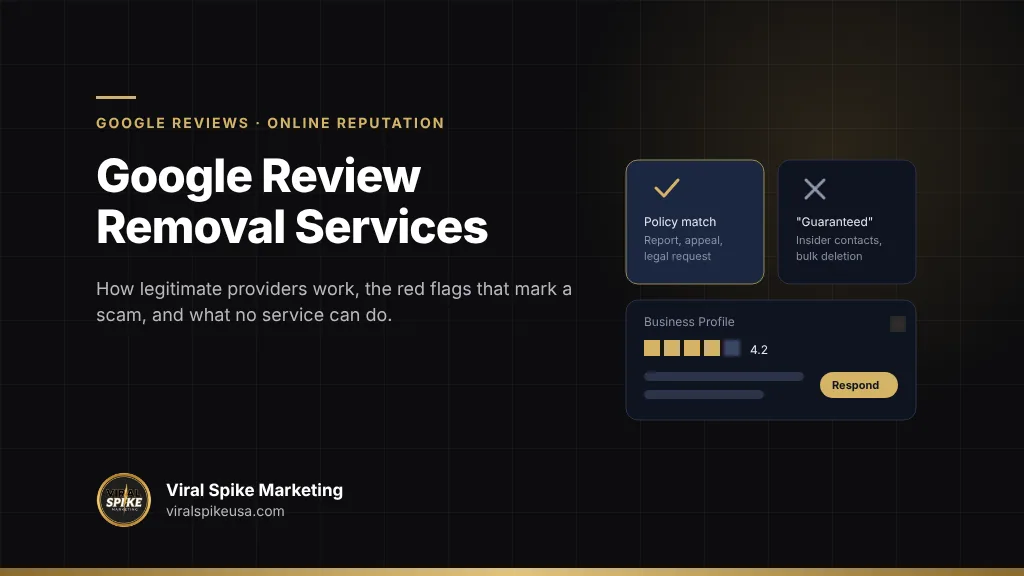
A legitimate Google review removal service does three things: it matches each review against Google’s published content policies and files reports and appeals through the Reviews Management Tool, it prepares legal removal requests where a review is defamatory or unlawful, and it documents everything so the business can see what was attempted and why. It also tells you, before you pay, which reviews no process will touch. No service can delete an honest negative review, because Google removes reviews only for policy violations and does not mediate disputes between businesses and customers. Scams sell what legitimate services cannot: guaranteed deletion, “insider contacts” at Google, bulk removal within days, or a wave of five-star reviews to bury the problem, which is now a federal violation. If you already know how the report and appeal process works, our step-by-step guide to removing a Google review covers it; this article is about deciding whether to hire help, and whom.
Key takeaways
- Google removes reviews only for violations of its content policies (fake engagement, conflicts of interest, off-topic content, harassment, impersonation and similar), and says not to report a review just because you disagree with it.
- Google’s own tooling is free: reports go through the Reviews Management Tool, evaluation “typically takes several days,” and a rejected report gets one appeal. A legitimate service adds judgment and evidence, not access.
- Google blocked or removed more than 292 million policy-violating reviews in 2025 and now pauses reviews on profiles hit by extortion spikes, so coordinated attacks are the strongest removal case.
- The FTC’s 2024 rule bans buying fake reviews and suppressing real ones with baseless legal threats, with civil penalties for knowing violators, which rules out most “bury it” offers.
- Pay only for defined work: assessment, filings, appeals, legal drafting, response and review-generation programs. Refuse any contract that charges per deleted review of content that does not violate a policy.
How does a legitimate Google review removal service work?
Everything a legitimate provider does is built on two Google documents. The first is the prohibited and restricted content policy for Maps contributions, which lists what Google removes: fake engagement and paid or duplicated reviews, off-topic content (“general, political, or social commentary or personal rants”), content based on a conflict of interest (“current or former employment, a contractual or consultory relationship”), harassment and hate speech, impersonation, and misrepresentation. The second is Google’s help article on reporting reviews for removal, which describes the Reviews Management Tool, the three report statuses (decision pending; reviewed, no policy violation; escalated), the one-time appeal of up to 10 reviews at a time, and the warning not to report a review “just because you disagree with it or dislike it.”
A competent service runs the following sequence for every review it is engaged on:
- Policy triage. Each review is mapped to a specific policy clause or marked “no basis.” This step separates professionals from sellers: for many reviews, nothing applies.
- Evidence assembly. Public profiles linking a reviewer to a competitor or former employment; the pattern across accounts in an attack (dates, phrasing, review histories); the quoted off-topic text; the record search for a reviewer who was never a customer.
- Report and track. Filed through the Reviews Management Tool under the matching reason, status logged.
- Appeal once, well. If the first decision is “no policy violation,” the single appeal is written with the evidence that the first reviewer may not have seen. There is no second appeal, so a provider that burns it on a weak argument has cost you the case.
- Legal removal request where warranted. Google’s legal removal process is separate from policy reporting: a request names the product, the specific URL and the legal basis, and Google replies with a reference number. It is for content that is unlawful, such as defamation established by a court order, not for reviews you consider unfair.
- Documentation. You receive the list of reviews, the policy cited for each, the evidence, filing dates, statuses and outcomes. A provider that cannot show this did not do the work.
Note what is absent: any contact with Google beyond the tools every owner can use. Google’s help page describes no channel through which a third party can request removal outside policy. A provider’s value is in knowing the policies, writing reports that match them, and not wasting the appeal.
What can no service do, regardless of price?
The hard limit is stated by Google itself: reviews that do not violate policy remain visible, Google does not mediate conflicts between businesses and customers, and negative reviews “can point to areas for improvement.” A one-star review saying the wait was long and the staff were curt is a protected opinion, even if unfair. No process at Google removes it, so a service claiming to is either lying about the method or using one that creates a bigger problem.
| Review type | Policy basis | Legitimate service can | No service can |
|---|---|---|---|
| Fake review from a non-customer | Fake engagement; off-topic (no experience) | Report with record search; appeal; document pattern | Guarantee removal; Google decides |
| Competitor or ex-employee | Conflict of interest | Report with public evidence of the link | Remove it on suspicion alone |
| Coordinated one-star attack | Fake engagement | Report the cluster; many are caught automatically | Promise a timeline |
| Extortion (“pay or it stays”) | Fake engagement; Google’s extortion detection | Report with the demand preserved | Negotiate with the extortionist |
| Defamatory factual claim | Legal removal (court order) | Draft the legal request; coordinate with counsel | Remove it without a legal basis |
| Honest negative experience | None | Draft a response; build a review program; suppress in search | Delete it |
The other limit is the law. The FTC’s final rule on fake reviews and testimonials, announced August 14, 2024, bans creating, buying or selling fake reviews, paying for reviews conditioned on sentiment, undisclosed insider reviews, and “review suppression” through baseless legal threats, intimidation or false accusations, and it lets the FTC seek civil penalties against knowing violators. The Consumer Review Fairness Act, per the FTC’s business guidance, separately bars contracts that penalize customers for honest reviews. A service whose method is a cease-and-desist letter to every reviewer or a package of new five-star reviews is selling you federal exposure. This is general information, not legal advice.
What do guarantees, refunds and pricing models actually mean?
Review removal is the one area of reputation work where “guaranteed” should make you stop. Glassdoor, facing the same pitches on its own platform, puts it plainly on its content removal policy page: claims of guaranteed review removal are “untrue and misleading,” and some services charge for actions that can be done free through an account. The same is true on Google. A legitimate provider assesses every review against the policy in writing first and only takes on the ones with a basis; those are removed or refunded in full.
What a legitimate provider also guarantees is the work: every review assessed, reports filed under the correct policy with evidence, the appeal used well, a legal request drafted where there is a basis, and documentation of all of it. Some charge only for reviews that are removed; that is defensible when the provider has first told you which reviews have a policy basis and limits the outcome fee to those. It is a red flag when the fee applies to any review, because the only way to earn it on an honest review is to break a rule.
How pricing is usually structured
- Assessment fee. A flat charge to triage every review and report which have a basis. This is the stage most worth paying for, because it is where you learn whether removal is on the table.
- Per-filing or per-case fee. For report, appeal and legal request preparation on reviews with a basis. Paid upfront, which is standard across the industry for removal work because the labor is incurred whether or not Google agrees.
- Outcome-based fee. Charged only on removal, acceptable when scoped to policy-matched reviews and paired with a documented filing.
- Monthly retainer. For the broader program: monitoring, responses, review generation, suppression and coverage. Priced by scope, not by review count.
Figures vary by volume, by whether legal drafting is involved, and by what else the engagement includes; ranges for the broader category are in how much reputation management costs. The useful test is whether the proposal separates removal work (defined, upfront, outcome uncertain) from reputation work (ongoing, measurable, outcome in your control).
What are the red flags of a review removal scam?
Most scams in this category share a small set of tells. Any one of them is enough to walk away.
| Red flag | Why it cannot be true, or why it is dangerous |
|---|---|
| “Guaranteed removal of any review” | Google removes only policy violations and makes the decision itself; no third party controls it |
| “Insider contacts at Google” | Google’s reporting path is the Reviews Management Tool and the legal form, open to everyone; no help page describes any other channel |
| “Bulk removal in 48 hours” | Google says evaluation “typically takes several days” per report; bulk claims imply mass-flagging, which risks the profile |
| Fee per deleted review with no assessment first | The only way to earn it on honest reviews is fraud; the provider has an incentive to use it |
| Offer to “replace” the bad review with positive ones | Buying reviews violates Google policy and the FTC’s 2024 rule, with civil penalties |
| Offer to contact the reviewer and “negotiate” | Offering anything for review changes is prohibited by Google and is extortion-adjacent if pressure is involved |
| No written list of which reviews have a policy basis | Triage is the core deliverable; its absence means the provider has not read the policy |
| Requests your Google account password | Account takeover risk; a legitimate provider works as a manager with limited access |
| Unsolicited outreach the day after a bad review | Often paired with the attack itself; Google now pauses reviews on profiles hit by extortion spikes |
On the last row: Google’s April 2026 post on new protections for businesses on Maps describes scams in which people “demand payment to remove fake one-star reviews,” and says Google now detects those patterns, removes the fake content, pauses new reviews on the profile, alerts the owner and shows a banner. If a bad review and a removal offer arrive together, the offer is part of the scam: report through the tool and keep the messages. The broader vetting questions are in how to choose a reputation management agency.
How do you vet a provider before you pay?
Five questions settle it.
- “Which of my reviews have a policy basis, and which policy?” A legitimate provider answers review by review and names clauses from Google’s content policy. Vague answers (“we have a method”) end the conversation.
- “What happens if Google says no?” The right answer describes the one appeal, when a legal request applies, and the plan for reviews that stay. “We keep escalating” is not something Google’s process allows.
- “What will I receive?” A log of filings, policies cited, evidence, dates and statuses. Ask for a redacted sample from a past engagement.
- “How do you handle reviews with no basis?” Response drafting, a neutral review-generation program and search suppression, with no reviews from anyone but real customers.
- “What access do you need?” Manager access to the Business Profile, never your Google password. Google’s own guidance on reviews and replies is explicit that offering goods, services or discounts in exchange for reviews, review changes or removal of negative reviews is prohibited; a provider that does not know that should not have access to anything.
Then check the provider the way you would check anyone else: its own Google reviews, its search results, how long it has existed, and whether its claims name outcomes you can verify.
What about reviews showing on the knowledge panel?
The rating and review snippets in the Business Profile panel on Google Search and in Maps are the same reviews you see in the Reviews Management Tool; Google’s help content says reviews appear next to your Business Profile in Maps and Search. There is no separate removal process for the panel. If a review is removed through the tool, it leaves the panel; if not, it stays. What you control is the context: your replies sit beside the reviews, and a steady flow of new reviews from real customers changes what a reader sees first even when an old one cannot be deleted.
One related risk: review attacks sometimes arrive with suggested edits to your hours, category or name. Google’s April 2026 update added proactive email alerts for verified, active owners so important edits can be checked before they publish, and blocked 79 million inaccurate or unverified edits in 2025. A profile under attack should have those alerts on and an owner reading them.
What are the alternatives when removal is not available?
For most negative reviews, which are real and unprovable, three things work, and a service worth paying for runs all three. If the ongoing work is what you need rather than a one-off removal, the choice between a tool and a team is covered in which to pick, reputation software or an agency.
Response
Google’s guidance on replies: keep them polite, professional and brief, avoid generic thank-yous, never share a reviewer’s private information, invite complex issues offline, and be honest about mistakes without taking responsibility for things outside your control. A good response changes conversion among the people reading it; it does not change the rating. Wording for the common cases is in our negative review response templates.
Review generation, done within the rules
Google allows businesses to ask customers for reviews with a link or QR code, as long as nothing is offered in exchange. A standing request at the point of service, to every customer, is the most reliable way to move a rating over months, because it replaces a sample dominated by the unhappy with the actual customer base. Filtering who is asked, or rewarding the review, is what the FTC rule and Google’s policy prohibit.
Suppression in search
The Business Profile panel is one result among several for your name. Your own site, your profiles on the directories your industry uses, and independent coverage in recognized publications fill the rest of the page and are what AI assistants quote when asked about you. The method is in how to suppress negative search results the right way. The same logic applies on Yelp and Trustpilot, with platform-specific rules in our Yelp and Trustpilot removal guides.
Where Viral Spike fits
Viral Spike’s reputation management service is structured the way this article says a legitimate service should be. The engagement opens with a review-by-review assessment against Google’s content policy, delivered in writing, so you know which reviews have a basis before anything is filed. Removal work (reports, the single appeal, legal request drafting with your counsel) is defined and paid upfront, as is standard in the industry, with full documentation of every filing. For the reviews that stay, we draft responses, set up a compliant review-generation program, and build the search layer around the profile: your own pages ranking for your name, consistent directory profiles, and guaranteed editorial placements in recognized outlets, where you approve the draft, the article is published and indexed on Google, and the engagement is refunded in full if it never runs. The reviews we take on are removed or you receive a full refund, with the written assessment and the refund terms in your agreement before any work starts. We do not contact reviewers or supply reviews. To get the assessment, contact us with your Business Profile link.
Ask for the triage first, and pay for work, not promises
Before you hire anyone, open the Reviews Management Tool and read Google’s content policy against your worst five reviews. If you can name the clause each one breaks, you may not need help; if you cannot, that list is what a provider should produce before you pay. Then judge the proposal by one line: does it assess each review against the platform’s policy in writing before taking it on, and guarantee the ones it takes on with removal or a full refund? The ones that do are the ones to hire.
Frequently asked questions
Are Google review removal services legitimate?
Some are. A legitimate service assesses each review against Google’s content policies, files reports and the single appeal through the Reviews Management Tool, prepares legal removal requests where a review is defamatory or unlawful, documents everything, and handles responses and review generation for reviews that stay. Services that guarantee deletion of any review, claim insider contacts at Google, or offer to bury reviews with new five-star ones are not legitimate.
Can a service remove an honest negative Google review?
No. Google removes reviews only for violations of its content policies, such as fake engagement, conflicts of interest, off-topic content or harassment, and says not to report a review simply because you disagree with it. An honest account of a bad experience does not violate any policy, so no provider can have it removed. The realistic plan for those reviews is a professional response, a compliant review program and search suppression.
How much does Google review removal cost?
Pricing is usually structured as an assessment fee to triage reviews, a per-case fee for reports, appeals and legal drafting on reviews with a policy basis, and sometimes an outcome fee scoped to those reviews; broader reputation work is priced as a retainer. Figures vary with volume and legal involvement, so judge proposals by structure rather than price. Any fee per deleted review with no prior assessment is a red flag.
Why do removal services charge upfront?
Because the labor is incurred whether or not Google agrees. Policy triage, evidence assembly, report writing, the appeal and legal drafting take the same time either way, and the decision belongs to Google. Paying upfront for defined removal work is standard across the industry; what should not be paid upfront is a promise of deletion. Ask for the written triage first, and for documentation of every filing afterward.
Is it legal to pay for positive reviews to offset a negative one?
No. The FTC’s final rule on fake reviews and testimonials, announced in August 2024, bans creating, buying or selling fake reviews and paying for reviews conditioned on sentiment, with civil penalties for knowing violators. Google’s policy separately prohibits offering anything in exchange for reviews or review changes. Asking every real customer for a review through a link or QR code, with nothing offered, is allowed and is the compliant alternative.
What should I do if someone offers to remove a bad review for a fee right after it appears?
Treat the offer and the review as one event. Google’s April 2026 update describes scams in which people demand payment to remove fake one-star reviews, and Google now pauses reviews on profiles hit by such spikes. Do not pay. Preserve the messages, report the review through the Reviews Management Tool under fake engagement, note the extortion in your explanation, and report the fraud to the FTC at ReportFraud.ftc.gov.
Sources
Primary sources referenced in this article, in order of first use.
- prohibited and restricted content policy (support.google.com)
- reporting reviews for removal (support.google.com)
- legal removal process (support.google.com)
- final rule on fake reviews and testimonials (ftc.gov)
- business guidance (ftc.gov)
- content removal policy page (glassdoor.com)
- new protections for businesses on Maps (blog.google)
- reviews and replies (support.google.com)

More in Online Reputation


Related services