
Wikipedia, Wikidata and AI Answers: Entity SEO for Brands and Executives
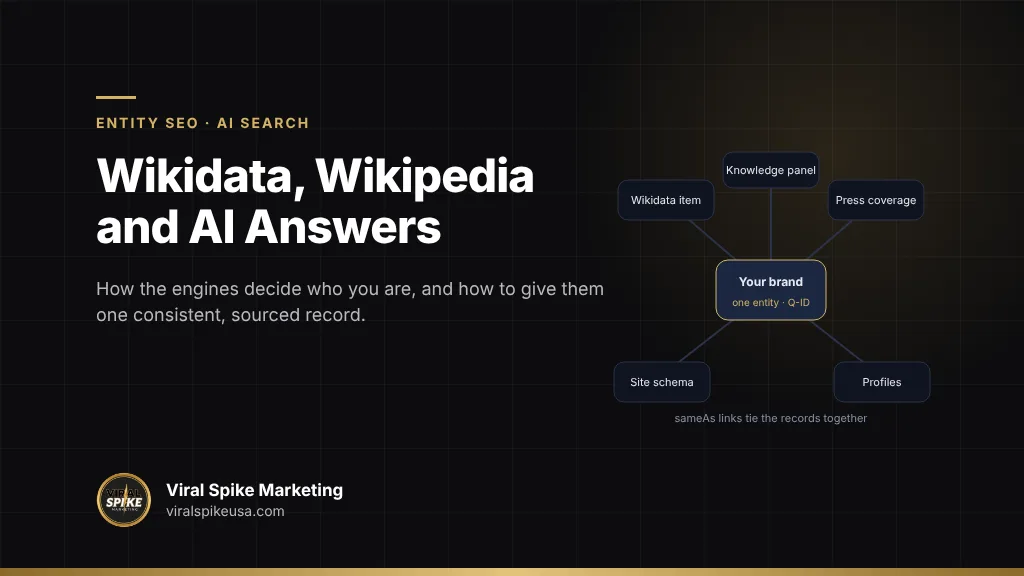
Wikidata SEO is the practice of making sure the structured records that search engines and AI assistants use to identify your brand or executive exist, agree with each other and are properly sourced. Google’s Knowledge Graph, ChatGPT, Gemini, Perplexity and Claude all resolve a name to an entity before they describe it, and they do that by reconciling a small set of public records: a Wikidata item, a Wikipedia article where one exists, your site’s Organization or Person schema with sameAs links, business databases such as Crunchbase, professional profiles such as LinkedIn, and press coverage that corroborates the facts. Most companies will never qualify for a Wikipedia article, and that is fine; a correctly built Wikidata item, consistent profiles and independent coverage will resolve the entity without one. What does not work is shortcuts: undisclosed paid Wikipedia editing violates the Wikimedia Terms of Use, Wikidata items without serious references get deleted, and schema that claims facts the web does not support is ignored. This guide covers which records matter, how to create a Wikidata item the right way, and how to connect everything with sameAs.
Key takeaways
- AI engines and Google describe entities, not keywords; if five sources describe your company five ways, the engine hedges or leaves you out.
- Wikipedia was one of ChatGPT’s two most-cited domains in Semrush’s 2025 study, but a Wikipedia article requires significant independent coverage that most companies do not have; Wikidata has a lower bar.
- A Wikidata item qualifies if it describes a clearly identifiable entity “that can be described using serious and publicly available references,” and Wikidata itself asks people with a conflict of interest to request the item rather than create it.
- Google’s Organization structured data uses sameAs to point to your profiles elsewhere, and its Article markup recommends url or sameAs on authors so it can disambiguate them.
- Anyone paid to edit Wikipedia must disclose employer, client and affiliation under the Wikimedia Terms of Use; Wikidata has the same disclosure policy, and undisclosed paid editors are prohibited from editing.
What is entity SEO, and why does it decide what AI says about you?
Entity SEO is the work of making a brand, product or person recognizable as one specific thing in the databases that search engines and language models consult. The idea dates to Google’s launch of the Knowledge Graph on May 16, 2012, described as “things, not strings,” which started with about 500 million objects and 3.5 billion facts drawn from public sources including Freebase, Wikipedia and the CIA World Factbook, per Google’s announcement. Google now describes the graph as “our database of billions of facts about people, places, and things,” built from organizations that compile factual information, licensed data, and content owners who supply information directly, including people who claim and correct their own knowledge panels, per Google’s explanation of how the Knowledge Graph works.
AI assistants do not read Google’s graph, but they read the same public sources it was built from. In Semrush’s study of more than 230,000 prompts between July and October 2025, Reddit and Wikipedia were ChatGPT’s two most-cited domains, cited about five times as often as the next domains, and LinkedIn ranked in the top five on both Google AI Mode and Perplexity, per Semrush. When an assistant answers “who is the CEO of [company],” it is reconciling what Wikipedia, Wikidata, LinkedIn, Crunchbase, your site and the press say. Agreement produces a confident answer; disagreement produces hedging, an outdated description, or silence.
Content optimization gets a page cited for a fact; entity consistency gets the brand named at all. The broader discipline is covered in what generative engine optimization is, and the retrieval mechanics in how ChatGPT and Perplexity choose their sources.
Which records do Google and the AI engines use to resolve an entity?
The records that carry the most weight are the ones you control least.
| Record | What it supplies | Who controls it | Bar to entry |
|---|---|---|---|
| Wikipedia article | The description Google and assistants quote most readily; the strongest single trust signal | Volunteer editors; subjects may only request edits | Significant coverage in multiple independent, reliable secondary sources; most companies do not qualify |
| Wikidata item | A machine-readable identity with a stable Q-number, official website, founding date, headquarters, founders and links to external identifiers | Open to anyone, subject to notability and sourcing rules | A clearly identifiable entity described by serious, public references |
| Google Knowledge Graph entry | Knowledge panel, and the facts reused by AI Overviews and AI Mode | Google; verified representatives can suggest edits | Enough confirmed facts from the sources above and below |
| Your site’s Organization or Person schema | Your canonical statement of name, legal name, founding date, address, logo, and sameAs links to every other record | You | Must match what is visible on the page |
| LinkedIn company page and executive profiles | Leadership, headcount, locations, and dated employment history; among the most-cited domains in AI Mode and Perplexity | You, within LinkedIn’s rules | None beyond accuracy |
| Crunchbase and business registries | Founding date, funding, founders, legal entity; a common cross-reference for AI answers about companies | You can claim and edit a Crunchbase profile; registries are public record | None beyond accuracy |
| Press coverage in recognized outlets | Independent corroboration of every fact above, and the references Wikidata and Wikipedia require | Editors; earned or placed | Newsworthiness or a placement program |
Two rows do most of the work: the Wikidata item, because it is the structured backbone the others link to, and press coverage, because it is the evidence everything else cites. How a knowledge panel emerges from these records is covered in how to get a Google knowledge panel for a business and, for individuals, for a person.
How is Wikidata different from Wikipedia, and which one can you get?
Wikipedia is an encyclopedia written in prose; Wikidata is the structured database behind it, where each entity is an item with a Q-number and a set of property-value statements such as instance of: business, inception: 2019, headquarters location: Austin. Wikipedia’s bar is high. Under Wikipedia’s notability guideline for organizations and companies, a company is presumed notable only if it “has been the subject of significant coverage in multiple reliable secondary sources that are independent of the subject.” Each source must be significant, independent, reliable and secondary; press releases, routine announcements, listings, and contributor-platform profiles do not count, and “no company or organization is considered inherently notable.” Notability is not inherited: a company does not become notable because its founder is. Whether you clear that bar is worked through in do you qualify for a Wikipedia page.
Wikidata’s bar is lower and differently shaped. Under Wikidata’s notability policy, an item is acceptable if it meets any one of three criteria: it has a valid sitelink to a Wikimedia project page; it “refers to an instance of a clearly identifiable conceptual or material entity that can be described using serious and publicly available references”; or it fulfills a structural need. A company with a registry record, an official site and coverage in recognized publications generally meets the second criterion. An executive usually meets it when independent sources describe them by name and role. The policy says its guidelines are “intentionally left a bit vague” and that disputed items go to a deletion discussion, so the references you attach decide the outcome. A reform of the policy was under discussion as of October 2026, so check the current text before you rely on it.
The sequence for most brands: build the sourced Wikidata item now, keep the Wikipedia question open until the coverage exists, and never force the second by creating it yourself.
How do you create a Wikidata item correctly?
Creating an item takes an afternoon once the references exist. Doing it without them produces a deletion and a public record of the attempt.
- Decide whether to request rather than create. Wikidata’s Requests for new items page says anyone can create an item, but asks you to request one instead if “you have a conflict of interest, such as requesting an item about yourself, your organisation, your company,” or if you are unsure the entity meets the notability policy. Requests must include evidence of notability. For a brand or executive, the request route is the one the community expects.
- Search first. Check whether an item already exists under a variant name; duplicates get merged, inaccuracies included.
- Collect references before writing anything. Wikidata’s sourcing guideline says “the majority of statements on Wikidata should be verifiable” and should point to reliable sources “such as university-level textbooks or reference books, academic journals, and newspapers.” Wikipedia pages are not acceptable as sources for Wikidata statements; statements supported only by “imported from Wikimedia project” are not considered sourced. Independent references are what make the item survive review.
- Add the core statements. For a company: instance of, official name, inception, headquarters location, country, founded by, chief executive officer, official website, industry, and a short description in the format “American digital PR agency” rather than marketing copy. For a person: instance of human, occupation, employer with start date, position held, educated at, date of birth only if it is already public, and official website.
- Link the external identifiers. Wikidata has dedicated properties for a Crunchbase organization ID and a LinkedIn company ID, among many others. These are how engines cross-reference the item against the profiles you control, and Wikidata’s guideline treats them as self-verifying because they link directly to the record.
- Reference each contestable statement. Use “stated in” for a publication that has its own item, or “reference URL” for a web page, and add “retrieved” with the date. One good reference per fact beats five weak ones.
- Respect the living people policy. Wikidata’s living people policy says statements “that can reasonably be expected to be challenged should be supported by a reliable source” and that private details should not be added unless they are widespread public knowledge or the person has shared them openly. For an executive item, that means no home city, no family, no exact birth date unless it is already published by a reliable source.
- Disclose if you are paid. Wikidata’s paid editing policy requires disclosure of “every organization (regardless of legal status) and individual that pays the user money for contributing to Wikidata,” on the user page in plain text or with the PaidContributions template. An agency building a client’s item must disclose.
After creation, resist adding every fact you know. Eight sourced statements are more useful to an engine than forty, half of them unsourced and liable to removal.
How do you connect the records with schema and sameAs?
The Wikidata item, the profiles and the press coverage become one entity when your own site tells the engines they describe the same thing. That is the job of the sameAs property in schema.org markup.
Google’s Organization structured data documentation lists name, alternateName, legalName, url, description, foundingDate, logo, address, contactPoint, telephone, email, numberOfEmployees and identifiers such as DUNS, LEI, NAICS and VAT or tax IDs, and defines sameAs as “the URL of a page on another website with additional information about your organization,” giving a profile page on a social media or review site as the example. Multiple sameAs URLs are allowed. Google uses the markup to tell your organization apart from others with similar names and to choose which logo appears in results and the knowledge panel. No property is required; Google recommends adding every one that applies, on the home page or a single About page.
For executives and authors, Google’s Article structured data documentation says it “strongly recommend[s] using the type and url (or sameAs) properties” on authors so that “Google can understand both sameAs and url when disambiguating authors,” and asks that author.name contain only the name, with titles and honorifics in their own fields.
| sameAs target | Organization markup | Person markup (executive or author) | Why it matters |
|---|---|---|---|
| Wikidata item URL | Yes | Yes, once the item exists | The stable identifier every other database can resolve to |
| Wikipedia article | Only if one exists | Only if one exists | The strongest single description source; never link a draft or a deleted page |
| LinkedIn company page or profile | Yes | Yes | Among the most-cited domains in AI Mode and Perplexity; confirms leadership and dates |
| Crunchbase profile | Yes | If a profile exists | Founding, funding and founder facts that assistants cross-check |
| Google Business Profile or Maps URL | For location-based businesses | No | Name, address and phone that match the rest of the web |
| Official social accounts | Yes | Yes | Disambiguation and the handles Google shows in the panel |
| Author or bio pages on other sites | No | Yes | Lets Google merge bylines on different sites into one author entity |
Two rules keep sameAs honest. Only link pages about this exact entity, not a parent company, a product or a namesake. And make sure the facts in the markup appear visibly on the page; Google’s AI features documentation recommends that structured data match the visible text, and markup that describes what the user cannot see is ignored rather than trusted.
What should you not do? Paid editing, conflicts of interest and fake references
The failure modes in entity work are all variations of trying to write your own reference entry.
Undisclosed paid editing on Wikipedia
The Wikimedia Foundation’s Terms of Use require every editor to disclose their “employer, client, and affiliation with respect to any contribution for which they receive, or expect to receive, compensation,” on their user page, the article’s talk page, or in the edit summary, per Wikipedia’s paid-contribution disclosure policy. The policy adds that “editors who fail to disclose paid contributions are prohibited from editing,” that non-disclosure agreements do not excuse the requirement, and that anyone compensated for “any publicity efforts related to the subject” is treated as a paid editor even if they were not paid specifically to edit. A PR firm editing for a client must disclose both the firm and the client.
Writing about yourself
Wikipedia’s conflict of interest guideline says COI editing “is strongly discouraged,” that editors with a conflict “are strongly discouraged from editing affected articles directly,” that they “should put new articles through the Articles for Creation (AfC) process instead of creating them directly,” and that they may propose changes on the talk page with an edit request. Articles created in breach of this are routinely deleted, and the deletion discussion, which names the company, remains searchable. An executive with no article is better placed than one whose article was deleted as promotional.
Thin or circular references on Wikidata
Press releases, your own site, directory listings and undisclosed paid content are not independent references, and an item built on them is a deletion candidate. Do not cite a Wikipedia article as the reference for a Wikidata statement either; find the underlying citation instead.
Schema that overstates
Markup claiming a founding date, an award or a headquarters that the page and the public record do not support creates a contradiction the engines resolve by trusting you less. The same goes for profile fields: “employees: 200” on LinkedIn next to “employees: 12” in a registry is a reason for a model to hedge.
Where platform terms and the law overlap, as they do with undisclosed paid promotion, this is general information, not legal advice.
How do you keep the entity consistent over time?
Entities drift. A rebrand, a new CEO, a move or an acquisition changes the facts, and the records update at different speeds. A maintenance routine keeps the drift from becoming the answer.
- Write one canonical paragraph. Name, what you do, where you are, when you were founded, by whom, and who runs it now. Every record should be a subset of it.
- Keep a record inventory. Every profile and database entry with its URL and last-checked date.
- Update in order. Site and schema first, then the profiles you control, then the Wikidata item with a reference to the coverage that reports the change, then a knowledge panel edit suggestion if you have a claimed panel.
- Audit quarterly, and after any change. Ask ChatGPT, Gemini and Perplexity “who runs [company]” and “what is [company]” and compare the answers to the paragraph. Each discrepancy traces to a record.
- Add coverage that states the new facts. One recognized-outlet article naming the new CEO is the reference the Wikidata statement needs and the signal the assistants weigh.
For executives, the same inventory is the defense against mixed-identity answers, where an assistant blends you with a namesake; the search-results side of that problem is covered in reputation management for CEOs. The page-level habits that make your own pages easy to cite are in the answer engine optimization checklist, and the full audit method is in what ChatGPT says about your company.
Where Viral Spike fits
Viral Spike Marketing’s brand authority service runs the entity program end to end: the canonical description, Organization and Person schema with sameAs links, alignment of LinkedIn, Crunchbase, registry and Business Profile records, and a Wikidata item created or requested through Wikidata’s own process with full paid-editing disclosure and references attached. The references come from the guaranteed editorial placement program in recognized outlets, where you approve the draft, the article is published and indexed on Google, and the engagement is refunded in full if it never runs. We do not create or edit Wikipedia articles about clients; where coverage reaches Wikipedia’s bar, we tell you and explain the disclosed edit-request route. The AI search visibility service then measures whether the assistants describe you correctly. To see how the engines resolve your brand today, contact us for a baseline audit.
Write the paragraph, then make the records match it
Start with the canonical paragraph and a list of every record that describes you. Open them side by side and fix every mismatch you control this week. Then gather the independent references, request or create the Wikidata item with each statement sourced, and add its URL to your site’s sameAs. The Wikipedia question can wait until the coverage exists; the entity cannot. Once the records agree, ask the assistants who you are and keep asking every quarter.
Frequently asked questions
What is Wikidata SEO?
Wikidata SEO is the practice of creating and maintaining a correctly sourced Wikidata item for a brand, product or person and linking it to the other records that search engines and AI assistants use to identify an entity: your site’s schema markup, LinkedIn, Crunchbase, Google Business Profile and press coverage. The goal is one consistent, machine-readable identity so that Google’s Knowledge Graph and assistants such as ChatGPT describe you accurately and confidently.
Do I need a Wikipedia page to show up in AI answers?
No. Wikipedia is a strong signal, but most companies do not meet its notability bar, which requires significant coverage in multiple independent, reliable secondary sources. A Wikidata item, consistent profiles, Organization schema with sameAs links and independent press coverage will resolve a brand as an entity without a Wikipedia article. Creating an article that does not meet the bar usually ends in a public deletion, which is worse than having none.
Can I create a Wikidata item for my own company?
Technically anyone can create an item, but Wikidata’s Requests for new items page asks people with a conflict of interest, including those creating an item about their own company or themselves, to request it instead and supply evidence of notability. The item must describe a clearly identifiable entity supported by serious, publicly available references, and anyone paid to contribute must disclose who is paying them under Wikidata’s paid editing policy.
What references does a Wikidata item need?
Wikidata’s sourcing guideline says most statements should be verifiable through reliable sources such as newspapers, academic journals and reference works, added with the stated in or reference URL properties and a retrieved date. Wikipedia pages are not acceptable as references, and statements marked only as imported from a Wikimedia project are not considered sourced. External identifiers such as a Crunchbase or LinkedIn company ID are self-verifying because they link directly to the record.
What is sameAs in schema markup and why does it matter?
sameAs is a schema.org property that points from your page’s markup to other pages about the same entity. Google’s Organization documentation defines it as the URL of a page on another website with additional information about your organization, such as a social media or review profile, and its Article documentation recommends url or sameAs on authors so Google can disambiguate them. Linking your Wikidata item, LinkedIn, Crunchbase and official profiles tells engines these records describe one entity.
Is paid Wikipedia editing allowed?
Paid editing is allowed only with disclosure. The Wikimedia Terms of Use require anyone compensated for a contribution to disclose their employer, client and affiliation on their user page, the talk page or in the edit summary, and Wikipedia’s policy prohibits undisclosed paid editors from editing at all. Paid and conflicted editors are also strongly discouraged from editing articles directly and are expected to use edit requests and the Articles for Creation process instead.
Sources
Primary sources referenced in this article, in order of first use.
- Google's announcement (blog.google)
- Google's explanation of how the Knowledge Graph works (support.google.com)
- Semrush (semrush.com)
- Wikipedia's notability guideline for organizations and companies (en.wikipedia.org)
- Wikidata's notability policy (wikidata.org)
- Requests for new items (wikidata.org)
- sourcing guideline (wikidata.org)
- living people policy (wikidata.org)
- paid editing policy (wikidata.org)
- Organization structured data documentation (developers.google.com)
- Article structured data documentation (developers.google.com)
- AI features documentation (developers.google.com)
- Wikipedia's paid-contribution disclosure policy (en.wikipedia.org)
- Wikipedia's conflict of interest guideline (en.wikipedia.org)

More in AI Search


Related services