How to Rank in Google AI Overviews and AI Mode: What Google Actually Pulls From
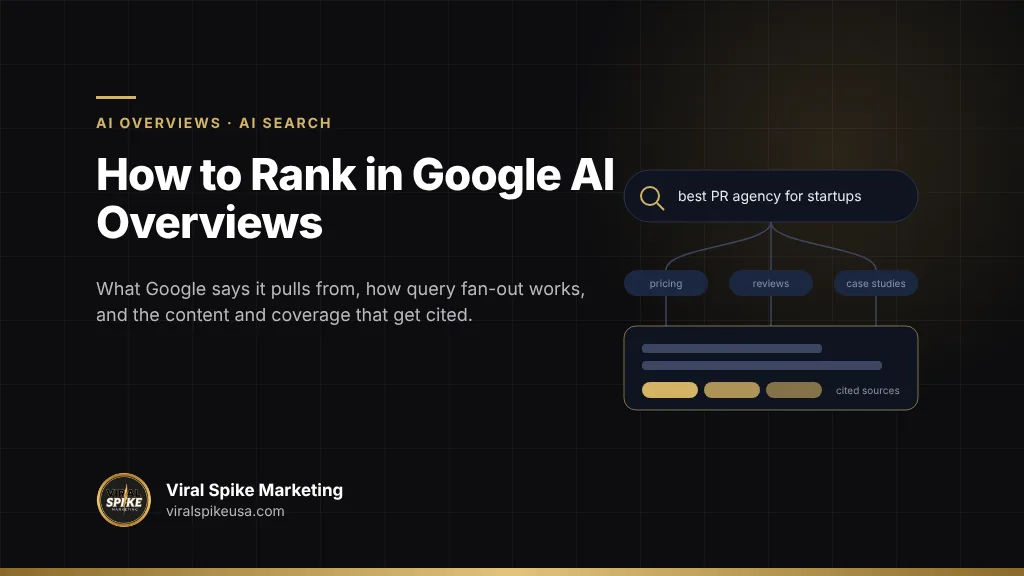
To rank in Google AI Overviews and AI Mode, a page first has to be indexed and eligible to show a snippet in regular Search; Google states there are no additional technical requirements and no special markup or AI-specific file needed. From there, inclusion depends on three things Google’s systems do differently from classic ranking: they break a question into several sub-queries (query fan-out), they pull passages rather than whole pages, and they assemble an answer from a wider and more diverse set of sources than the top ten. The pages that get cited are the ones that answer one of those sub-queries directly and credibly, on a site Google already trusts for the topic. For brand and “best of” questions, the answer also draws on what independent sources say, so coverage in recognized publications and consistent facts about your business across the web decide whether you are recommended at all.
Key takeaways
- Eligibility is the same as for Search: indexed, snippet-eligible, no noindex or nosnippet. Google says no extra optimization is required, which also means there is no shortcut.
- AI Mode and AI Overviews issue multiple related searches behind one question. Pages that would never rank for the head term can be cited for a sub-question they answer well.
- Google reports clicks and impressions from AI features inside the Search Console Performance report under the Web search type; they are not broken out separately.
- Pew Research measured a drop in clicks on traditional results from 15 percent to 8 percent of visits when an AI summary is present, so the cited source captures most of the remaining attention.
- For commercial and “best” queries, independent coverage and consistent entity data matter as much as your own content, because the model is checking its recommendation against other sources.
What are AI Overviews and AI Mode?
AI Overviews are the AI-generated summaries that appear at the top of some Google results pages, with a short synthesized answer and a set of linked sources. Google shows one only when its systems decide the summary adds value beyond the classic results, so many queries, especially navigational and simple ones, never trigger one. AI Mode is a separate tab and experience in which the whole results page is a conversational answer with follow-up questions, built on the same retrieval but with heavier use of reasoning and multiple searches per question.
Both are now mainstream surfaces. Alphabet reported in its second-quarter 2025 results that AI Overviews had reached about 2 billion monthly users and that AI Mode had passed 100 million monthly users in the US and India, per Semrush’s compilation. Semrush’s own analysis of queries that trigger AI Overviews found more than 88 percent were informational, which is why the feature matters most for the educational content that sits above a purchase decision.
If you are new to the broader topic, our pillar on what generative engine optimization is explains how Google’s AI features relate to ChatGPT, Perplexity and the other answer engines, and how ChatGPT and Perplexity choose their sources covers the two assistants most often compared with it.
What does Google say about ranking in AI features?
Google’s guidance is short and worth reading directly, because most of the advice online overstates what is known. In its documentation on AI features and your website, Google says there are no additional requirements to appear in AI Overviews or AI Mode and no special optimizations necessary; standard SEO best practices apply. A page must be indexed and eligible to appear in Search with a snippet, and meeting every requirement still does not guarantee being crawled, indexed or shown.
Four specifics from that page shape everything else in this guide.
- Query fan-out. Both features may issue several related searches across subtopics and data sources to build a response, and while the response is generated Google identifies additional supporting pages. The stated effect is that AI features show a wider and more diverse set of links than classic Search.
- Preview controls apply. The nosnippet, data-nosnippet, max-snippet and noindex directives limit what Google can show from your pages, in AI features as elsewhere. If you have an aggressive max-snippet value from an old content-protection decision, you are limiting your own citations.
- No special schema or files. Google says no particular schema.org markup is required and no new machine-readable or AI text file is needed. Structured data should match visible text.
- Reporting is folded into Search Console. Traffic from AI features is counted in the Performance report under the Web search type, not separated out.
Google-Extended, the control for AI training and grounding in Google’s other products, is separate from Googlebot; blocking it does not affect AI Overviews or AI Mode, which use Search’s own crawl.
How AI Overviews choose which pages to cite
Google does not publish a citation algorithm, but combining its own statements with what large-scale tracking studies observe gives a workable model.
The sub-query is the unit of competition
Ask “how much does a PR agency cost” and the system may run searches for retainer ranges, hourly rates, pay-per-placement pricing and what affects cost, then stitch the findings together. A page that ranks 14th for the head term but is the clearest source on pay-per-placement pricing can be cited for that part of the answer. The practical consequence is that comprehensive pages covering every sub-question of a topic, with each answered plainly under its own heading, give Google more candidate passages to pull.
Passages, not pages
The model lifts a sentence or paragraph, attributes it, and moves on. The passage has to stand on its own: the claim, the number, the qualification, all in one place. Content that says “as discussed above” or that spreads one answer across three sections is hard to cite accurately, so it tends not to be cited.
Trust at the site level
Google’s AI features draw on the same quality signals as Search, which means a site with a demonstrated track record on a topic is favored over a new domain with one good page. Topic clusters, consistent authorship, dated updates and real expertise shown on the page all contribute, as they do in classic ranking.
Corroboration for recommendations
Informational answers cite the clearest explanation. Recommendation answers (“best,” “top,” “should I use”) cite sources that make the recommendation, which are rarely the brand’s own site. Review platforms, industry publications, news features and comparison articles supply the evidence. This is where visibility work extends off your domain; the data on which off-site signals correlate with AI mentions is in brand mentions vs backlinks.
Why being cited matters more than ranking fourth
When an AI Overview appears, it absorbs most of the attention the results page used to distribute. Pew Research Center analyzed the March 2025 browsing of 900 US adults and found that users clicked a traditional result in 8 percent of visits with an AI summary present, compared with 15 percent without one; clicks on the summary’s own source links ran at about 1 percent, and sessions ended on the results page 26 percent of the time with a summary versus 16 percent without. Google called the methodology flawed, but no competing study has shown clicks rising.
Read together with Google’s own statement that AI features link to a wider set of pages, the picture is this: fewer clicks overall, spread across more sources, with the brands named in the answer getting the credibility whether or not they get the click. A page that ranks fourth below an AI Overview that cites three other sites is effectively invisible. A page cited in the Overview is the answer.
A checklist for content that gets cited
These are the practices that consistently correlate with citations in AI Overviews and AI Mode. None is exotic; the discipline is in doing all of them on every important page.
| Practice | Why it matters for AI features | How to apply it |
|---|---|---|
| Answer first | The citable passage is the first complete answer the model finds | Open each section with a one- to three-sentence direct answer, then expand |
| Question-form H2s that match sub-queries | Fan-out searches are phrased as questions and subtopics | List the sub-questions a buyer asks, make each a heading, answer each independently |
| Specific numbers with dates and sources | Dated, sourced figures are preferred over vague claims and are safer for the model to repeat | Cite the primary source inline; state the year |
| Self-contained paragraphs | Passages are lifted out of context | No “as noted above”; restate the subject in each paragraph |
| Tables for comparisons, numbered lists for processes | Structured content is extracted accurately | One comparison table per decision, one ordered list per process |
| Visible author, organization and update date | Trust and freshness are weighed; both need to be visible | Byline, organization schema, dateModified kept current when content changes |
| Snippet controls not over-restricted | max-snippet and nosnippet limit what can be shown | Audit robots meta tags; remove restrictive values unless deliberately protecting content |
| Topic coverage across the site | Site-level trust on the topic favors citation | Build clusters: a pillar plus supporting articles that link to each other |
| FAQ section with matching schema | Catches long-tail sub-queries the body does not address | Four to six questions, each with a complete answer, FAQPage markup matching the text |
| Independent corroboration | Recommendation answers cite third parties | Earn or place coverage in outlets Google already trusts; keep entity facts consistent everywhere |
What does not help: stuffing the head term into every heading, adding an llms.txt file in the belief it influences Google (Google says it does not use any AI-specific file; see llms.txt explained), or publishing many thin pages for every keyword variation. The original generative engine optimization research found keyword stuffing reduced visibility below the unoptimized baseline.
How to measure whether you appear in AI Overviews
Search Console reports the traffic but not the appearance, so measurement needs a manual or tooled prompt program alongside it.
- Build a query set. Thirty to fifty queries across informational (“how does X work”), comparison (“X vs Y”) and commercial (“best X for Y,” “X cost”) intents in your category, plus five to ten about your brand by name.
- Record the AI surface monthly. For each query, in a logged-out browser and from at least two locations, note whether an AI Overview appeared, which domains were cited, and whether your brand was mentioned. Repeat in AI Mode.
- Watch Search Console for the signature. Rising impressions with falling clicks on a query often means an AI Overview arrived above you. Rising impressions with stable or rising clicks on a page that was not on page one often means you are being cited.
- Track share, not single results. Individual answers vary. Measure the share of queries where you are cited or mentioned, and compare it with the two or three competitors that matter. Tools that automate this are compared in AI visibility tools and metrics.
The same program, extended to ChatGPT, Gemini, Perplexity and Claude, is described in how to audit what ChatGPT says about your company.
What to do if AI Overviews cite competitors and not you
Diagnose which of three problems you have before changing anything.
Not retrieved. Your page does not rank for the head term or any of the likely sub-queries. This is an SEO problem: index coverage, internal links, topical depth and competition. Fix retrieval first; nothing downstream matters until the page is a candidate.
Retrieved but not cited. You rank, but the Overview quotes someone else. Usually the competitor’s passage is more direct, more specific or more current. Rewrite the relevant section to lead with a sourced, dated, complete answer, and check your snippet controls.
Cited for information, absent from recommendations. Google quotes your explanation but names other brands when asked who to use. This is a corroboration gap. The fix is off your site: coverage in recognized outlets, accurate review profiles, consistent entity data and third-party comparisons that include you. How coverage converts into recommendations across AI systems is set out in how press coverage gets your brand recommended by ChatGPT, and the reason strong rankings alone no longer close this gap is in why strong SEO no longer guarantees AI answer visibility.
Where Viral Spike fits
Viral Spike Marketing’s AI search visibility service runs this program end to end: a query-set audit of AI Overviews, AI Mode and the major assistants to establish where you are cited, restructuring of the pages that are retrieved but not quoted, and the corroboration layer that decides recommendations. That layer is built on guaranteed editorial placements in outlets Google’s systems already trust, where you approve the draft, the article is published and indexed, and the engagement is refunded in full if it never runs. If you want a baseline before deciding anything, contact us and we will show you which Overviews in your category cite you and which cite competitors.
Fix retrieval, then extractability, then corroboration
Work the three layers in order. Make sure your important pages are indexed, snippet-eligible and ranking for the sub-questions in your topic. Then rewrite each section so the first paragraph is the answer, with a number, a date and a source. Then look at the recommendation queries you are missing and build the independent coverage that makes Google comfortable naming you. Measure monthly with a fixed query set, and judge progress on share of citations over a quarter rather than any single answer on any single day.
Frequently asked questions
Do you need special optimization to appear in Google AI Overviews?
No. Google’s documentation states there are no additional requirements to appear in AI Overviews or AI Mode and no special optimizations necessary. A page must be indexed and eligible to show a snippet in Search. Standard SEO best practices apply, including structured data that matches the visible text, and Google says no AI-specific file or markup is required.
How does query fan-out affect AI Overviews?
Query fan-out means Google may run several related searches across subtopics and data sources to build one AI response, and identifies additional supporting pages while generating it. The result is that AI features link to a wider and more diverse set of pages than classic Search, so a page that answers one sub-question clearly can be cited even if it does not rank for the main query.
Can I see AI Overview traffic in Google Search Console?
Partly. Google includes clicks and impressions from AI Overviews and AI Mode in the Performance report under the Web search type, but does not break them out as a separate filter. To know whether you are being cited, run a fixed set of queries manually or with a tracking tool and record which domains the Overviews link to.
Does llms.txt help you rank in AI Overviews?
Not according to Google. Its AI features documentation says no new machine-readable or AI text file is required. An llms.txt file may help other AI crawlers navigate a site, but there is no evidence it influences which pages Google cites. Time is better spent on indexing, answer-first content and independent coverage.
How do I stop my content appearing in AI Overviews?
Use the same controls that govern Search snippets: noindex removes the page entirely, nosnippet and data-nosnippet prevent text from being shown, and max-snippet limits its length. Google notes these apply to AI features too, and that changes take effect after recrawling, which can take days to months. Note that blocking Google-Extended does not affect AI Overviews or AI Mode.
Why do AI Overviews cite sites that rank below me?
Because AI features select passages for sub-queries, not pages for the head term. A lower-ranking page with a more direct, specific or current answer to one part of the question can be cited over a higher-ranking page that answers it indirectly. Rewriting your section to lead with a sourced, dated, complete answer is the usual fix.
Sources
Primary sources referenced in this article, in order of first use.
- Semrush's compilation (semrush.com)
- AI features and your website (developers.google.com)
- Pew Research Center (pewresearch.org)

More in AI Search



Related services