Brand Mentions vs Backlinks: What Matters for AI Answers?
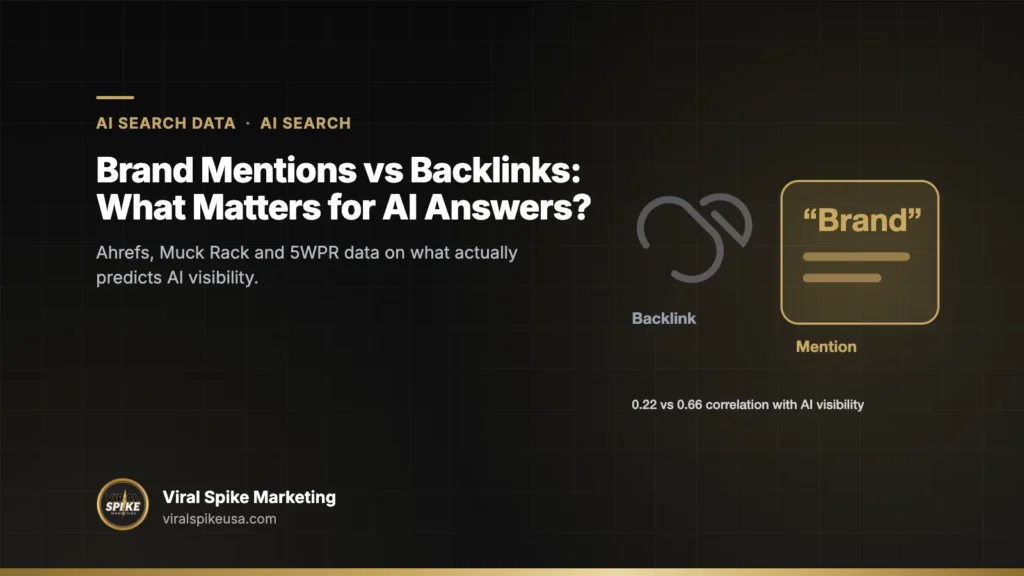
For AI answers, brand mentions matter more than backlinks; for Google rankings, backlinks still matter more than mentions. Ahrefs’ study of 75,000 brands found branded web mentions correlate with AI Overview visibility at 0.664, roughly three times the 0.218 correlation for backlinks, and Muck Rack’s analysis of 25 million AI citations found 84% go to earned media. Backlinks are not dead: they still drive the Google rankings that feed AI Overviews, AI Mode and Gemini grounding. The practical answer is to earn coverage in trusted outlets that names your brand next to the topics you want to be recommended for, and to treat the link as a bonus rather than the goal.
Key takeaways
- Across ChatGPT, AI Mode and AI Overviews, branded web mentions correlate with AI visibility far more strongly than backlinks or domain rating.
- AI assistants overwhelmingly cite earned media (84% per Muck Rack), and paid advertorial content accounts for 0.3% of citations.
- Only 12% of URLs cited by AI tools overlap with Google’s top 10, per 5WPR, and Ahrefs found 37% of AI Overview citations rank in the top 10, so rankings help but do not decide.
- Unlinked mentions work because language models learn associations between your brand and a topic from co-occurrence in trusted text.
- Links still matter for classic rankings, for Google-grounded systems, and for getting your own pages retrieved and cited.
Do backlinks matter for AI search?
Backlinks matter for AI search indirectly, and much less than they matter for traditional rankings. The most direct evidence is Ahrefs’ May 2025 analysis of 75,000 brands, which measured how brand-level signals relate to how often a brand appears in Google AI Overviews. Branded web mentions correlated at 0.664, branded search volume at 0.392, referring domains at 0.295 and backlinks at 0.218. The study’s own summary: “Web mentions (0.664) correlate much more strongly than backlinks (0.218).”
Ahrefs extended the work in a December 2025 study across ChatGPT, AI Mode and AI Overviews, again on 75,000 brands. Branded web mentions correlated with visibility at 0.66 to 0.71 across the three systems. Branded anchor text, a hybrid signal that requires both a link and a brand name, came in at 0.511 for ChatGPT, 0.628 for AI Mode and 0.527 for AI Overviews. Domain rating correlated with ChatGPT visibility at only 0.266, and total site pages at roughly 0.194, which Ahrefs described as almost no relationship between content volume and AI visibility.
One caution: correlation is not causation, and big brands accumulate mentions, links and search volume together. But the direction is consistent across studies and platforms: how often trusted text talks about you outperforms how many pages link to you.
Are unlinked brand mentions valuable?
Yes. An unlinked mention in a credible outlet does two things a backlink alone does not. It teaches models what your brand is associated with, and it puts your name inside pages that retrieval systems pull when someone asks a related question.
The 5WPR State of AI Citations 2026 report makes the first point directly: 5WPR reports that “ChatGPT mentions brands roughly 3.2 times more often than it cites them with links,” and that brand search volume is “the strongest known predictor of AI citation likelihood,” with a 0.334 correlation it describes as materially stronger than backlinks. In other words, AI answers name brands far more often than they link to them, and the brands they name are the ones that already have a presence in the wider web and in people’s search behavior.
Mentions also travel where links cannot. A journalist quoting your CEO in a trend piece, a trade publication listing you among vendors, a podcast transcript, a Reddit thread that names you: none of these needs a hyperlink to be read by a crawler, embedded into a model or retrieved at answer time.
How do retrieval-augmented answers select sources?
Most AI answers you see today are retrieval-augmented: the assistant runs one or more searches, pulls a set of pages, and writes an answer grounded in what those pages say, often with citations. Which pages get pulled depends on the search layer underneath, and which brands get named depends on both the retrieved pages and what the model already knows.
Google is explicit about its own layer. Its documentation on AI features and your website says AI Overviews and AI Mode may use “query fan-out” across subtopics to identify supporting pages, that “there are no additional requirements to appear in AI Overviews or AI Mode, nor other special optimizations necessary,” and that “you don’t need to create new machine readable files, AI text files, or markup to appear in these features.”
The retrieved set is broader than page one, though. Ahrefs’ March 2026 update, based on 863,000 keyword SERPs and 4 million AI Overview URLs, found that 37.10% of cited URLs ranked in the top 10 for the query, down from roughly 76% the year before. 5WPR reports a related figure across AI tools: “only 12% of URLs cited by AI tools overlap with Google’s top-10 organic results.” Ranking well still helps; it is simply no longer sufficient or necessary.
What the different assistants read also diverges. 5WPR reports Wikipedia accounts for approximately 47.9% of ChatGPT’s top-10 source share, Reddit for approximately 46.7% of Perplexity’s, and approximately 43% of AI Overview citations link back to Google-owned properties, with “only an estimated 11% of domains” cited by both ChatGPT and Perplexity. No single tactic covers all of them.
And what they cite is dominated by journalism and independent commentary. Muck Rack’s May 2026 study of more than 25 million links from ChatGPT, Claude and Gemini found earned media accounts for 84% of citations, journalism alone for 27%, and paid or advertorial content for 0.3%. ChatGPT included citations in 96% of responses, Gemini in 82% and Claude in 55%. Across three editions of the study, earned media never dropped below 82%.
Why does co-occurrence of brand and topic in trusted outlets matter?
Because language models represent meaning through association. When your brand appears repeatedly near a topic (“payroll software for restaurants,” “reputation management for surgeons”) in text the model was trained on or retrieves at answer time, the model learns that the two belong together. A single link from a high-authority page does not build that association; a hundred mentions across relevant, credible pages do.
Three properties make a mention count more:
- Source trust. Mentions in outlets that already appear frequently in AI citations, such as national business press, trade publications and widely referenced reference sites, carry more weight than mentions on low-quality directories.
- Topical proximity. The mention should sit inside a discussion of the problem you solve, not in a generic company listing.
- Consistency. The same brand name, the same description and the same category across sources, so the model does not split you into several weak entities.
This is also why sponsored features, which are rarely cited, can still be useful: a labeled feature that correctly states who you are and what you do adds one more consistent, crawlable instance of your entity facts next to your topic. It supports the association; it does not substitute for earned coverage.
Where do links still matter?
Links still matter in four places, and ignoring them would be a mistake.
Google rankings. Google’s core ranking systems still weigh links, and rankings feed AI Overviews, AI Mode and Gemini’s grounding. Ahrefs’ December 2025 data showed AI Mode correlating more strongly with traditional authority signals than ChatGPT did, which fits a system that sits on top of Google Search.
Retrieval of your own pages. If you want the assistant to cite your site rather than only name your brand, your page has to be indexed, retrievable and considered credible. Links help with all three.
Branded anchors. The 0.51 to 0.63 correlations Ahrefs found for branded anchor text suggest links that carry your brand name are worth more than links that do not, because they are a mention and a link at once.
Verification of entity facts. Links between your website, your profiles and coverage about you help Google and other systems confirm that the company in the article is the same one on your site.
The piece on why strong SEO no longer guarantees AI answer visibility goes deeper on how rankings and AI answers have decoupled.
Signal by signal: rankings versus AI answers
| Signal | Effect on Google rankings | Effect on AI answers | How to earn it |
|---|---|---|---|
| Editorial backlink from a trusted site | Strong; core ranking input | Indirect via rankings and grounding; weak direct correlation (0.218 per Ahrefs) | Original data, expert commentary, newsworthy announcements |
| Unlinked brand mention in earned media | Minor; may be treated as an implied signal | Strong; 0.66 to 0.71 correlation across ChatGPT, AI Mode and AI Overviews | Expert-source pitching, founder commentary, contributed insight to journalists |
| Branded anchor text link | Strong, with over-optimization risk if forced | Strong; 0.51 to 0.63 correlation | Natural citations of your brand in coverage and partner pages |
| Brand and topic co-occurrence in trade and business press | Indirect | Strong; teaches association and appears in retrieved pages | Consistent messaging in every interview, quote and feature |
| Branded search volume | Indirect (navigational demand) | Moderate; 0.35 to 0.47 per Ahrefs, strongest predictor per 5WPR | Advertising, PR, events, product experience |
| Wikipedia and reference-site presence | Indirect | Strong for ChatGPT specifically (about 47.9% of top-10 source share per 5WPR) | Genuine notability built on independent coverage; never paid editing |
| Reddit and community discussion | Minor | Strong for Perplexity (about 46.7% of top-10 source share per 5WPR) | Real participation, customer advocacy, transparent founder answers |
| Sponsored or advertorial feature | Minor, and paid links should be nofollow or sponsored | Rarely cited directly (0.3% per Muck Rack); supports consistent entity facts | Guaranteed placements; confirm in writing how the article will be presented and whether it is indexed |
| Press release on a wire | Minor | Small; Muck Rack found releases 3.5 times more likely to be cited for industry-trend queries than best-of queries | Reserve for genuine news, write it as a source document |
How do you earn brand mentions through press?
Earning mentions looks more like a PR program than a link-building campaign.
- Define the topics you want to be recommended for. Write down the five to ten questions a buyer would ask an assistant. Those phrases are your co-occurrence targets.
- Audit what assistants currently say. Ask ChatGPT, Gemini, Perplexity and Google AI Mode those questions, note which brands and sources appear, and record what they say about you. The guide to auditing and fixing what ChatGPT says about your company walks through this.
- Fix your entity facts first. Website, LinkedIn, Google Business Profile, Crunchbase and any existing coverage should agree on your name, category and description.
- Build a point of view and some data. Journalists mention brands that give them something quotable: a proprietary statistic, a contrarian take, a first-hand example.
- Pitch expert quotes on your target topics. Source platforms, direct pitches to trade reporters, and founder commentary on X and LinkedIn all produce mentions, most of them unlinked and all of them useful.
- Anchor with a few substantial features. A full article in a recognized outlet gives journalists and models a complete reference. If the feature is sponsored, label it and treat it as entity reinforcement rather than as a citation play.
- Amplify into communities and video. Ahrefs’ December 2025 study found YouTube mentions correlating with AI visibility at roughly 0.737, the highest of any factor tested, and 5WPR shows Reddit dominating Perplexity’s sources.
- Re-audit quarterly. Track which brands appear for your target questions and which sources are cited, then direct the next quarter’s pitching at the gaps.
For how coverage flows from publication into an assistant’s recommendation, see how press coverage gets your brand recommended by ChatGPT. For the service-level view of combining links, coverage and citations, read digital PR services that earn links, coverage and AI citations.
Where a digital PR agency fits
Viral Spike Marketing works as a public relations agency for brands, founders and creators, combining AI search visibility work with guaranteed editorial placements in outlets such as Forbes, Entrepreneur, Business Insider, USA Today, Newsweek and Yahoo Finance on a pay-per-placement basis with a publish-or-refund guarantee. The agency is direct about the evidence: guaranteed placements are published and indexed on Google, they are rarely cited by AI assistants, and their job is to establish consistent entity facts, credibility and search presence while earned mentions do the associative work. Clients approve every article draft before placement, which is where the entity facts get locked in, and the publication, format, timeline and refund terms are named in writing before payment. To map which topics you should own and how mentions and placements fit together, contact the team. An overview of the approach is in the guide to AI search visibility services.
Decide what you are optimizing for
If your goal is classic rankings, keep earning editorial links; they still work. If your goal is to be the brand an assistant names when a buyer asks a question, shift the emphasis to mentions in trusted outlets that put your name next to your topic, keep your entity facts consistent, and measure the assistants’ answers directly rather than only your link count. If you want a plan that maps your target questions to the coverage that would earn them, contact Viral Spike Marketing and start with an audit of what the assistants already say.
Frequently asked questions
Do backlinks matter for AI search?
Indirectly, yes. Backlinks still influence Google rankings, and rankings feed AI Overviews, AI Mode and Gemini grounding. But Ahrefs’ 75,000-brand studies found backlinks correlate with AI visibility at about 0.22 versus 0.66 to 0.71 for branded web mentions, so links are a supporting signal rather than the primary driver of whether an assistant names your brand.
Are unlinked brand mentions valuable for AI visibility?
Yes. Unlinked mentions in credible outlets teach models to associate your brand with a topic and place your name inside pages that get retrieved at answer time. 5WPR reports ChatGPT mentions brands about 3.2 times more often than it links to them, which shows how much of AI visibility happens without any hyperlink at all.
How do ChatGPT and Google AI Overviews choose sources?
They retrieve pages through a search layer, then write answers grounded in those pages. Google says no special files or markup are needed and that standard SEO fundamentals apply. Cited pages skew heavily toward earned media (84% per Muck Rack), and only a minority overlap with Google’s top 10 (37% of AI Overview citations per Ahrefs; 12% across AI tools per 5WPR).
Does a sponsored article help with AI answers?
Rarely as a citation: Muck Rack found paid or advertorial content makes up 0.3% of AI citations. A labeled sponsored feature can still help by publishing your entity facts consistently in a crawlable, credible place, which supports the brand-and-topic association. Treat it as reinforcement for credibility and search presence, not as a replacement for earned mentions.
What is the fastest way to earn brand mentions?
Pitch expert quotes on the specific topics you want to be recommended for, using source platforms and direct outreach to trade reporters, while keeping your brand name and description identical everywhere. Mentions accumulate over months, not days. Anchor the program with a few substantial features and re-audit assistant answers each quarter to see which gaps remain.

More in AI Search

Related services