
Reputation Management for Hotels and Restaurants: Reviews at Scale, Response SLAs, Staff Playbooks and Removal Routes by Platform
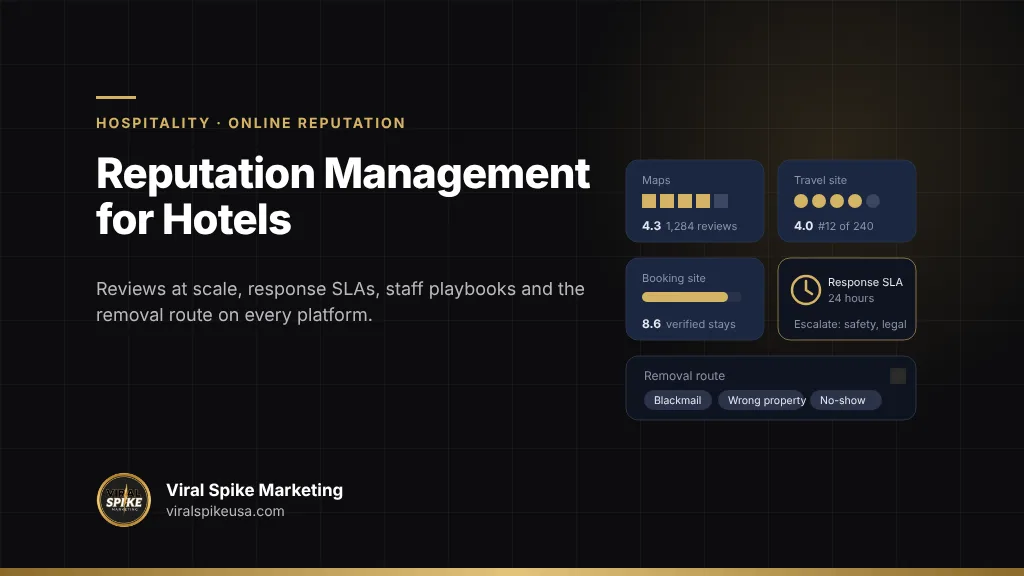
Reputation management for hotels and restaurants is the operating system for reviews at scale: a property or restaurant group collects hundreds or thousands of reviews a year across Google, Tripadvisor, Yelp and the booking platforms it sells through, and the work is to respond to every one within a set time, route the serious ones to the right person, remove the ones that break a platform rule, and build enough independent coverage that a prospect’s first impression is not a single rating. The removal part is smaller than most operators hope and more structured than they expect: each platform publishes the grounds on which it deletes a review, and in hospitality those grounds include two that are rare elsewhere, blackmail (a prohibited practice on Tripadvisor, a removal ground with written evidence on Booking.com) and stays that never happened (Booking.com removes reviews tied to cancellations and no-shows; Expedia accepts reviews only from bookers). Everything else is a response, a service fix, a steady flow of real reviews, and press that outranks the review pages for your name.
Key takeaways
- Five surfaces decide a hospitality reputation: Google, Tripadvisor, Yelp, the OTAs (Booking.com, Expedia) and the local and travel press. Each has its own removal rules and its own response etiquette.
- Tripadvisor moderated 4.2 million reviews in 2024 and caught 2.7 million fraudulent ones; 54 percent of fraud was “review boosting” by owners, staff or affiliates, and about 9,000 businesses were warned for incentivized reviews. Platforms police operators as hard as they police reviewers.
- Booking.com reviews come only from guests with a reservation, stay live for 36 months, and can be removed for no-shows, cancellations, wrong-property reviews and blackmail with evidence. Expedia accepts reviews only from bookers and removes them after three years.
- A response SLA of 24 hours for one- and two-star reviews, with a named owner per shift, is the single control that most improves what prospects see, because the reply is the only text on the page you write.
- Incentivizing reviews, gating who is asked, or threatening reviewers breaks every platform’s rules and the FTC’s 2024 fake-reviews rule; the compliant lever is asking every guest, every time.
What makes hospitality reputation management different?
Three things. Volume: a 150-room hotel or a busy restaurant collects more reviews in a month than a law firm does in a decade, so a process that depends on the owner reading each one fails. Platform count: a hotel is reviewed on Google, Tripadvisor and Yelp like any local business, and on every OTA it sells through, where reviews are tied to bookings and sit beside the price. Stakes: Tripadvisor ranks properties within a destination and Booking.com shows a score next to the rate, read by travelers who have never seen the building. Tripadvisor’s 2025 Transparency Report (March 18, 2025) gives the scale: 31.1 million reviews submitted in 2024, business owners responding to more than 11 million of them, and 87.8 percent of reviews passing automated checks while 13.5 percent were moderated by its Trust and Safety team before or after posting.
The system has four parts, taken in order below: a platform map, a response SLA, a staff playbook, and a removal route per platform, with press as the layer above all of it.
Which review platforms matter, and how does each one work?
The same review gets a different answer on each surface.
| Platform | Who can review | How long it counts | Owner response | Removal basis |
|---|---|---|---|---|
| Google Business Profile | Anyone with a Google account; no purchase check | Indefinitely | Public reply | Maps content policy: fake engagement, conflicts of interest, off-topic, harassment, personal information |
| Tripadvisor | Anyone, first-hand experience, within one year of the visit, one review per stay or meal | Indefinitely; ranking weights recency | Management Response | Review guidelines: blackmail, conflicts of interest, incentivized, hearsay, irrelevant, promotional |
| Yelp | Anyone; recommendation software filters reviews it does not trust | Indefinitely; filtered reviews do not count | Public comment or direct message | Content Guidelines: conflicts of interest, relevance, privacy, threats, promotional content |
| Booking.com | Guests with a reservation, invited by email after checkout, 90 days to respond | 36 months, then archived and the score recalculated | Reply to reviews with text | Removal grounds: no-shows, qualifying cancellations, wrong property, blackmail with written evidence |
| Expedia Group (Expedia, Hotels.com, Vrbo) | Only people who booked, invited after the stay, within six months | Three years for accommodation (12 months for car hire) | Partner response, not edited by Expedia | Content guidelines: fake or fraudulent, personal data, offensive, duplicate, wrong property, booking not fulfilled |
The OTA rows change the math. On Booking.com the score is the plain average of guests’ 1-to-10 overall ratings and reviews expire after 36 months, so a bad quarter two years ago is about to drop out. None of this exists on Google, where a review from 2017 by someone who never stayed counts the same as last week’s.
What response SLA should a hotel or restaurant run?
A response SLA sets how fast each kind of review gets a reply and who writes it. The reply is the only text on a review page that you author, and Tripadvisor’s figure of owners answering 11 million reviews in a year shows how normal travelers find one. Google’s guidance on reviews and replies asks for “timely” replies that are short, professional and specific, with complex issues moved to phone or email. The SLA below is what we set up for multi-property operators; adjust the clock to your volume, not the other way round. Whether a dashboard or a managed team should own that SLA depends on property count and staff time, a decision we break down in software or agency for reputation management.
| Review type | Respond within | Who responds | What the reply must contain |
|---|---|---|---|
| Safety, discrimination, illness or injury claim | 4 hours (acknowledge), 24 hours (substantive) | General manager; owner informed; legal if an injury or a protected-class claim | Acknowledgment, direct contact, no admission or denial of facts |
| One or two stars, service or cleanliness | 24 hours | Department head (front office, F&B, housekeeping) | The specific issue named, what was checked or changed, an invitation to contact |
| Three stars, mixed | 48 hours | Shift manager from an approved template | Thanks, one specific thing fixed, invitation back |
| Four or five stars | 72 hours, or batch twice a week | Any trained staff member | Two sentences, specific to the review; no promotional copy |
| Suspected fake, blackmail or competitor | No public reply until assessed; report within 48 hours | Reputation lead | Nothing accusatory in public; Tripadvisor prohibits accusing a reviewer of fraud in a response |
Tripadvisor’s Management Response guidelines prohibit “accusing a reviewer of review fraud,” threatening or coercing reviewers, speculating about a reviewer’s identity, including guest correspondence, and promotional content; a response that breaks them is removed, and a pattern can draw penalties on the listing. Suspicion goes into the report form, never into the reply. Wording for each row is in our negative review response templates.
How do you build a staff playbook that holds up across shifts?
A playbook lets a night auditor and a weekend manager answer as well as the general manager would. Five parts.
- Ownership by platform and shift. One named person owns each platform’s inbox each day, and alerts go to a shared address checked at shift change, not the owner’s phone.
- Approved and forbidden language. Approved: “I am sorry the room was not ready at check-in; I have reviewed the arrivals log for that day with our front office manager.” Forbidden: guest names, booking details, health information, counter-accusations, anything offered in exchange for editing the review, and anything that confirms or denies a factual claim that could become a legal matter. Expedia and Tripadvisor ban offering compensation for positive reviews or revisions; Google calls incentives for review changes “strictly prohibited.”
- Escalation triggers. Injury, illness, theft, discrimination, a named employee, a threat, a demand for money, or a mention of a lawyer or regulator. These go to the GM the same hour.
- The ask. Every guest, at checkout or with the bill, gets the same request for a review on the platform you are building that quarter, nothing offered in return. On Yelp, do not ask: its guidelines say “businesses should never ask customers to write reviews,” and its recommendation software treats solicited reviews as a signal to filter.
- The weekly review meeting. Twenty minutes, department heads, the week’s one- and two-star reviews read aloud, one operational fix agreed per recurring theme. The fix is what stops the next review.
Put the playbook in writing and train on it twice a year. Tripadvisor’s transparency report says it warned about 9,000 businesses for incentivized reviews and removed 360,000 reviews tied to employee reward programs in 2024: that is what happens when staff improvise. If a review incident grows into a public story, the crisis steps are in our crisis communications plan for small businesses.
Which reviews can you get removed, platform by platform?
Removal is a policy exercise: the reputation lead reads each flagged review against the platform’s published grounds and either files with evidence or marks it “respond only.”
| Situation | Tripadvisor | Yelp | Booking.com | Expedia | |
|---|---|---|---|---|---|
| Guest never stayed or dined | Report as fake engagement with record search | Report as not first-hand | Report under relevance | Not applicable; a reservation is required | Not applicable; bookers only |
| No-show or cancellation, then a review | Report as fake engagement | Report as not first-hand | Report under relevance | Removable: no-show, guest cancellation, or your cancellation at least 24 hours before check-in | May be removed with evidence the booking was not fulfilled |
| Wrong property or location | Report as off-topic | Report as irrelevant | Report under relevance | Removable | Removable |
| Blackmail or demand for money | Merchant extortion form; Google pauses reviews on spam spikes | Report fraud, blackmail threat; prohibited practice under its guidelines | Report with screenshots | Removable with written evidence | Prohibited as review manipulation; dispute form with evidence |
| Competitor, ex-employee, friend of staff | Report as conflict of interest | Prohibited: affiliated people and owners of similar businesses within 10 miles may not review | Report as conflict of interest | Rare; reviews require a stay | Prohibited; report as fake |
| Honest bad stay | Stays | Stays | Stays | Stays, even if the guest left early | Stays; Expedia does not remove reviews for being negative |
The filing mechanics differ. On Booking.com, open the Extranet Inbox, then Messages, select See contact options, choose Guest Reviews and send the booking number with the explanation; if only the text is removed, the score can stand. On Expedia, partners use the review dispute form or customer service. On Tripadvisor, reviews are reported through the site’s reporting function, and suspected fraud can also go to contentintegrity@tripadvisor.com. On Google, the Reviews Management Tool gives a status per report and one appeal; the walk-through is in how to remove Google reviews. Yelp’s human moderators evaluate reports from the business account and, per its moderation page, do not “take sides in factual disputes”; the details are in how to remove Yelp reviews. Vacation rental operators have a different two-sided system; see how to remove an Airbnb review.
How do you handle blackmail, review bombing and OTA disputes?
These are the three situations where a hospitality operator has more leverage than most businesses, if the evidence is kept.
Blackmail
Tripadvisor defines it as “bad-faith demands made by threatening a negative review or offering removal of one,” and notes that a guest mentioning they plan to write a review after a bad experience does not count. The playbook: the staff member who receives the threat records the time, the words used and any witnesses, keeps every message, and tells the GM. Nobody pays or offers anything, and the review is reported with the evidence the moment it appears: on Tripadvisor as a blackmail threat, on Booking.com through the Extranet with the written evidence it requires, on Google through the merchant extortion form. Report the attempt to the FTC as well; its 2024 final rule on fake reviews treats buying, selling and suppressing reviews as violations with civil penalties, so your own response cannot be a threat either.
Review bombing
A viral post or a news story can bring dozens of one-stars from people who were never guests. Tripadvisor says that when a listing receives “a significant volume” of non-first-hand content it “may temporarily suspend publishing for that listing,” and Google’s April 2026 update describes pausing new reviews, removing the fake content and alerting the owner when a spam spike hits a profile. Report the cluster as off-topic or not first-hand with dates and account details, keep one calm public statement on channels you control, and do not reply to each post. OTA scores are insulated, because only bookers can review.
OTA disputes
The losing argument on Booking.com is “the guest left early, so the review should go”; its page is explicit that a guest who arrived and left early can still review. The winning arguments are documentary: the no-show record, the cancellation timestamp, the invalid card on the check-in day, the wrong-property mismatch. Keep the property management system records for the 36 months the review will live.
How do local press and travel features change the picture?
A hotel or restaurant’s search results are unusually review-heavy: for the business name, Google shows the Business Profile with its rating, then Tripadvisor, Yelp and the OTAs, each with a score in the snippet. Reviews are the whole first page unless something else earns a place on it. Editorial coverage does. A feature in the local paper, a city magazine’s dining list or a travel site’s weekend guide ranks for the name, carries a trust the review sites do not, and is what AI assistants quote when a traveler asks “is this hotel any good.” For restaurants specifically, the opening, the review cycle and the local feature each need their own approach, which we lay out in PR for restaurants.
For hospitality the hooks are already in the building: a chef’s story, a renovation, a local farm relationship, a seasonal event, an anniversary. How to pitch them is in how to get your story in local news. Travel and lifestyle features are slower to earn and more durable; a profile in a recognized outlet stays on page one for years. The goal is a results page where two or three editorial results sit beside the rating, so a bad quarter on one platform is one data point among several.
How do you measure hospitality reputation work?
Track six numbers monthly, by property and platform, and judge direction over a quarter.
- Rating by platform, with the OTA scores tracked separately because they expire and the Google score does not.
- Review volume and mix: reviews per month and the share at one or two stars. Volume rising while the negative share falls is the signature of a working ask-every-guest program.
- Response rate and median response time against the SLA, by shift; the first number to slip when training lapses.
- Recurring themes: the top three complaint categories and whether each one is shrinking after the operational fix.
- Removals filed and outcomes, by platform.
- Search results for the name: how many of the first ten results are editorial rather than review pages.
Treat each month as a sample, not a verdict; hospitality reviews are seasonal, and a January dip in a beach town is weather, not reputation.
Where Viral Spike fits
Viral Spike’s reputation management service for hotels and restaurants starts with a platform-by-platform review assessment in writing: which reviews on Google, Tripadvisor, Yelp, Booking.com and Expedia match a published removal ground, the evidence for each, and which are honest opinions no report will touch. Removal reports are filed through each platform’s official channels, and the reviews we take on are removed or you receive a full refund: we assess every review against the platform’s policy in writing first, so we only take on reviews with a basis, and the terms are in your agreement before any work starts. That work is scoped and paid upfront. We then install the response SLA and staff playbook, set up the compliant ask-every-guest program, and build the editorial layer: local and travel coverage through our PR service and guaranteed editorial placements in recognized outlets, where you approve the draft, the article is published and indexed on Google, and the engagement is refunded in full if it never runs. To get the assessment for your property, contact us with the property name and the platforms you sell through.
Start with the SLA, then the ask, then the press
This week, name an owner for each platform per shift and set the 24-hour clock on one- and two-star reviews. Next week, add the uniform request for a review to checkout and to the bill, with nothing attached. This month, pull every negative review from the last year into one sheet, mark the ones with a removal ground, and file those with evidence. Then pitch the one story in your building a local editor would run. Reviews will keep coming; the system decides whether they run you or you run them.
Frequently asked questions
What is reputation management for hotels?
It is the system a hotel uses to handle reviews and public perception at scale: monitoring Google, Tripadvisor, Yelp and OTA reviews on Booking.com and Expedia, responding to each within a set time, escalating serious complaints, reporting reviews that break a platform’s published rules, asking every guest for a review in a compliant way, and earning local and travel press that ranks beside the review sites for the hotel’s name, so that no single rating defines the property.
Can a hotel remove a bad review on Booking.com?
Only on the grounds Booking.com publishes: the guest canceled or did not arrive and the review concerns a stay that never happened, the property canceled at least 24 hours before check-in, a no-show, a cancellation for an invalid card on the check-in day, a review of the wrong property, or blackmail with written evidence. Requests go through the Extranet inbox with the booking number. A guest who stayed and was unhappy can review.
How fast should a restaurant respond to a negative review?
Within 24 hours for one- and two-star reviews, with a named manager responsible per shift, and within hours for anything involving illness, injury, discrimination or a threat, where the first reply only acknowledges and offers a direct contact. Three-star reviews can wait 48 hours and positive reviews can be batched. Suspected fake or blackmail reviews get no public reply until they have been assessed and reported, because platforms such as Tripadvisor remove responses that accuse reviewers of fraud.
Does Tripadvisor remove blackmail reviews?
Tripadvisor’s review guidelines list blackmail, meaning bad-faith demands made by threatening a negative review or offering to remove one, as a prohibited practice, and its reporting flow includes a blackmail threat option. Report it with the written threat preserved, including dates and the exact words, and do not pay or offer anything. Tripadvisor notes that a guest saying they intend to write a review after a bad experience is not blackmail, so the demand itself is what you need to document.
Is it against the rules to offer guests a discount for a review?
Yes, on every major platform. Google calls incentives for reviews or review changes strictly prohibited, Tripadvisor bans offering or promising anything in exchange for a review regardless of rating, Expedia bans asking for positive reviews or revisions in exchange for compensation, and Yelp says businesses should not ask for reviews at all. The FTC’s 2024 rule adds civil penalties for paying for reviews by sentiment. Asking every guest, with nothing offered, is the compliant method.
How long do OTA reviews stay on a hotel’s listing?
Booking.com keeps guest reviews on a property page for 36 months, then archives them and recalculates the score from the reviews still online. Expedia Group removes accommodation reviews after three years, except for properties with few reviews, and car hire reviews after 12 months. Google, Tripadvisor and Yelp reviews do not expire, which is why an older bad stretch on those platforms needs a response and new reviews rather than time.
Sources
Primary sources referenced in this article, in order of first use.
- 2025 Transparency Report (tripadvisor.mediaroom.com)
- Maps content policy (support.google.com)
- Review guidelines (tripadvisor.com)
- Content Guidelines (yelp.com)
- Removal grounds (partner.booking.com)
- Content guidelines (expedia.com)
- reviews and replies (support.google.com)
- Management Response guidelines (tripadvisor.com)
- recommendation software (trust.yelp.com)
- moderation page (trust.yelp.com)
- 2024 final rule on fake reviews (ftc.gov)
- April 2026 update (blog.google)

More in Online Reputation
Related services