
How to Remove an Airbnb Review: Host and Guest Options, Airbnb’s Policy, and What It Won’t Remove
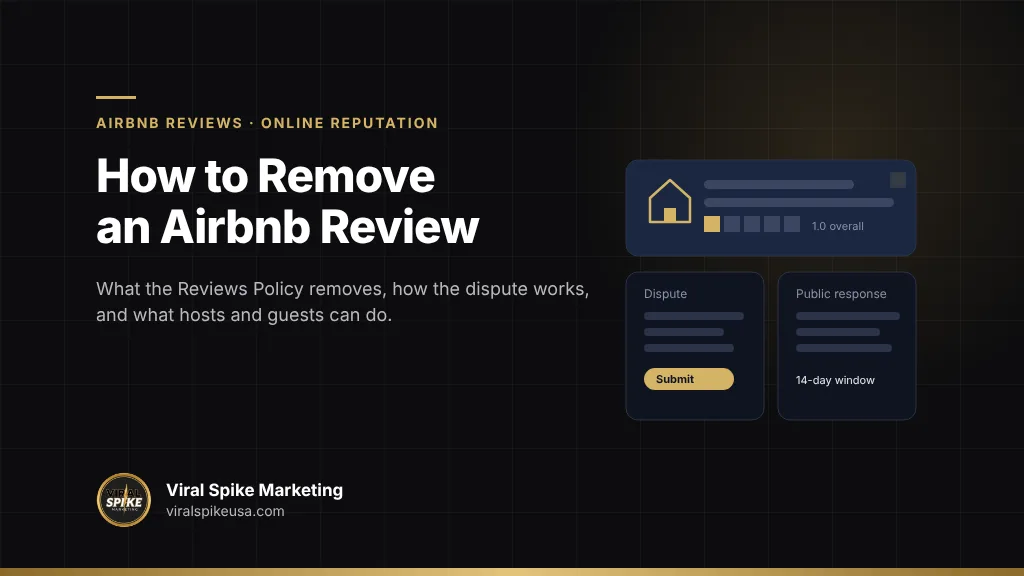
You can remove an Airbnb review only if it violates Airbnb’s Reviews Policy, and only Airbnb can remove it. The policy requires reviews to be relevant, authentic and trustworthy: Airbnb removes reviews that are not tied to a real reservation, that come from someone who never arrived, that are biased by incentives, pressure, coordination or extortion, that are written by a competitor or affiliate, that break the Content Policy, or that are retaliatory in the narrow sense Airbnb defines. Hosts and guests share one route: open the review dispute page, select the review, choose the reason, explain it, upload evidence and submit. Airbnb states that “a review won’t be removed solely due to disagreement or dissatisfaction with the star rating,” that it “generally [doesn’t] mediate disputes concerning review accuracy,” and that subjective opinions and factors outside the host’s control stay up. When a review survives, the remaining tools are a public response, the next ten reviews, and the reputation you build outside the platform.
Key takeaways
- Airbnb removes reviews for policy violations: fake, irrelevant, biased, extortionate, competitive, retaliatory or in breach of the Content Policy. It does not remove reviews for a low rating or a subjective opinion.
- Both parties have 14 days after checkout to write a review; reviews publish only when both have submitted or the window closes, so neither side sees the other’s review first.
- A review counts as retaliatory only if the reviewer committed a policy violation, was notified, and then left a biased review because it was reported.
- A reviewer can delete their own review within 30 days of publication; once a review is removed for a violation, no new review can be written for that reservation.
- Superhost status needs a 4.8 overall rating across the trailing 12 months, so a single one-star review hurts most on a listing with few reviews.
What does Airbnb’s Reviews Policy actually prohibit?
Airbnb’s Reviews Policy is the only document that matters for removal, and it is organized around what a review must be: relevant, authentic, trustworthy, and compliant with the Content Policy. Each requirement maps to a removal ground.
| Requirement | What violates it | Evidence that supports a dispute |
|---|---|---|
| Relevant | Reviews that do not reflect first-hand experience of the reservation; reviews from guests who never arrived or canceled for unrelated reasons; reviews about a different service from the same host | Reservation record showing no check-in; message thread showing the cancellation reason |
| Authentic | Reviews not tied to a real reservation; reviews not written by a participant or someone acting for them | Reservation history; account details |
| Trustworthy (no bias) | Reviews used to mislead; coordinated or manipulated reviews; reviews traded for discounts, refunds or reciprocal reviews; threats of a bad review to extract money or benefits; reviews by competitors or affiliates | Messages containing the demand or offer, with dates; evidence of the competing listing |
| Not retaliatory | A reviewer who committed a policy violation, was notified, and then left a biased review because the violation was reported | The report you filed, its timestamp, and the review’s timing and content |
| Content Policy | Explicit, discriminatory, harmful or illegal content | The offending text itself |
The policy is equally clear about what stays: disagreement with a star rating, mentions of factors outside the host’s control such as neighborhood noise, and subjective opinions about the stay. Airbnb generally does not mediate accuracy disputes and points both parties to the public response. A violation can also lead to restrictions on the related listing or account, not only removal of the review.
Two details catch people out. First, “once a review you wrote is removed, you can not write a new one for that reservation.” Second, the retaliation rule is narrow by design: discussing a Resolution Center or AirCover claim “is not automatically retaliatory.” A guest who disputes a damage claim and then leaves a bad review is not, by itself, in breach.
How do you dispute an Airbnb review, step by step?
Airbnb’s help article on reviews and disputes describes a single route for hosts and guests. You cannot delete a review written about you; you can only request removal for a policy violation.
- Open the review dispute page and select Get started.
- Select the review you are disputing.
- Select the reason for removal. Pick the one requirement from the table above that the review most clearly breaks; a dispute that cites everything reads as a complaint about the rating.
- Explain why it should be removed in plain terms a support agent with no context can follow: the rule, the sentence or fact that breaks it, and where the evidence is.
- Upload supporting documents: screenshots of the message thread showing a demand or an offer, the reservation timeline, the report you filed about the other party’s conduct, photos with timestamps where relevant.
- Submit, then wait. You can also contact Airbnb support to have the request reviewed if you need to add context.
The decision turns on evidence more than argument. Keep conversations inside Airbnb’s messaging system where possible; a demand made in the Airbnb thread is already in front of the agent. The same discipline applies on every platform; our Google review removal guide shows what a policy-matched report looks like in full.
Airbnb does not publish a response time for disputes. Submit early: the review is live and affecting bookings while you wait.
How does the 14-day review window work?
Airbnb’s article on how reviews work sets the mechanics that shape every removal case. Both guest and host are prompted to review on the day of checkout and “will have 14 days after checkout to submit their review.” Reviews “are only posted after both parties have submitted their reviews, or once the 14-day period has ended.” Neither side can read the other’s review before writing their own, which is why a host cannot write a defensive review in reaction to a guest’s.
Each review includes an overall star rating plus subcategory ratings (for homes: cleanliness, accuracy, check-in, communication, location and value), and the overall rating “is its own category (not an average of the other categories).” Only the overall rating is public. A listing’s rating appears in search once it has at least three reviews, and guests can edit a home review until it publishes.
If a reservation is canceled before check-in, neither party can review it, though some reservations canceled on or after check-in can be. That is the basis for the “never arrived” ground. A review from someone who booked, arrived and left after an hour is still a first-hand experience in Airbnb’s terms.
The window also sets the clock for a reviewer’s own removal: Airbnb’s policy says you can remove a review you wrote “up to 30 days from the date it’s published.” That is the one case where a review disappears without a policy violation, and it is in the reviewer’s hands, not yours.
What can hosts do, and what can guests do?
The dispute route is identical for both sides, but the situations differ, and so do the second-best options when the review stays.
| Situation | Host options | Guest options |
|---|---|---|
| Guest threatened a bad review unless refunded | Dispute under bias/extortion with the message thread; keep the demand on-platform | Not applicable |
| Host threatened a bad guest review unless a damage claim was dropped | Not applicable | Dispute under bias/extortion with the thread; report the host’s conduct |
| Review from a guest who never checked in | Dispute under relevance with the reservation timeline | Not applicable |
| Review written after the reviewer was reported for a violation | Dispute as retaliatory: show the report, its notification and the review’s timing | Same route if a host retaliated after a guest reported the listing |
| Review by a competing host or an affiliate | Dispute under competitive harm with evidence of the competing listing | Rarely applicable |
| Accurate but harsh review | Public response; next reviews | Public response; the review of a guest follows them to future bookings, so a calm response matters |
| Reviewer changes their mind | Only the reviewer can delete, within 30 days; do not offer anything for it | Delete your own review within 30 days of publication |
One line for hosts: you cannot ask a guest to change or remove a review in exchange for a refund, a discount or dropping a claim. The policy lists trading reviews for refunds or “promises not to take action” among the prohibited forms of bias, and the offer itself becomes evidence against you.
For guests, a host’s review is read by every future host deciding whether to accept a request. The same dispute path applies if it is retaliatory or extortionate, and the same public response if it is merely unfair.
How should you write the public response?
Airbnb’s article on responding to reviews says hosts can respond to guest reviews and guests to host reviews, that the response is public and appears alongside the original review on the listing page, and that “your response will be posted immediately.” You can reply whether you agree or disagree. Hosts find all reviews under Insights.
The response is read by prospective guests as a sample of how you handle problems. Acknowledge the specific issue, say what you changed, keep it short, stop. Ready-to-adapt wording is in our negative review response templates. Three Airbnb-specific rules:
- Do not relitigate the stay. A paragraph-by-paragraph rebuttal makes the listing look like a dispute waiting to happen. One sentence of correction is the limit.
- Never disclose the guest’s details (full name, reason for travel, who was in the party) or reference an AirCover claim. That is a Content Policy and privacy risk of your own.
- Name the fix with a date. “The water heater was replaced on 3 March” tells the next guest more than any apology.
Write it once; Airbnb’s article describes no edit option after posting, and the review and response are read together for as long as the listing exists.
How does a bad review affect Superhost status and search ranking?
Two Airbnb mechanisms translate a review into money. The first is Superhost. Per Airbnb’s Superhost requirements, a host must have “maintained a 4.8 or higher overall rating,” hosted at least 10 reservations (or 3 totaling at least 100 nights), kept a response rate of 90 percent within 24 hours and a cancellation rate below 1 percent, all measured over the past 12 months and assessed in a 7-day window starting January 1, April 1, July 1 and October 1. Only listings you own count. A single one-star review on a listing with 12 reviews averaging 5.0 drops the average to about 4.7, below the threshold; the same review on a listing with 60 reviews drops it to about 4.93. The damage is a function of review count, which is why new listings suffer most and why the next ten stays matter more than the dispute.
The second is search. Airbnb’s article on what determines how a listing appears in search says the algorithm weighs quality (photos, ratings and reviews, communication, cancellation information), popularity, price and location, and that “higher quality listings with better ratings and reviews tend to rank higher in search.” For homes, it also uses the Superhost criteria: cancellations, responsiveness, and ratings and reviews. The article gives no numeric threshold at which a listing is hidden, and it notes the algorithm changes over time.
Airbnb’s ground rules for home hosts add the enforcement side: when hosts receive low ratings, Airbnb “may send messages to encourage them to meet guests’ expectations of quality,” and “repeated low ratings indicate that a listing or host may not be meeting guest expectations.” Repeated or severe violations can lead to suspension or removal of a listing, loss of Superhost status, or a block on publishing new listings, and hosts can appeal by contacting Airbnb with new or corrected information. One bad review does not trigger any of that; a pattern does.
When does a review problem become a reputation problem?
Most Airbnb reviews stay inside Airbnb. A few leave it. A review that accuses a host of discrimination, a hidden camera or a scam can be screenshotted, posted to social media, picked up by local press and land in the search results for the host’s or property’s name, where it outlives the listing. For hosts who operate under a brand, run several properties or hold a professional license, that is where the real cost sits, and no Airbnb dispute resolves it. Hosts running several listings, or a property that also sells rooms directly, should read our guide to hospitality reputation management, which covers Tripadvisor, Booking.com and Google reviews.
The signals that a review has crossed that line:
- The review or a screenshot of it appears in a Google search for your name, your company or the property.
- A local outlet, neighborhood group or housing forum has repeated the accusation.
- An AI assistant answers “is [host or property] safe” by quoting it.
- Guests mention it in booking inquiries.
At that point the work shifts from Airbnb’s policy to search and corroboration: your own pages for the property and the business, consistent profiles across the platforms you list on, and independent coverage that gives search engines and AI systems something more authoritative to cite. The method is in how to suppress negative search results the right way, the timelines in what reputation repair can fix and how long it takes, and the cost structure in how much reputation management costs. If the same guest has reviewed you on Google, the parallel rules are in what a legitimate Google review removal service can do.
A note on legal routes: a review that makes a specific, false, damaging factual claim can ground a defamation action, but the Consumer Review Fairness Act, explained in the FTC’s business guidance, bars using house rules or terms to prohibit or penalize honest guest reviews, and the FTC’s 2024 rule on fake reviews treats suppressing reviews with baseless legal threats as a violation. This is general information, not legal advice; consult a lawyer in your state before acting on a specific review.
Where Viral Spike fits
Viral Spike’s reputation management service is built for the hosts and property businesses whose review problem has left the platform, or whose listings are a brand. We assess the review against Airbnb’s Reviews Policy, assemble the dispute and evidence, draft the public response, and then work on what Airbnb cannot touch: the search results for your name and your properties, consistent profiles across every platform you list on, and guaranteed editorial placements in recognized outlets, where you approve the draft, the article is published and indexed on Google, and the engagement is refunded in full if it never runs. The reviews we take on are removed or you receive a full refund: we assess every review against Airbnb’s policy in writing first and only take on the ones with a basis, with the terms in your agreement before any work starts. We do not contact guests on your behalf or trade anything for review changes, because each of those is a policy violation that hands Airbnb grounds to act against the listing. To find out whether your review is disputable, contact us with the listing link.
Dispute what breaks the policy, respond to the rest, and book the next ten stays
Read the review against the five requirements in the first table and decide in one sitting whether it breaks any of them. If it does, file the dispute today with the message thread attached. If not, write a three-sentence response, post it once, and turn to the next ten reservations, because on a 4.8 threshold that is the only lever that moves the number. Then search your name and the property’s; if the review has escaped the platform, that is the project.
Frequently asked questions
Can a host remove a guest’s review on Airbnb?
Not directly. A host can file a review dispute asking Airbnb to remove a review that violates the Reviews Policy: fake, from a guest who never arrived, biased by incentives or extortion, written by a competitor, retaliatory, or in breach of the Content Policy. Airbnb says it will not remove a review solely because of disagreement with the star rating and does not mediate accuracy disputes; the host can post a public response instead.
What counts as a retaliatory review on Airbnb?
Airbnb applies a narrow test. A review is retaliatory only if the reviewer committed a policy violation, was notified of it, and then left a biased review because the violation was reported. A guest who disputes a damage or AirCover claim and then leaves a critical review is not automatically retaliating. To dispute on this ground, show the report you filed, when the other party was notified, and the review’s timing and content.
How long do you have to leave or dispute an Airbnb review?
Both guest and host have 14 days after checkout to write a review, and reviews publish only when both have submitted or the window ends. A reviewer can delete their own review within 30 days of publication. Airbnb does not publish a deadline for filing a dispute about a review written about you, but file early, because the review is live and affecting bookings while the request is considered.
Can I see a guest’s review before I write mine?
No. Airbnb holds both reviews until both parties have submitted or the 14-day window closes, then publishes them together. Neither side can read the other’s review in advance, which prevents reactive reviews. A host who learns a guest’s view from messages can still write an honest review of the guest, but cannot condition it on the guest’s rating or trade reviews, which the policy treats as bias.
How much does one bad review affect Superhost status?
Superhost requires a 4.8 or higher overall rating across the trailing 12 months, assessed quarterly, along with 10 reservations or 3 totaling 100 nights, a 90 percent response rate within 24 hours and a cancellation rate under 1 percent. A one-star review on a listing with a dozen five-star reviews pulls the average below 4.8; on a listing with sixty it does not. The effect depends almost entirely on review count.
Can I offer a refund if the guest removes their review?
No. Airbnb’s Reviews Policy prohibits trading reviews for discounts, refunds, reciprocal reviews or promises not to take action, and treats threats of a bad review to extract money as extortion. An offer to refund in exchange for deletion violates the policy whether it comes from the host or the guest, and the message itself becomes evidence. A guest may delete their own review within 30 days, but only on their own initiative.
Sources
Primary sources referenced in this article, in order of first use.
- Reviews Policy (airbnb.com)
- reviews and disputes (airbnb.com)
- how reviews work (airbnb.com)
- responding to reviews (airbnb.com)
- Superhost requirements (airbnb.com)
- what determines how a listing appears in search (airbnb.com)
- ground rules for home hosts (airbnb.com)
- business guidance (ftc.gov)
- 2024 rule on fake reviews (ftc.gov)

More in Online Reputation
 How to Remove a Google Review: 2026 Policy and Appeals
 How to Remove Facebook Reviews and Recommendations: Reporting, Turning Recommendations Off, and What to Do When a Page Is Attacked
 How to Remove Google Reviews: Step by Step Through Flagging, the Reviews Management Tool, Appeals and Legal Requests
Related services