
PR for Restaurants: Opening Timelines, Local Food Press, Critics, Influencer Meals and Reviews
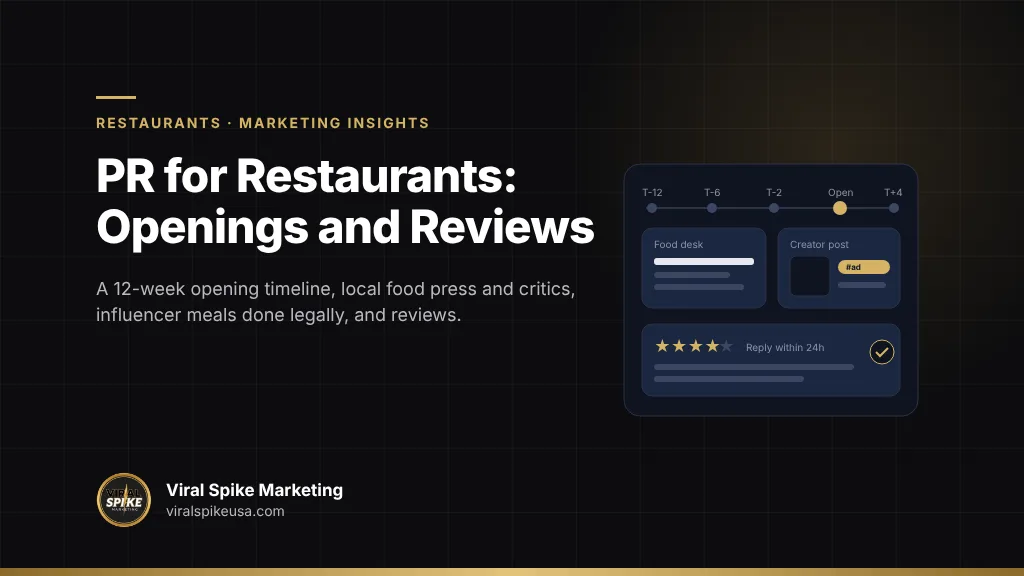
PR for restaurants comes down to three windows: the opening, when local food media is most willing to cover you and you have one chance to be new; the review period, when critics and the public decide what they think; and the long tail, when you need real reasons to be written about again. The opening is a calendar exercise that starts about twelve weeks out, with food editors, local news desks, city sites and a small set of creators each pitched at the right time. Critics at outlets with review policies, such as The Infatuation, visit unannounced and pay for their meals, so the only preparation is being ready. Influencer meals are advertising under the FTC’s Endorsement Guides and need a clear disclosure in the post itself. Reviews on Google and Yelp are governed by platform rules and, since 2024, an FTC rule that bans buying reviews or suppressing negative ones. Guaranteed placements fill the gap when a specific outlet matters by a specific date. What follows is the timeline, the outlets, the rules and the mistakes.
Key takeaways
- Start opening PR twelve weeks out. Food editors plan “coming soon” and “now open” coverage weeks ahead, and a restaurant that pitches on opening day has missed the first window.
- Local food press, city guides and local news are different desks with different needs. Eater runs city sites in 23 US cities as of 2025; The Infatuation’s critics dine anonymously and pay their own way.
- A free or discounted meal for a creator is a material connection. The FTC says the disclosure must be in the post, clear and hard to miss, and that the restaurant is responsible for it, not just the creator.
- Google allows asking customers for reviews; Yelp asks businesses not to solicit them at all; the FTC’s 2024 rule bans paying for reviews and suppressing negative ones with threats.
- After the opening, PR is a rhythm of small, real reasons to cover you. A restaurant with nothing new is a restaurant with no press.
What does a restaurant opening PR timeline look like?
Food desks work ahead. A “coming soon” item needs the concept, the people, the neighborhood and an opening month; a “now open” piece needs a confirmed date, a menu, prices, hours and photographs. The table runs backward from opening day (T) and assumes a single independent restaurant; a group with a publicist compresses some of it.
| When | What to do | Who it is for |
|---|---|---|
| T-12 weeks | Write the one-paragraph concept, chef and owner bios, and a fact sheet (cuisine, seats, price range, neighborhood, opening month). Claim the name on Google Business Profile, Yelp, Instagram and the reservation platform. Build a simple press page with a contact. | Everyone who will ask later |
| T-10 weeks | List the outlets: the daily’s food editor, the city’s Eater site if it has one, the alt-weekly, the business journal, local TV web desks, hyperlocal sites, neighborhood newsletters, regional magazines. | Your pitch list |
| T-8 weeks | Pitch “coming soon” to the food editors and Eater-style sites with the concept, the people and a rendering or a construction photo. Pitch the business angle (lease, build-out cost if you will share it, jobs) to the business journal. | Food and business press |
| T-6 weeks | Professional photography of the space and six to ten dishes, plus headshots. Menu with prices finalized enough to share. Update the press page. | Every outlet that will run a photo |
| T-4 weeks | Confirm the opening date. Pitch “now open” pieces with an embargo to outlets that post on day one. Invite the local news desk to a preview if you have a visual hook. Draft the creator list. | Food press, local news, creators |
| T-2 weeks | Friends-and-family service. Fix what breaks. Host one or two small media previews or creator meals, with disclosure terms in writing. | Creators, select press |
| T-1 week | Send the final “now open” note with date, hours, menu link, photos and reservation link. Confirm Google Business Profile hours and menu. Brief staff on how to handle a critic or a reporter who identifies themselves. | Everyone on the list |
| Opening (T) | Post, respond to coverage, share clips. Watch reviews from day one and reply to each. | Public |
| T+2 to T+6 weeks | Critics’ visits typically fall here. Consistency is the only preparation. Begin the second-wave pitches: the dish that is selling out, the bar program, the brunch launch. | Critics, food press |
| T+8 weeks and on | Monthly calendar of small, real news. Measure branded search and reviews per cover. | Ongoing |
The press page at T-12 does most of the work: the structure is in press kit vs media kit. Build it before the first pitch, because the first thing a food editor does with a concept they like is look for photos and a bio.
Who covers restaurants locally, and what does each desk want?
A city’s restaurant coverage is spread across desks with different incentives, and a pitch written for one usually fails with the others.
| Desk | What they run | What they need from you | Lead time |
|---|---|---|---|
| Food editor or dining critic at the daily or alt-weekly | Coming-soon items, opening roundups, reviews, chef profiles, trend pieces | Concept, people, menu, photos, a reason it matters to the city | 2 to 8 weeks |
| City food sites (Eater city sites and similar) | Openings, closings, chef moves, “hottest” and “essential” maps, news | Confirmed facts fast: date, address, hours, menu, photos | Days to 4 weeks |
| Guides and critics (The Infatuation and similar) | Rated reviews, neighborhood and occasion guides | Nothing you can send; they visit anonymously | Weeks to months after opening |
| Local TV web desk and morning shows | Visual segments: a dish being made, a grand opening, a charity tie-in | A visual hook, a time and place, someone camera-ready | 1 to 2 weeks |
| Business journal | Leases, build-outs, expansions, hires, closings | Numbers: square footage, investment, jobs, lease term | 1 to 3 weeks |
| Hyperlocal sites and neighborhood newsletters | Anything new on the block | A short note and a photo | Days |
| Regional lifestyle magazines | Best-of lists, seasonal features, long profiles | Pitches months ahead; strong photography | 2 to 4 months |
Two of these deserve detail. Eater, founded in 2005 and owned by Vox Media since 2013, runs a national site and, as of 2025, sites in 23 US cities, and its city editors cover openings and closings as news; some city sites have closed in recent years, so check whether yours is active before pitching. The Infatuation, owned by JPMorgan Chase since 2021, states that its writers visit unannounced under fictitious names, pay for all of their own meals and reservations, accept no free meals or special treatment, and review after a few visits. You cannot pitch a review there; you can only be consistently good when it happens. Neither outlet, nor any other, can be promised to you by a vendor as a placement.
The local news desk is a separate skill from food press, and it is where a restaurant gets its non-food stories: the owner’s background, a community program, a hiring push. The method, including who to email at a TV station, is in how to get your story in local news.
How do you pitch a food editor?
Short, factual and early. A workable opening pitch is under 200 words and contains: the name and neighborhood; the concept in one sentence; who is behind it and one line of relevant background; the opening month (coming soon) or date (now open); the price range; two or three dishes that define the menu; a link to the press page with photos; and a direct phone number. No adjectives about passion or journeys. If the chef has a story the city would care about, that is the second paragraph, not the first.
What makes a restaurant pitch newsworthy to a city desk: a chef or operator the city already knows; a cuisine or format the neighborhood lacks; a notable space; a hard number (build-out cost, jobs); a partnership with a known local producer; or a timing hook. Not newsworthy on its own: “great food and service,” a generic grand opening, a ribbon cutting without a visual.
After opening, the second-wave pitch needs a new fact: a dish selling out nightly with the number, a brunch or late-night launch, a guest chef, a collaboration, a seasonal menu built around a local farm, an anniversary with a figure attached. Keep a monthly note of what is new and send the strongest item to the one desk it fits. The broader method for small businesses without a PR department is in how small businesses land press coverage.
Influencer meals and FTC disclosure: the rules that apply
A free meal, a discount or a fee given to a creator in exchange for a post is a material connection under the FTC’s Endorsement Guides, and the FTC’s own guidance on the Guides, revised in 2023, is specific about restaurants: reviewers who receive free meals should tell readers, friends or relatives invited to eat for free should disclose both the relationship and the meal, and even a small gift may need disclosure if it could affect how readers weigh the review. The reviewer’s own belief that the meal did not influence them does not matter; what matters is how the audience would view it.
The FTC also specifies how the disclosure must be made. It must be clear and conspicuous, placed near the endorsement and ideally at the start, not buried at the end of a caption or in a comment. A disclosure only in the creator’s profile is not enough, a “disclosure” link is not enough, and a platform’s built-in paid-partnership tool alone is not enough; the endorser remains responsible for adding a disclosure. Vague tags such as “#gifted,” “#partner” or “#ambassador” can fail, while plain language such as “Ad” or “Paid ad” usually works. If the endorsement is in video, the disclosure should be in the video, and if it is spoken, it should be audible. Responsibility sits with the advertiser as well as the endorser: the FTC says delegating to a PR firm does not remove the restaurant’s obligation, and advertisers should have training and monitoring in place and pre-approve paid posts where possible.
A practical creator program that stays inside those lines:
- Choose five to ten local creators whose audience is your city, and whose engagement looks like people rather than purchased activity.
- Put the terms in writing: what is provided (meal for two, up to a value), what is expected (one post, one story, or nothing required), and that any post must carry a clear disclosure such as “Ad” or “Sponsored by [Restaurant]” at the start of the caption and on screen in video.
- Do not require a positive review. Conditioning the meal on positive content is deceptive, and the resulting post is both less credible and a compliance problem.
- Keep a log of who was hosted, when, and whether the disclosure appeared. That is the “monitoring” the FTC expects.
- Brief the floor staff. Creators get the same food and service as everyone else.
The same disclosure rules apply to sponsored articles on outlets; the labels and what they mean for credibility are explained in understanding sponsored article placement and FTC disclosure. This section is general information, not legal advice.
Reviews: what you can ask for, what you cannot, and how to respond
Reviews are the review period’s public verdict, and the rules differ by platform. The longer-term system of response times, staff playbooks and removals is covered in reputation management for hotels and restaurants.
Google. Google’s guidance for businesses allows asking customers for reviews and sharing a direct review link or QR code, and asks businesses to respond promptly, keep replies short, professional and relevant, and avoid private information and personal attacks. It prohibits offering free or discounted goods or services in exchange for posting, changing or removing a review. A table card with a QR code and a line on the receipt are fine; “leave a five-star review for a free dessert” is not.
Yelp. Yelp’s position is stricter: it asks businesses not to solicit reviews at all, from customers, mailing lists, friends or staff contests, and not to offer anything in exchange for them, as described in Search Engine Land’s report on the policy. Yelp’s Consumer Alerts program flags businesses caught offering incentives. “Find us on Yelp” signage is the practical limit.
Federal law. The FTC’s final rule on fake reviews and testimonials, announced August 14, 2024, prohibits creating or buying fake reviews, paying for reviews conditioned on a particular sentiment, undisclosed reviews from insiders such as owners or managers, suppressing negative reviews with baseless legal threats or intimidation, and buying fake followers or views, and lets the FTC seek civil penalties against knowing violators. A restaurant that asks its staff to post reviews without disclosure, or that threatens a reviewer to get a post removed, is inside that rule.
Responding. Reply to every review within a day, name the specific thing the guest mentioned, and take anything contentious to email or phone. A critic’s or guest’s bad night is best answered by a short, specific, non-defensive reply and a better next service. Scripts for one-star reviews, unfair reviews and reviews that mention staff by name are in how to respond to negative reviews. Reviews that violate a platform’s content rules (no customer experience, a competitor, harassment) can be flagged through official channels.
Guaranteed placements for restaurants: when the shortcut makes sense
Food desks are selective and critics cannot be booked, which leaves gaps that matter commercially: a second location in a market where nobody knows the brand, a catering business that needs credibility with corporate buyers, a chef building a profile ahead of a cookbook, or a results page for the restaurant’s name that is nothing but review sites. A guaranteed editorial placement, a feature in a specific recognized outlet committed in advance, fills those gaps on a schedule.
What it is not: a review, a critic’s pick, an Eater or Infatuation listing, or any outcome at an outlet with an editorial review policy. Any vendor who promises one of those is describing something they cannot deliver. What it is: a feature about the restaurant, the chef or the owner in a business, lifestyle or regional publication, written to editorial standards, which you approve before it runs. Used well, it goes into the press page, the catering deck and the first page of search results. For most independent restaurants, one or two such features after the opening, timed to a second-wave story, do more than a dozen before it; the earned work comes first.
Common restaurant PR mistakes
- Pitching on opening day. The coming-soon window closed six weeks earlier.
- No photos, or phone photos. Food coverage is visual. A desk that likes the concept and has no usable image moves on.
- Treating creators as press. A creator meal is advertising with disclosure obligations; a critic’s meal is journalism you cannot influence. Mixing the two produces undisclosed posts and offended critics.
- Soliciting reviews on Yelp or offering anything for a review anywhere.
- Owner or staff reviews. Undisclosed insider reviews are covered by the FTC’s 2024 rule.
- Silence after a bad review. An unanswered one-star review reads as agreement. Reply within a day, briefly.
- Going quiet after the opening. The restaurants that keep getting covered send one real update a month.
- No plan for a bad week. A health inspection story, a viral complaint or a staff incident needs a holding statement and a single spokesperson decided in advance; the outline is in crisis communications for small businesses.
- Measuring coverage by the logo wall. Count branded search, reservations in the week after a piece, and reviews per cover; the scorecard is in how to measure PR results.
Where Viral Spike fits
Viral Spike Marketing runs restaurant PR on the calendar above. The public relations team builds the press page and photography brief, pitches food editors, city sites, business journals and local news desks in sequence, runs creator meals with written disclosure terms and a monitoring log, and sets up review response so nothing sits unanswered. Where a specific outlet matters, for a second location, a catering business or the first page of results for the restaurant’s name, guaranteed editorial placements across 1,600+ outlets put a feature there on a date: you approve the draft, the article is published and indexed on Google, and the engagement is refunded in full if it never runs. If you are opening in the next six months, send the date and we will map the twelve weeks.
Put the opening date on a calendar and count back
Write the opening date at the top of a page and mark T-12, T-8, T-6, T-4, T-2 and T-1. Under T-12, list the concept paragraph, the bios, the fact sheet and the press page. Under T-10, the twenty outlets and the name of the person at each. Under T-6, the photographer’s date. Under T-4, the creator list with the disclosure line you will require. Under T-1, the final note and the staff briefing. Then, under T+8, write the first second-wave story you will pitch. A restaurant that has that page is ahead of most openings in its city, and the rest is cooking.
Frequently asked questions
How far in advance should a restaurant start PR before opening?
About twelve weeks. Food editors and city food sites plan coming-soon coverage weeks ahead and want the concept, the people, the neighborhood and an opening month by roughly eight weeks out, with photos, a menu and a confirmed date by four weeks out. Regional magazines work two to four months ahead. A restaurant that first contacts the press on opening day has missed the coming-soon window and competes only for now-open roundups.
How do you get a restaurant reviewed by a critic?
You cannot book it. Outlets with review policies, such as The Infatuation, state that their writers visit unannounced under fictitious names, pay for their own meals and accept no special treatment. Critics at daily papers work the same way. The only preparation is consistency in the weeks after opening, when visits typically happen, and a staff briefed to treat every table the same. Any vendor promising a review or a guide listing is promising something they cannot deliver.
Do influencers have to disclose a free meal from a restaurant?
Yes. Under the FTC’s Endorsement Guides, a free meal is a material connection and the disclosure must be clear, conspicuous and in the post itself, near the start, not only in a profile or a comment. Vague tags like #gifted or #partner can fail; plain words like ‘Ad’ or ‘Sponsored’ work. The restaurant is responsible as well as the creator, so put the disclosure requirement in writing and check that it appears.
Can a restaurant ask customers for Google or Yelp reviews?
Google allows it: businesses may ask customers and share a review link or QR code, but may not offer anything in exchange for posting, changing or removing a review. Yelp asks businesses not to solicit reviews at all and flags businesses that offer incentives. The FTC’s 2024 rule separately bans buying reviews, undisclosed reviews from owners or staff, and suppressing negative reviews with threats, with civil penalties for knowing violations.
What is a guaranteed placement for a restaurant?
A feature about the restaurant, chef or owner in a specific recognized business, lifestyle or regional outlet, with the outlet and publication committed in advance and the draft approved by you before it runs. It is not a review, a critic’s pick or a listing on a guide with an editorial policy; those cannot be guaranteed. It is most useful after opening, for a second location, a catering business or the search results for the restaurant’s name.
What should a restaurant do about PR after the opening?
Send one real update a month to the one desk it fits: a dish selling out with a number, a brunch or late-night launch, a guest chef or collaboration, a seasonal menu tied to a local producer, an anniversary with a figure. Keep the press page current with new photos, reply to every review within a day, and track branded search and reservations in the week after each piece to see which outlets move the room.
Sources
Primary sources referenced in this article, in order of first use.
- Eater (en.wikipedia.org)
- The Infatuation (theinfatuation.com)
- guidance on the Guides (ftc.gov)
- guidance for businesses (support.google.com)
- Search Engine Land's report (searchengineland.com)
- final rule on fake reviews and testimonials (ftc.gov)

More in Marketing Insights

Related services