
Reputation Management Software vs Agency: Which Do You Need? An Honest Comparison
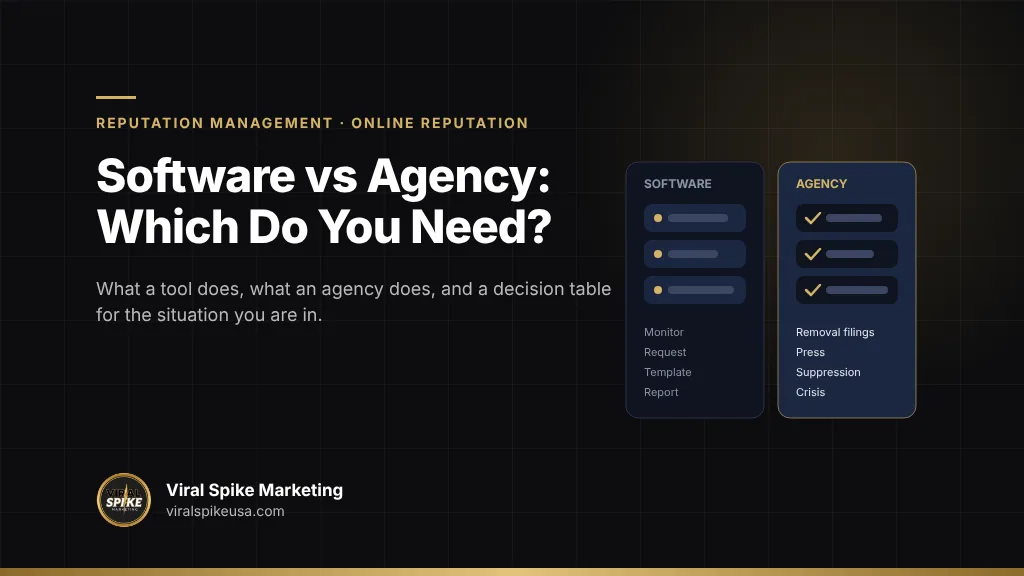
Reputation management software and a reputation management agency solve different problems, and the honest answer to “which do I need” is usually: software if your problem is volume and consistency, an agency if your problem is a specific piece of damaging content or a gap in what the web says about you. Software watches review sites and mentions, sends review requests, routes replies through templates and produces reports. It is cheap per location, scales across many, and does nothing about a review that breaks policy, a news article on page one, a Ripoff Report, an autocomplete prediction or a crisis. An agency does those things with people: it assesses content against platform rules and files removal reports, earns and places press coverage, builds the pages and profiles that outrank what you cannot remove, and runs the response when something goes wrong in public. Many businesses need software permanently and an agency for a defined engagement. The mistake in both directions is paying one to do the other’s job: a tool will not get an article removed, and an agency on retainer to send review request texts is an expensive way to run a tool.
Key takeaways
- Review category definitions are consistent: G2 requires reputation management software to monitor review sites, aggregate reviews, alert and report, and provide a way to gather new reviews. Removal, press and suppression are not on the list.
- Consumers reward what software does well. BrightLocal’s 2026 survey found 89 percent expect owners to respond to reviews and 80 percent are likely to use a business that responds to all of them.
- Removal is a policy and legal process, not a feature. Google evaluates flagged reviews in several days with one appeal; court orders go through a separate legal channel.
- The FTC’s 2024 rule bans buying reviews, incentivized sentiment, undisclosed insider reviews and suppression by baseless threats, which limits what any vendor can legitimately promise.
- A decision table below matches eight common situations to software, agency or both.
What does reputation management software actually do?
The category is well defined because buyers compare products on feature lists. G2’s online reputation management category, which it says is “also known as review management software,” requires a product to do four things: “Monitor online review sites for new and existing negative reviews,” “Have a management platform to aggregate and interpret online reviews,” “Create alerts and reports regarding a brand’s current online reputation,” and “Provide forms or a vehicle to garner new online reviews.” Sentiment analysis and response tools are common additions. G2 also notes these products differ from social media monitoring software in that they “aim to collect online reviews.”
In practice, the software categories a business will meet are:
| Software category | Core job | What it does well | What it does not do |
|---|---|---|---|
| Review management platforms | Request, monitor and reply to reviews across Google, Facebook, industry sites | Consistent asking at scale; one inbox for replies; templates; location-level reporting | Remove reviews; argue policy with a platform; fix a non-review result |
| Brand and media monitoring tools | Alert on mentions across news, blogs, forums and social | Early warning; share-of-voice and sentiment trends | Change any of it |
| Listing and profile management | Sync name, address, hours and categories across directories | Consistency across dozens of listings; suspension prevention | Win back a suspended profile; create authority |
| Social listening and inbox tools | Unify comments and DMs; flag spikes | Response speed; routing to the right person | Decide what to say in a crisis |
| Data-broker opt-out services | Submit removal requests to people-search sites on a schedule | Volume and recurrence | Anything beyond the sites on their list; see removing yourself from people-search sites |
None of this is a criticism. Consumers reward exactly what these tools make routine. BrightLocal’s 2026 Local Consumer Review Survey of 1,002 US adults found that 97 percent read reviews for local businesses, 89 percent “expect business owners to respond to reviews,” and 80 percent “say they’re likely to use a business that responds to all of its reviews.” A tool that gets a business from replying to a third of its reviews to all of them, within a day, is paying for itself. Response wording for the hard ones is in our negative review response templates.
What does a reputation management agency actually do?
An agency’s work starts where the feature list ends. The deliverables are judgment, filings, relationships and content.
Removal assessment and filings
Every platform removes content only for violations of its own rules, through its own process. Google’s review reporting page says “Review evaluation typically takes several days,” that a one-time appeal is available for up to ten reviews, and warns, “Do not report a review just because you disagree with it or dislike it.” An agency’s value is knowing which rule a review breaks, assembling evidence a moderator can verify, and filing once, properly, across Google, Yelp, Trustpilot, Glassdoor and the rest. What that looks like for Google specifically is in what a legitimate Google review removal service does.
Press and authority
Software cannot put your founder in a business publication or get a trade outlet to cover a launch. Earned and placed editorial coverage is what ranks for your name above the content you cannot remove, and it is what AI assistants quote when someone asks whether you are legitimate. An agency with media relationships, or a guaranteed placement product, is the only way to buy this.
Suppression
Pushing a negative result down is a months-long program of owned pages, consistent profiles, coverage and links, sequenced against the specific queries that matter. It needs someone to decide what to build and in what order, which is a strategy job, not a dashboard. The method is in how to suppress negative search results the right way.
Legal coordination
Where a statement is provably false, an agency works alongside counsel: documenting the harm, preparing the Google legal request once a judgment exists, and handling the content side while the lawyer handles the claim. This is general information, not legal advice.
Crisis response
When something goes wrong in public, the first 48 hours decide the next six months. Statements, holding lines, who speaks, what gets posted and what does not: this is people on the phone, not alerts in an inbox.
Software vs agency: the decision table
| Your situation | Software | Agency | Why |
|---|---|---|---|
| Multiple locations, inconsistent review volume, slow replies | Yes | No | A process problem; the tool enforces the process |
| A few fake or policy-violating reviews on Google or Yelp | No | Yes, scoped | Evidence and filings; a defined project with a written assessment first |
| A negative news article or forum thread on page one for your name | No | Yes | Removal is legal or editorial; the fallback is suppression |
| A Ripoff Report or complaint-site page that will not come down | No | Yes | Legal review plus suppression; see Ripoff Report removal |
| A negative autocomplete prediction | No | Yes | Policy report plus a change in the search footprint |
| Thin or absent presence: few results, no coverage, AI assistants do not know you | Partial | Yes | Authority has to be built with content and press |
| A public incident unfolding now | Alerts only | Yes, immediately | Judgment and speed |
| Steady state after a cleanup | Yes | Quarterly check-in at most | Monitoring is a tool’s job; strategy is occasional |
The pattern: software when the fix is doing a known thing more consistently; an agency when the fix requires deciding what to do, dealing with a platform, a publisher or a court, or creating something that did not exist. A regulated professional, such as a dentist, lawyer or financial adviser, often needs both at once, because the response templates have compliance constraints and the authority layer matters more; the healthcare version is in reputation management for dentists.
What does each cost, and how should you compare?
Software is priced per location or per seat per month, with tiers for features such as multi-platform requesting, sentiment analysis and API access. Agencies price in three ways: a monthly retainer for ongoing work, a fixed project fee for a defined scope such as a removal assessment and filings or a suppression campaign, and per-deliverable pricing for items like placements. Our cost guide is in how much reputation management costs.
Comparing them on price alone is the error. Compare on what has to be true at the end:
- If the outcome is “every review answered within 24 hours across 30 locations,” software is the cheaper way to get there by an order of magnitude.
- If the outcome is “the article is off page one for my name,” no software subscription at any price gets there, and the agency fee should be weighed against what the result is costing you in lost deals or hires.
- If the outcome is “three fake reviews gone,” the fair price is for the assessment and the filings, scoped upfront, with no fee contingent on a deletion that is the platform’s decision.
A sensible structure for most businesses is a software subscription running permanently, an agency project when a specific problem appears, and a short retainer only during a period of active authority building or a crisis.
Red flags when buying either
Software red flags
- Review gating built in. A flow that asks “how was your experience” and sends only the happy answers to Google violates Google’s contributed content policy, which bars merchants from any attempt to “discourage or prohibit negative reviews, or selectively solicit positive reviews.” Ask the vendor to show the flow before you sign.
- Incentive features. Discounts or entries for reviews are prohibited on Google and, under the FTC’s 2024 rule on fake reviews, incentives conditioned on sentiment are a violation with civil penalties for knowing violators.
- “Removal” as a feature. A button that files a report is fine; a tier that promises removals is not something a tool controls.
- Auto-generated replies posted without review. Google checks replies against policy, and a regulated practice can breach confidentiality with an automated “sorry about your appointment.”
Agency red flags
- Guaranteed deletions. Removal decisions belong to the platform or a court. A written assessment of which items are removable and why is the legitimate version.
- Vague methods. If the agency will not say which policy a report cites, which outlets it is pitching or which pages it is building, it is not doing the work.
- Fake reviews or “review seeding.” Illegal under the FTC rule and grounds for a platform penalty on your profile.
- Legal threats as a service. The FTC rule names “unfounded or groundless legal threats” as review suppression; an agency that offers to scare reviewers is creating liability for you.
- Press you cannot verify. Placements on sites nobody reads, or “features” that are undisclosed ads, do not build authority and can embarrass you. Ask for the outlet list and check it.
Can you do it yourself with software and no agency?
Often, yes, for the steady state. A single-location business with a stable reputation, a review tool, a monthly habit of checking its name in search, and a short list of what to do if something appears can run without an agency indefinitely.
What a solo operator cannot easily do is the work that needs leverage: a defamation judgment, coverage in outlets that do not take cold pitches from the subject, or a suppression program that requires a dozen assets built in a sequence. Those are the moments to bring in people, with a defined scope and an end date. Think of the agency as a contractor you call for the renovation, and the software as the thermostat that runs every day.
Where Viral Spike fits
Viral Spike is an agency, and we tell prospective clients when they do not need one. Our reputation management service starts with a written assessment: which reviews or pages match a removal policy and on what evidence, which need a legal route, and which require suppression and authority building. Reports are filed through the official channels, and the reviews we take on are removed or you receive a full refund: we assess every review against the platform’s policy in writing first, so we only take on reviews with a basis, and the terms are in your agreement before any work starts. Removal work is scoped and paid upfront. The authority layer uses our guaranteed editorial placements in recognized outlets, where you approve the draft, the article is published and indexed on Google, and the engagement is refunded in full if it never runs. If your problem is review volume and reply speed, we will say so and point you at a tool. If it is a specific piece of content, a thin presence or a crisis, contact us and we will scope the engagement in writing before any work starts.
Diagnose the problem before you buy the fix
Search your business name and your own name in an incognito window and write down what is on page one. Then look at your last 20 reviews and note how many got a reply and how fast. If the page is fine and the replies are slow, buy software this week. If the page has something on it that is costing you and no tool has a button for it, get a written assessment of that item before anyone sends you a retainer agreement. The right purchase is the one that matches the problem on that page.
Frequently asked questions
What is the difference between reputation management software and an agency?
Software monitors review sites and mentions, sends review requests, routes replies through templates and reports on ratings; G2’s category definition requires monitoring, aggregation, alerts and a way to gather new reviews. An agency does the work that needs judgment and people: assessing content against platform rules and filing removal reports, earning and placing press, building the pages and profiles that outrank what cannot be removed, coordinating with counsel, and managing a crisis. Software scales routine work; an agency changes specific results.
Can reputation management software remove negative reviews?
No. Software can help you flag a review to the platform, but removal is the platform’s decision under its own policies and process. Google, for example, evaluates flagged reviews over several days and offers one appeal, and tells businesses not to report a review simply because they dislike it. A tool that advertises removal as a feature is overstating what it controls. Policy-based removal with evidence is agency work, and even then the outcome is never guaranteed.
When is a reputation management agency worth it?
When the problem is a specific item a tool cannot touch: a policy-violating review that needs evidence and a proper filing, a news article or forum thread on page one, a complaint-site page, a negative autocomplete prediction, a thin presence that AI assistants and prospects cannot find, or a crisis unfolding now. The engagement should be scoped in writing with a defined outcome. For routine review requests and replies, software is cheaper and better.
Is review gating software legal?
Review gating, meaning filtering customers by expected sentiment and sending only happy ones to a public platform, violates Google’s contributed content policy, which bars merchants from discouraging negative reviews or selectively soliciting positive ones, and can lead to removed reviews or profile penalties. The FTC’s 2024 rule separately prohibits incentives tied to review sentiment and suppression through baseless threats. Ask any review tool vendor to show the exact request flow before you buy.
How much does reputation management software cost compared to an agency?
Software is typically priced per location or seat per month and is the cheaper route for ongoing monitoring and review requests, especially across many locations. Agencies charge monthly retainers, fixed project fees for defined scopes such as a removal assessment or a suppression campaign, or per-deliverable fees for items such as placements. Compare on the outcome you need, not the monthly figure: no software subscription removes an article from page one, and no agency retainer is an efficient way to send review request texts.
Do I need both software and an agency?
Many businesses do, at different times. Software runs permanently for monitoring, requesting and replying. An agency is brought in for a defined engagement when a specific problem appears or when authority needs to be built: removal filings, press, suppression or crisis response. Regulated professionals such as dentists and lawyers often need both at once, because their reply templates carry compliance constraints and their search results depend more on credible coverage.
Sources
Primary sources referenced in this article, in order of first use.
- online reputation management category (g2.com)
- Local Consumer Review Survey (brightlocal.com)
- review reporting page (support.google.com)
- contributed content policy (support.google.com)
- 2024 rule on fake reviews (ftc.gov)

More in Online Reputation
 How to Choose a Reputation Management Agency: Questions to Ask First
 Reputation Management for Hotels and Restaurants: Reviews at Scale, Response SLAs, Staff Playbooks and Removal Routes by Platform
 Reputation Management for Dentists: HIPAA-Safe Review Responses, Profiles That Convert, and What to Do About the One-Star Rant
Related services