Answer Engine Optimization Checklist: 20 Checks to Run Before You Publish
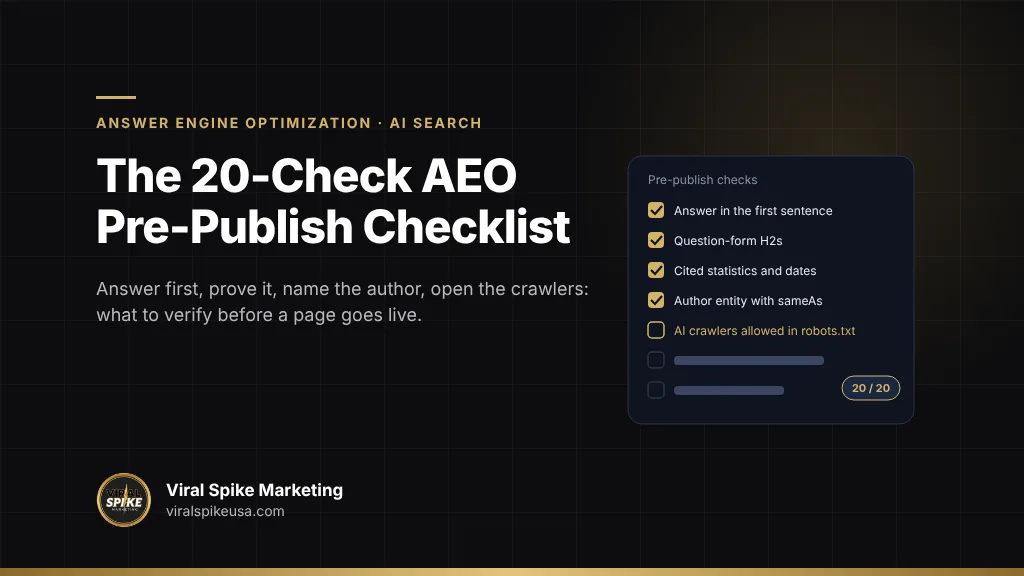
An answer engine optimization checklist is a fixed set of checks you run on a page before it goes live so that ChatGPT, Google AI Overviews and AI Mode, Perplexity, Gemini and Claude can retrieve it, extract a clean answer from it, trust the author and the evidence, and cite it. The 20 checks below fall into four groups: the answer itself (does the first sentence answer the question, are headings questions, are terms defined, are comparisons in tables), the evidence (are statistics sourced and dated, are quotations and citations present, is there anything original), the entity (is the author a real person with a linked profile, do the facts match your other pages), and access (can OAI-SearchBot, PerplexityBot, Claude-SearchBot and Googlebot fetch the page, is nothing blocked at the CDN). The content checks rest on the GEO research that found adding citations, quotations and statistics lifted visibility in generative responses by roughly 30 to 40 percent while keyword stuffing did nothing; the access checks come from each engine’s crawler documentation. Google’s own guidance says none of this requires special files or markup, so the checklist is about doing ordinary things completely.
Key takeaways
- The highest-value checks are the cheapest: a first sentence that answers the question, headings phrased as the question, and a statistic with a linked source and a date.
- Google retired FAQ rich results in May 2026 and says it does not use llms.txt; a visible FAQ section still helps, and llms.txt is optional housekeeping, not a lever.
- Google’s AI optimization guide says no special markup, chunking or AI-specific writing is needed and that seeking inauthentic mentions does not help; the checklist is consistent with that.
- Engines retrieve from their own crawlers: OAI-SearchBot for ChatGPT search, PerplexityBot for Perplexity, Claude-SearchBot for Claude, Googlebot for AI Overviews and AI Mode. One disallow line removes you from that engine’s answers.
- A page can pass all 20 checks and still not be recommended if nothing independent corroborates the brand; the checklist governs citation, not reputation.
What is answer engine optimization, and what does this checklist cover?
Answer engine optimization (AEO) is the on-page discipline of making content easy for an answer system to extract and attribute. It overlaps with generative engine optimization (GEO), which also covers the off-page signals, such as press coverage and entity consistency, that decide whether a brand is recommended rather than merely cited. The relationship between the two, and to SEO, is explained in what generative engine optimization is. This checklist covers the page-level work only.
It is worth being clear about what Google says, because Google’s AI features reach the most people. Its documentation on AI features and your website states that “there are no additional requirements to appear in AI Overviews or AI Mode, nor other special optimizations necessary,” and that “there’s also no special schema.org structured data that you need to add.” Both features use a “query fan-out” technique that issues multiple related searches, which is why a page that answers one sub-question cleanly can be cited even when it would not rank first for the head query. Google’s May 2026 guide to optimizing for generative AI features goes further and lists five AEO/GEO myths: that you need llms.txt or special markup, that content must be “chunked,” that you should rewrite content for AI, that inauthentic mentions help, and that structured data is required. None of the 20 checks below depends on any of those myths.
What the checks depend on is the behavior every engine shares: retrieve candidate pages, read passages, prefer the one that states the answer plainly with evidence, and attribute it to a source it can identify.
The 20-check answer engine optimization checklist
Run these in order. Each row says what to verify and why the engines care.
| # | Check | Pass condition | Why it matters |
|---|---|---|---|
| 1 | Answer-first intro | The first one or two sentences fully answer the title’s question without preamble | Engines lift the first clean, complete statement; preamble is skipped or quoted instead of the answer |
| 2 | Question-form H2s | Most section headings are phrased as the question a user would ask | Query fan-out matches sub-questions to sections; a heading that is the question is the easiest match |
| 3 | Each section leads with its answer | The sentence under each H2 answers that heading | Passage selection works per section, not per page |
| 4 | Definitions stated plainly | Every term of art is defined in one sentence the first time it appears | Definitions are among the most-quoted passages in generated answers |
| 5 | One idea per paragraph | No paragraph mixes two claims; most are under 90 words | Extraction is sentence-level; mixed paragraphs get partial, misleading quotes |
| 6 | Comparisons in tables | Any “X vs Y” or options content is a table with consistent columns | Tables are lifted accurately and often reproduced in AI Mode and Perplexity |
| 7 | Processes as numbered steps | Any how-to is an ordered list with one action per step | Step lists are quoted whole; prose instructions get summarized loosely |
| 8 | Visible FAQ section | Five or six self-contained Q&A pairs that cover long-tail questions the body does not | Each answer is a standalone passage for a specific prompt; FAQ rich results are retired, but the text still gets cited |
| 9 | Statistics with sources | Every number links to the primary page it came from, with the year stated | Statistics addition and source citation were among the strongest visibility gains in the GEO research |
| 10 | Quotations from credible sources | At least one short, attributed quotation from a primary source | Quotation addition was the single best-performing method in the GEO benchmark |
| 11 | Visible dates | Published and updated dates shown on the page and in Article markup with time zone | Live-retrieving engines prefer dated sources and discount undated ones |
| 12 | Something original | First-hand data, a worked example, a documented case or a practitioner’s method, not only summary | Google’s guide favors “non-commodity” content with a unique point of view over recycled summaries |
| 13 | Named author with entity links | A real person with a bio page and Person markup using url or sameAs | Google says it uses url and sameAs to disambiguate authors; engines weigh identifiable expertise |
| 14 | Organization markup | Organization schema on the home or About page with sameAs to official profiles | Lets engines resolve the publisher to a known entity |
| 15 | Facts consistent with your other pages | Founding year, services, locations and leadership match the About page, profiles and prior articles | Contradictions lower confidence; low confidence means omission |
| 16 | Internal links to supporting pages | Six to ten descriptive links to related pages on your site | Google’s AI features documentation lists internal linking among the practices that help its systems find content |
| 17 | AI crawlers allowed in robots.txt | No disallow for OAI-SearchBot, PerplexityBot, Claude-SearchBot or Googlebot on the page’s path | A blocked search crawler removes the site from that engine’s answers; changes take about 24 hours to register |
| 18 | Nothing blocked at the CDN or firewall | Published crawler IP ranges are allowed; no bot challenge on article URLs | OpenAI requires that the host or CDN allow its searchbot IPs; a 403 is the same as a disallow |
| 19 | Snippet controls checked | No nosnippet, data-nosnippet or restrictive max-snippet on the answer passages; page is indexable | Google’s documented controls for limiting AI Overviews are these snippet directives, so they also limit you by accident |
| 20 | llms.txt present and honest, if you use one | Optional; if present, it lists real pages and is kept current | Google ignores it and no engine confirms using it; it is housekeeping, not a ranking input, and a stale one misleads agents that do read it |
Checks 1 to 8: does the page state the answer?
The first eight checks are about extractability, and they are where most pages fail. The test for check 1 is mechanical: cover everything after the first two sentences and ask whether a reader would have the answer. “In this article we’ll explore the factors that affect…” fails. “A PR retainer for a small business typically runs three to twelve months and covers…” passes. The same test applies under every H2 for check 3.
Question-form headings (check 2) are not a gimmick. Google describes AI Overviews and AI Mode issuing multiple related searches across subtopics; an H2 that is literally the subtopic question is the shortest path from that fan-out query to your passage. Perplexity and ChatGPT search rewrite prompts into search queries the same way, as covered in how ChatGPT and Perplexity choose their sources.
Definitions (check 4) matter because models quote them readily and because a page that defines its terms reads as a reference, not an advertisement. Tables (check 6) and numbered steps (check 7) are the two structures engines reproduce most faithfully; a comparison buried in prose gets paraphrased, and paraphrase is where inaccuracy creeps in.
On FAQs (check 8), the landscape changed in 2026. Google’s Search Central changelog records a May 8, 2026 entry stating the FAQ rich result “will no longer appear in Google Search starting May 7, 2026,” and a June 15 entry confirming the feature is no longer shown and its documentation removed. FAQPage schema therefore earns no rich result on Google anymore. The visible FAQ section still earns its place because each short, self-contained answer is a passage an engine can lift for a long-tail prompt; keep the section, and treat the schema as optional.
Checks 9 to 12: is the answer backed by evidence?
The evidence checks are the ones with controlled research behind them. The paper that named the field, GEO: Generative Engine Optimization by Pranjal Aggarwal and colleagues, built a 10,000-query benchmark and tested nine content changes. The three that performed best were Quotation Addition, Statistics Addition and Cite Sources, with the paper reporting “a relative improvement of 30-40%” on its position-adjusted word count metric for the top methods, and the best method improving on baseline by 41 percent. Keyword Stuffing offered “little to no improvement” and scored below the unoptimized baseline in the paper’s main table.
Three rules follow for checks 9 and 10. Link the primary source, not a blog that summarized it. State the year in the sentence, because a model choosing between two sources with the same figure prefers the one that says when it was true. And quote sparingly: one attributed sentence from a regulator, a platform policy or a study carries more weight than three paragraphs of paraphrase.
Dates (check 11) are both a content and a markup check. Google’s Article structured data documentation asks for datePublished and dateModified in ISO 8601 format with time zone information, warning that without it Google assumes Googlebot’s time zone. The visible date matters as much as the markup; an engine reading the rendered page needs to see it.
Check 12 separates pages that get cited from pages that get summarized. Google’s AI optimization guide contrasts “commodity” content, such as a generic list of tips, with content that offers a unique point of view, first-hand experience or original data, and warns that mass-producing pages can violate its scaled content abuse policy. If a page contains nothing a model could not have written itself, the model has little reason to cite it.
Checks 13 to 16: can the engine tell who is speaking?
Entity checks are about attribution. An answer engine cites a source it can identify and recommends a brand it can resolve. Google’s Article documentation says it “strongly recommend[s]” the type and url (or sameAs) properties on authors because it uses them “when disambiguating authors,” and asks that author.name contain only the name. In practice: every article has a real byline, the byline links to a bio page, and the bio page carries Person markup with sameAs links to the author’s LinkedIn and other profiles. A byline of “Admin” or “Editorial Team” fails check 13.
Check 14 is the organization-level version: Organization schema on the home or About page, with sameAs to the profiles that describe the company elsewhere. How that markup connects to Wikidata, LinkedIn, Crunchbase and a knowledge panel is covered in entity SEO for brands and executives.
Check 15 catches a quiet failure. If this article says the company was founded in 2018 and the About page says 2019, the engine has two sources that disagree, and the usual resolution is to trust neither. Internal links (check 16) tell an engine which of your pages is the authority on a sub-question; use anchors that state what the linked page answers.
Checks 17 to 20: can the engines reach the page?
Access failures are silent and total. A page that passes every content check and blocks the crawler is absent from that engine’s answers, and nothing on the page can compensate. Each engine documents which crawler to allow.
| Engine | Crawler to allow for search answers | Crawler you can block without losing answers | What the vendor says |
|---|---|---|---|
| ChatGPT search | OAI-SearchBot | GPTBot (training only) | Sites that disallow OAI-SearchBot “will not be shown in ChatGPT search answers”; changes take about 24 hours; ChatGPT-User fetches on user request and may not follow robots.txt |
| Perplexity | PerplexityBot | None listed for training; Perplexity-User is user-triggered | PerplexityBot is “designed to surface and link websites in search results on Perplexity” and is not used for training; changes take up to 24 hours |
| Claude | Claude-SearchBot and Claude-User | ClaudeBot (training) | Disallowing Claude-SearchBot “may reduce your visibility and accuracy in search results”; IP blocking is not a reliable opt-out because it can stop the bot reading robots.txt |
| Google AI Overviews and AI Mode | Googlebot | Google-Extended (Gemini training and grounding) | AI is built into Search, so Googlebot rules and snippet controls are the levers; Google-Extended “does not impact a site’s inclusion in Google Search” |
Sources for the table: OpenAI’s crawler documentation, Perplexity’s crawler documentation, Anthropic’s crawler documentation, and Google’s crawler documentation.
Check 18 is the one site owners forget. OpenAI’s ChatGPT search help article says that to be eligible a site must allow OAI-SearchBot to crawl and “the website host or content delivery network allows traffic from OpenAI’s published searchbot IP addresses.” A bot-protection rule that challenges unknown user agents produces the same result as a disallow line, and it never shows up in robots.txt.
Check 19 reverses the usual SEO concern. Google’s documented way to limit what AI Overviews show from a page is the nosnippet, data-nosnippet and max-snippet controls, so a data-nosnippet on the first paragraph or an old max-snippet quietly removes your answer passage from eligibility.
Check 20 is deliberately last. Google’s guide says that creating such files for other services “will neither harm nor help your site’s visibility or rankings in Google Search, as Google Search ignores them,” and no other major engine has documented using the file for ranking or citation. If you keep one for agents and tools that read it, keep it accurate; the format and the evidence are in llms.txt explained.
What this checklist cannot do
The checklist governs whether a page is citable. It does not govern whether a brand is recommended, which depends on what independent sources say. Google’s guide is blunt that seeking inauthentic mentions “isn’t as helpful as it might seem” and that its generative features depend on the same quality and spam systems as Search; the authentic version of that signal, dated coverage in recognized outlets and consistent third-party profiles, is a separate program covered in brand mentions vs backlinks for AI answers and how press coverage gets your brand recommended by ChatGPT. The recommendation side, with a local business as the worked example, is covered in getting ChatGPT to recommend a local business.
It also does not replace ranking. Google’s generative features are “rooted in our core Search ranking and quality systems,” and ChatGPT and Perplexity retrieve from search indexes before they read anything. The ranking-side specifics are in how to rank in Google AI Overviews and AI Mode. And in opinion-based prompts one community platform often outweighs any single page; how Reddit threads shape recommendation answers is covered in why Reddit shapes what ChatGPT says about your brand.
How do you know the checklist worked?
Before publishing, record the prompts the page is meant to answer: the title question, each H2 question, and two or three phrasings a buyer would use with an assistant. After the page is indexed, run the set on ChatGPT, Perplexity, Google AI Mode and Gemini and log three things per prompt: whether the page is cited, whether the passage quoted is the answer-first sentence you wrote, and whether the facts attributed to you are correct. Repeat monthly. Google notes that AI Overviews and AI Mode clicks appear in Search Console’s Performance report under the Web search type. The tooling and cadence for this are in AI visibility tools and metrics.
When a page is not cited, the cause is almost always one of three: the crawler could not fetch it (checks 17 to 19), the answer is not in the first sentence of the relevant section (checks 1 to 3), or a competing page has a dated statistic with a source and yours does not (checks 9 and 11). Fix in that order.
Where Viral Spike fits
Viral Spike Marketing’s AI search visibility service applies this checklist to the pages that matter for your buying and reputational prompts, fixes the crawler, snippet and markup issues, and rewrites the answer passages so they extract cleanly. Because the checklist stops at citation, the program pairs it with the corroboration layer that drives recommendation: consistent entity records and guaranteed editorial placements in recognized outlets, where you approve the draft, the article is published and indexed on Google, and the engagement is refunded in full if it never runs. If you want to know which of your pages the engines cite today and which fail the checks, contact us for a baseline audit.
Run the first three checks on your most important page today
Open the page that should answer your single most valuable buying question. Read the first two sentences and ask whether they answer it. Read each H2 and ask whether it is the question a buyer would type. Open robots.txt and search for OAI-SearchBot, PerplexityBot and Claude-SearchBot. Those three checks take ten minutes, and they are where most of the lost citations live. Then work through the rest of the table, save the prompt set, and measure next month.
Frequently asked questions
What is an answer engine optimization checklist?
An answer engine optimization checklist is a fixed list of page-level checks run before publishing so that AI answer systems such as ChatGPT, Google AI Overviews and AI Mode, Perplexity and Claude can retrieve the page, extract a direct answer from it, identify the author and publisher, and cite it. This version has 20 checks in four groups: the answer, the evidence, the entity and crawler access.
Do I still need FAQ schema for AI search?
Not for Google rich results. Google’s Search Central changelog records that the FAQ rich result feature stopped appearing in Google Search on May 7, 2026 and that its documentation was removed in June 2026. A visible FAQ section is still worth keeping because each short, self-contained answer is a passage an engine can quote for a long-tail question. Treat FAQPage schema as optional and keep the text.
Does llms.txt help with answer engine optimization?
There is no evidence that it does. Google’s AI optimization guide, updated in June 2026, states that Google Search ignores such files and that creating them will neither harm nor help visibility or rankings in Google Search, and no other major engine has documented using the file for ranking or citation. If you keep one for agents and tools that read it, keep it accurate; it is housekeeping rather than a lever.
Which crawlers do I need to allow for AI search?
For ChatGPT search, OAI-SearchBot; for Perplexity, PerplexityBot; for Claude, Claude-SearchBot and Claude-User; for Google AI Overviews and AI Mode, Googlebot, since AI is built into Search. You can block the training crawlers, GPTBot, ClaudeBot and the Google-Extended token, without losing search answers, according to each vendor’s documentation. Also confirm your CDN or firewall allows the published crawler IP ranges.
What on-page changes improve AI citations the most?
The controlled evidence comes from the GEO research by Aggarwal and colleagues, which tested nine content changes on a 10,000-query benchmark. Adding quotations from credible sources, adding statistics and citing sources performed best, with roughly 30 to 40 percent relative improvement in visibility, while keyword stuffing scored below the unoptimized baseline. In practice, lead with the answer, cite primary sources with dates, and use tables and step lists.
Does Google require special markup to appear in AI Overviews?
No. Google’s documentation states there are no additional requirements to appear in AI Overviews or AI Mode and no special schema.org structured data to add. Its May 2026 AI optimization guide lists llms.txt, chunking, AI-specific rewriting, inauthentic mentions and over-focusing on structured data as myths. Standard practices still apply: allow crawling, use internal links, keep important content in text, and publish helpful, original content.
Sources
Primary sources referenced in this article, in order of first use.
- AI features and your website (developers.google.com)
- guide to optimizing for generative AI features (developers.google.com)
- Search Central changelog (developers.google.com)
- GEO: Generative Engine Optimization (arxiv.org)
- Article structured data documentation (developers.google.com)
- OpenAI's crawler documentation (developers.openai.com)
- Perplexity's crawler documentation (docs.perplexity.ai)
- Anthropic's crawler documentation (support.claude.com)
- Google's crawler documentation (developers.google.com)
- ChatGPT search help article (help.openai.com)

More in AI Search



Related services