
How to Get a Google Knowledge Panel as an Artist: Music Platforms, Discography Data and Claiming the Panel
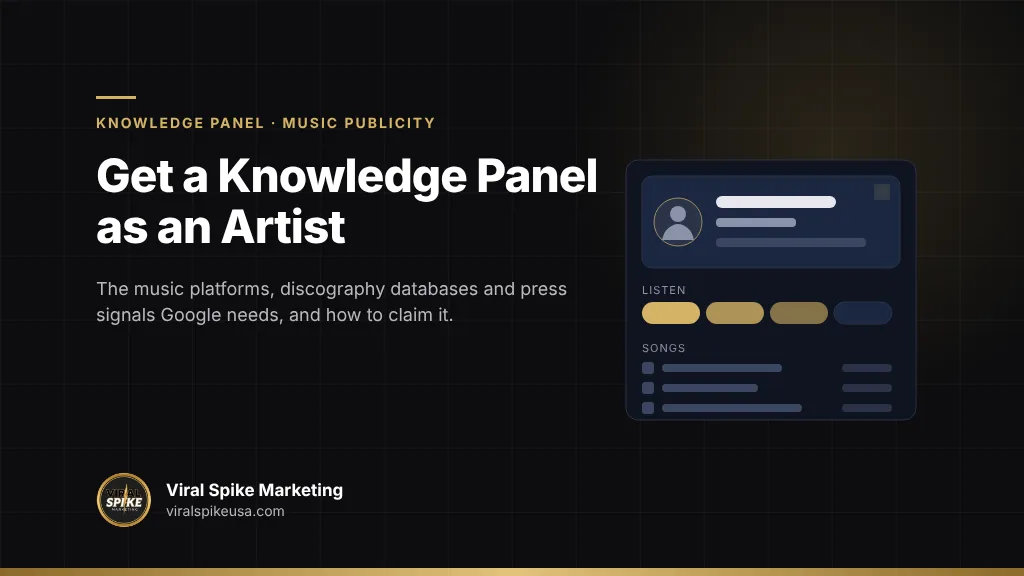
To get a Google knowledge panel as an artist, you need Google’s Knowledge Graph to recognize you as a distinct musical entity with a discography, which is a different problem from the one a CEO or author faces. Google assembles artist panels largely from music data: releases delivered by your distributor to Spotify, Apple Music and YouTube Music, a verified YouTube Official Artist Channel, structured records on MusicBrainz and Wikidata, and a description drawn from an authoritative third-party source, usually Wikipedia or press coverage. The practical sequence is: claim Spotify for Artists and Apple Music for Artists so your name, image and releases are consistent; get a YouTube Official Artist Channel so Google’s own video platform treats you as one artist; create or correct your MusicBrainz and Wikidata records so the open databases agree; earn press coverage that describes you the same way; then claim the panel through Google’s verification flow once it appears and use the Suggest edits tool to fix the photo, subtitle and links. Google decides automatically whether a panel shows, and no one can create one on request, but artists with releases on the major services get panels far more often than people in most other fields.
Key takeaways
- An artist panel differs from a person panel: it carries songs, albums, listen links and events, and much of that comes from music platform data rather than from Wikipedia.
- Spotify for Artists, Apple Music for Artists and a YouTube Official Artist Channel are the first three claims to make. Each has its own eligibility rules and review time.
- MusicBrainz and Wikidata are the open databases Google and the platforms read; an artist record with no releases or links on MusicBrainz is automatically removed, and Wikidata requires “serious and publicly available references.”
- Google verifies panel owners through YouTube, Search Console, X or Facebook, and verified users can suggest edits, replace the featured image and add social links; Google will not write a custom description.
- Press coverage is what makes the description accurate and makes the entity resolve. Without independent sources, a panel can appear with wrong facts or not at all.
What is different about an artist knowledge panel?
A knowledge panel for a person, covered in how to get a Google knowledge panel for a person, is mostly biography: name, occupation, a description sourced from Wikipedia or a similar authority, social profiles and a photo. A panel for a company, covered in the business version, adds founders, headquarters and stock data. A musical artist panel is built around a catalog. It typically shows top songs and albums, a row of listen buttons that open the artist on streaming services, upcoming events where a ticketing partner supplies them, and the same description, images and social links as a person panel.
That changes where the data comes from. Song and album entries are matched to releases the services received from your distributor; the listen buttons depend on Google recognizing that the Spotify artist, the Apple Music artist and the YouTube channel are one entity; images are often pulled from YouTube and the platforms; the description still needs an outside source. A person can sometimes get a panel from a Wikipedia article alone. An artist usually gets one because the discography data lines up across several databases, with or without Wikipedia. The flip side is more places for things to go wrong: a stage name shared with another act, two Spotify profiles, or a MusicBrainz record pointing at someone else’s releases can produce a merged or wrong panel. The order below fixes those problems: platforms, open databases, press, then claiming and correcting.
Which sources feed an artist panel?
Google does not publish a list, but these are the sources it names in its help pages, links visibly from the panel, or that the industry treats as the record of artist identity.
| Source | What it supplies | How you control it |
|---|---|---|
| Your distributor’s metadata | Artist name, release titles, dates, artwork and ISRC/UPC codes sent to every service, including YouTube Music | Use one exact spelling of your artist name on every release; fix errors through the distributor, not the platforms |
| Spotify for Artists | Verified artist profile, bio, images, social links, Artist Pick, concerts | Claim through the request form or instantly via a preferred distributor; manual review “can take a few days” |
| Apple Music for Artists | Artist image, which also feeds Shazam; catalog on Apple Music; bio supplied by Xperi | Claim with an Apple Account; content must be live for five business days; primary artist only |
| YouTube Official Artist Channel | Consolidated channel Google treats as the artist; images and videos surfaced in Search | Requested by your label, distributor or a listed music service partner once you meet the criteria |
| MusicBrainz | Open artist record with type, area, dates, relationships and links to every other profile | Anyone with an account can add or edit; disclose in the edit note if you are the artist |
| Wikidata | Structured entity with identifiers (Spotify ID, Apple Music ID, MusicBrainz ID, ISNI) that machines reconcile against | Must meet notability; the item needs “serious and publicly available references” |
| Wikipedia | The description Google prefers when an article exists | Only if independent coverage establishes notability; never write it yourself |
| Press coverage and official site | The description when no Wikipedia article exists; confirmation of facts; images | Earn consistent coverage; publish a plain bio page and verify the site in Search Console |
The common thread is consistency. Your name, genre, city, years active, members and official links should read identically on every row of that table before you expect Google to draw them together.
Step one: claim the platform profiles
Spotify for Artists
Spotify’s access guide lists four routes: submit the request form with a link to your website or social channels for manual review, which “can take a few days”; get instant access when you request it through a preferred distributor; be invited by the admin of an already-claimed profile; or, before a first release, contact support with your artist URI and the release’s UPC. Once inside, Spotify’s profile guide lets you add artist images, write a bio, add social links, set an Artist Pick, feature a playlist, manage concerts and merch, and upload visuals. It is the profile most other systems check first. A claimed profile matters beyond the panel too, since those streams are the units counted in how the Billboard charts are calculated.
Apple Music for Artists
Apple’s claim process requires an Apple Account, a link to your artist page, and that your content has been live on Apple Music for at least five business days. You must hold the primary artist role on an album; featured artists cannot claim, and label representatives must work with the artist. Signing in to social or distributor accounts speeds verification, and Apple’s FAQ says to contact support if more than 10 business days pass without word. Two details matter for the panel: the artist image you submit also appears on your Shazam artist page, and biographies on Apple Music come from Xperi, so a bio update goes to Xperi rather than Apple. If another artist’s albums appear on your page, Apple’s FAQ says to contact support under “Artist Catalog Issues”; left alone, that merge is the kind of signal that produces a merged knowledge panel.
YouTube Official Artist Channel
An Official Artist Channel (OAC) merges your topic channel, any Vevo channel and your own channel into one that YouTube treats as the artist. According to YouTube’s eligibility page, you need to own and operate a channel focused on a single artist’s music, have at least one official release on YouTube delivered by a music distributor or label, comply with YouTube’s policies, and either work with a YouTube partner manager, be in the Partner Program, be in a label network, or have your music distributed by a partner listed in the YouTube Services Directory. You do not apply directly: your label, distributor or a music service partner requests it. Because YouTube is one of the accounts Google accepts for panel verification, the OAC is the single most useful claim for the panel itself.
Step two: MusicBrainz and Wikidata
MusicBrainz is the open music encyclopedia that many services and tools, including the platforms’ own matching systems, use to reconcile artist identities. Its guide to adding an artist asks for a name, a sort name, a disambiguation comment when another artist shares the name (for example, “British metal band”), a type (person, group, orchestra and so on), the area where a person was raised or a group formed, begin and end dates, optional IPI and ISNI identifiers, and relationships such as group members and URLs. Two rules matter: an artist with no relationships or releases is automatically removed, so add releases and official links in the same session; and if you are the artist, say so in the edit note. Check for an existing record first; a stale duplicate pointing at another act’s releases is a common cause of a wrong panel.
Wikidata is the structured database behind Wikipedia, and its items carry the identifiers that let machines confirm that the Spotify artist, the Apple Music artist, the MusicBrainz record and the YouTube channel are one entity. Wikidata’s notability policy allows an item if it has a valid link to a Wikipedia-family page, or if it refers to “a clearly identifiable conceptual or material entity” that can be described using “serious and publicly available references,” or if it fills a structural need. For an artist without a Wikipedia article, the second criterion is the route, which is why press coverage comes next: the references have to exist before the item is defensible. An item referenced only by your own site and socials is likely to be deleted.
Wikipedia itself is optional and should not be forced. Writing an article about yourself, or paying for one that lacks independent coverage, tends to end in deletion and a public record of the attempt. Many working artists have panels without one because the platform and MusicBrainz data are sufficient.
Step three: press coverage and a site Google can read
Google’s knowledge panel help says the description comes from outside sources and cannot be edited directly; if it is wrong, you contact the source first, and Google may remove an inaccurate description but “won’t write a custom one.” The subtitle (for example, “American rapper”) is generated automatically, and Google does not accept custom subtitles. The two lines most artists care about are written by the web, not by you.
For an artist that means coverage in outlets Google already trusts, describing you consistently: the same genre descriptor, the same city, the same origin story, the same spelling. Interviews, premieres, reviews and features in music and culture publications all qualify, and they double as the references a Wikidata item or future Wikipedia article will need. How coverage is earned over a release cycle is covered in how music PR builds lasting visibility for artists, and which outlets are realistic is covered in how to get featured in Billboard, Rolling Stone and Complex.
Your official website matters because it is one of the accounts Google uses to verify who controls the entity. Publish a bio page with your name in the title, a current photo with your name in the file name and alt text, your discography with dates, and links to every official profile, then verify the domain in Google Search Console. Add Person or MusicGroup schema with a sameAs list of your Spotify, Apple Music, YouTube, MusicBrainz and Wikidata URLs; it is not a trigger, but it tells Google which profiles belong together.
How to claim the panel
Once a panel appears, claim it. Google’s verification guide says to sign in to a Google Account, search for your artist name, find the panel and click “Claim this knowledge panel,” then sign in to one of the official accounts Google lists: YouTube, Search Console, X or Facebook. This is why the Official Artist Channel and a verified website are worth setting up before the panel exists; they are the credentials. If Google cannot find associated accounts, it asks for more information, and not every panel is claimable yet.
| Situation | What Google’s help pages say to do |
|---|---|
| You see “Someone is already managing the account” | Submit changes through Feedback, or use Account Recovery: Google shares your email with the current owners, waits 3 business days, and makes the panel claimable again if no one responds |
| Your manager or label needs access | Add them in Contributor studio as Manager (can suggest edits and add or remove users) or Contributor (suggest only); only the Owner can transfer ownership |
| An X or Facebook account is linked that should not be | Associations are stored automatically after verification; remove one through Webmaster Central with Unverify |
| The panel shows another artist’s profile or mixed-up content | Use the help form for mixed-up content; fix the underlying platform merge in parallel, or the error returns |
Claiming does not give you an editor. It gives your feedback priority and unlocks Suggest edits, plus some direct changes such as social profile links. Google’s policy is that automated systems decide whether panels appear or disappear; it does not manually create or delete them.
How to fix a wrong photo, bio, subtitle or merged artist
Signed in with the verified account, search your name and click Suggest edits at the top of the panel. Submit each suggestion separately, describe what is wrong, and include public URLs that support the change. Google checks suggestions against other public web information and says verified users usually get a resolution within a few days by email.
- Wrong or outdated featured image. If the panel already has an image, you can suggest a replacement by supplying a direct image URL (ending in .jpg or .png, publicly accessible, not the page the image sits on). The image must represent you and must not be an ad. If the panel has no image, Google says it cannot add one on request; put strong, correctly named images on your site, YouTube channel and platform profiles and wait.
- Wrong description. Contact the source first (the publication, or Wikipedia’s talk page if the article is the source). If that fails, submit feedback with strong evidence. Google may remove the description; it will not write one.
- Wrong subtitle. Flag it as inaccurate. The system may replace it. Subtitles describing a family, spouse or romantic relationship can be removed on request, as can date of birth, relationships and similar personal items.
- Another artist’s songs in your panel. This is almost never fixable inside the panel. It is a platform-level merge: two artists sharing a Spotify or Apple Music page, or a MusicBrainz record with the wrong releases. Fix it at Spotify for Artists and Apple Music support, add a disambiguation on MusicBrainz, have your distributor use a distinct artist ID, then submit panel feedback pointing to the corrected profiles.
- Missing listen buttons or a missing service. Confirm the release is live on that service under the exact artist name, that the platform profile is claimed, and that the MusicBrainz and Wikidata records carry that service’s artist ID. Listen links follow entity resolution; they are not requested.
Items such as “People also search for” are removed only if they violate Google’s policies, and Google may decline any change it cannot confirm. If the problem is reputational rather than factual, an old controversy dominating the description for example, that is a search reputation project, not a panel edit.
Why artist panels do not appear, and how long it takes
There is no submission form and no fixed timeline. Panels appear when Google’s systems are confident the entity is distinct and well described, and they can disappear if that confidence drops. The usual causes of a missing or unstable panel:
| Symptom | Likely cause | Fix |
|---|---|---|
| No panel despite releases on every service | Name collision with a better-known artist, brand or common word; no independent description source | Add disambiguation on MusicBrainz and Wikidata, earn coverage that uses your name plus genre and city, keep the exact spelling everywhere |
| Panel appears, then vanishes | Conflicting data: a second Spotify profile, a renamed YouTube channel, a merged Apple Music page | Resolve the platform conflict, then reclaim and submit feedback |
| Panel shows songs but no description or photo | Discography resolved; no trusted biographical source | Press coverage and a verified official site with a bio page; consider Wikidata once references exist |
| Panel shows the wrong person | Entity confusion with someone sharing the name | Platform-level fixes first; then the mixed-up content help form |
Expect weeks between a corrected signal and a visible change, and months for a new entity to be assembled from scratch. Artists who release through a distributor and claim the three platform profiles often see a basic panel with songs and listen buttons within one or two release cycles; the description, the right photo and a stable panel follow the coverage. The payoff goes beyond Google: the same resolved entity is what ChatGPT, Gemini and Perplexity read when someone asks who you are, as explained in what generative engine optimization is.
Where Viral Spike fits
Viral Spike treats an artist’s knowledge panel as an entity project with three layers: the platform and database records that establish who you are, the coverage that describes you, and the claim and corrections that keep the panel accurate. Our music promotion service earns the interviews, premieres and features that give Google and the open databases their references, and our brand authority work aligns the bio, images and identifiers across Spotify, Apple Music, YouTube, MusicBrainz, Wikidata and your site. Where a specific outlet is needed to anchor the description, we use guaranteed editorial placements across 1,600+ outlets: you approve the draft, the article is published and indexed on Google, and the engagement is refunded in full if it never runs. For a panel that shows the wrong artist, an old controversy or an outdated photo, our reputation management service handles the corrections and the search results around them. No one can create a panel on request, and we do not claim to; what we control is every input Google reads. Contact us with your artist name and we will audit how each source currently describes you.
Run the five-source check this week
Search your artist name on Spotify, Apple Music, YouTube, MusicBrainz and Google, and write down what each shows for your name, image, genre, location and releases. Every mismatch is a reason the panel is missing, wrong or unstable. Claim the three platform profiles, fix the MusicBrainz record, verify your site in Search Console, then decide whether coverage is the remaining gap. The panel is a mirror of that list.
Frequently asked questions
How do I get a Google knowledge panel as a musician?
Release music through a distributor to Spotify, Apple Music and YouTube Music under one exact artist name, claim Spotify for Artists and Apple Music for Artists, have your distributor request a YouTube Official Artist Channel, create or correct your MusicBrainz record and, once references exist, a Wikidata item, and earn press coverage that describes you consistently. Google’s systems then decide automatically whether to show a panel; there is no application form.
Can I claim my artist knowledge panel?
Yes, if Google has made it claimable. Sign in to a Google Account, search your name, click “Claim this knowledge panel,” and verify by signing in to an official YouTube, Search Console, X or Facebook account associated with you. Verified owners get priority on edit suggestions, can replace the featured image, add social links, and add managers or contributors through Contributor studio. Google notes that not all panels are claimable yet.
Why does my knowledge panel show the wrong photo?
The image is selected automatically from sources such as your YouTube channel, platform profiles and press. If a panel already has an image, a verified owner can suggest a replacement by submitting a direct, publicly accessible image URL ending in .jpg or .png that represents you and is not an ad. If there is no image at all, Google says it cannot add one on request; improve the images on your official profiles and site instead.
Do I need a Wikipedia page to get an artist knowledge panel?
No. Many artists have panels built from streaming platform data, a YouTube Official Artist Channel and MusicBrainz records without a Wikipedia article. Wikipedia helps most with the description, which Google draws from an outside source and will not write itself. If you lack an article, consistent press coverage and a verified official site with a bio page serve as the description source. Do not write your own article; it will likely be deleted.
How is an artist panel different from a person panel?
An artist panel is organized around a discography: top songs, albums, listen buttons to streaming services and sometimes events, in addition to the description, images and social links a person panel has. Its data comes mainly from music platforms and open databases such as MusicBrainz and Wikidata rather than from a biography alone, so the fixes are different too. A wrong song list is usually a platform merge, not a Google error.
How long does it take for an artist knowledge panel to appear?
There is no set timeline because Google’s systems create panels automatically. Artists releasing through a distributor who claim their Spotify, Apple Music and YouTube profiles often see a basic panel within one or two release cycles; a description and a stable photo follow once independent coverage exists. Corrections submitted by a verified owner are usually resolved within a few days, but changes that depend on new sources take weeks to months.
Sources
Primary sources referenced in this article, in order of first use.
- access guide (support.spotify.com)
- profile guide (support.spotify.com)
- claim process (artists.apple.com)
- FAQ (artists.apple.com)
- YouTube's eligibility page (support.google.com)
- guide to adding an artist (musicbrainz.org)
- notability policy (m.wikidata.org)
- knowledge panel help (support.google.com)
- verification guide (support.google.com)

More in Music Publicity
 How to Get Featured in Billboard, Rolling Stone and Complex: Editorial Pitches, Paid Sections and Guaranteed Placements
 How the Billboard Charts Work: Hot 100, Billboard 200 and Genre Charts Explained (and What It Takes to Get On Them)
 Before Hiring a Music Publicist: Budget, Timing, and Readiness Checklist
Related services