
How to Get Featured in Billboard, Rolling Stone and Complex: Editorial Pitches, Paid Sections and Guaranteed Placements
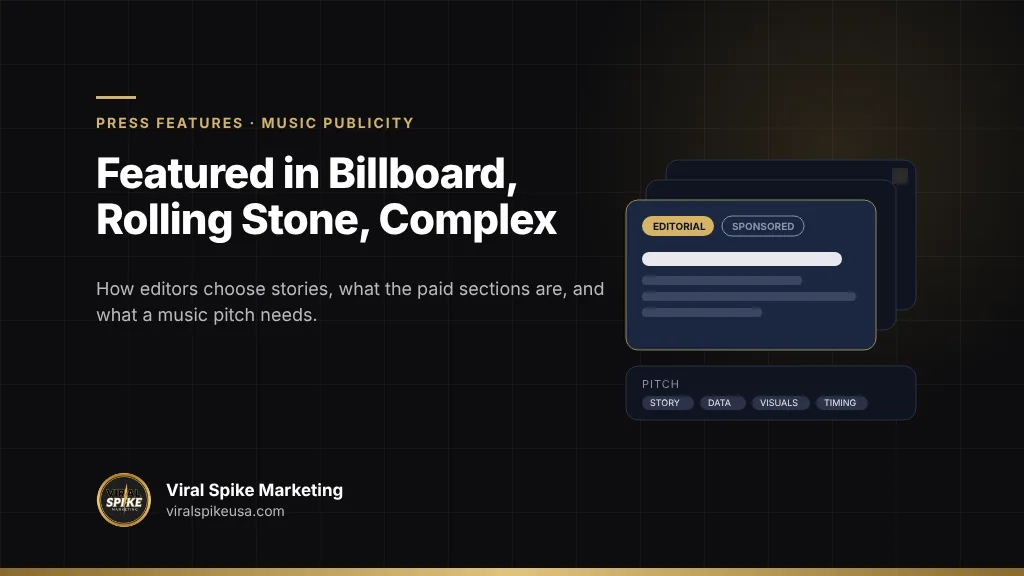
To get featured in Billboard, Rolling Stone or Complex you need one of three things: a story an editor wants to tell, a place in one of the outlet’s paid or member-contributed sections, or a guaranteed editorial feature arranged through an agency and approved by you before it runs. Editorial coverage is earned by pitching the right person at the right time with a story that has news value, numbers that prove momentum, visuals ready to run, and a date that fits the outlet’s calendar. Paid routes exist at each outlet and are clearly separated from editorial: Rolling Stone runs a vetted, fee-based Culture Council whose articles carry a Culture Council label, Billboard has operated a branded content studio since 2015, and Complex has produced branded content for major advertisers for more than a decade. None of these buys a review or a news story. For an independent artist the realistic path is a ladder: genre and regional outlets first, then the music verticals of the big three, with data from a growing audience as the proof. Guaranteed placements fill a specific gap, a credible article you approve, published and indexed, with a full refund if it never runs, and they should be understood for what they are rather than confused with a cover story.
Key takeaways
- All three outlets accept tips at public addresses, and their editors say the same thing: know the outlet, tailor the pitch, lead with the hook, and do not send rewritten press releases.
- Paid and member sections are real but labeled. Rolling Stone’s Culture Council charges membership dues, requires $500K in revenue or $1M in funding, and marks its articles as non-editorial.
- A music pitch needs four things: a story beyond “new single out Friday,” data (streams, sales, ticket counts, playlist adds), ready-to-run visuals, and timing that gives the writer room.
- Independent artists reach these outlets by building a documented trail in smaller outlets first; editors say to start smaller and build up.
- Guaranteed placements are a different product: you approve the draft, it is published and indexed, and you are refunded in full if it never runs. They support credibility, search results and AI answers; they do not replace earned editorial.
How do Billboard, Rolling Stone and Complex decide what to cover?
Each outlet publishes a public route in. Rolling Stone’s contact page directs press releases, story ideas and news tips to tips@rollingstone.com. Billboard’s contact page lists tips@billboard.com for editorial and a separate advertising contact. Complex’s contact page invites news tips through a message form. Those inboxes are read, but they are the lowest-probability route, because the decision is made by section editors and staff writers who are looking for stories that fit what they already cover.
What those editors want is not a secret. At a Billboard panel at Canadian Music Week in 2024, reported by Billboard Canada, editor Richard Trapunski said to “know who you’re pitching to, read some of the stories that have been on” the publication, that the outlet wants “solid story pitches that are well-tailored,” and that the hook belongs in the subject line: “Make me pay attention right away.” He added that the outlet is not in the business of printing rewritten press releases, and that who sends the pitch matters less than the pitch: “if it’s a story, it’s a story.” A publicist on the same panel advised against mass-emailing 50 outlets and against aiming at the biggest targets first.
The three outlets differ in what counts as a story. Billboard is a trade and chart publication: it covers business moves, chart milestones, signings, touring data and industry trends, so a pitch with numbers and a business angle fits. Rolling Stone is a culture magazine: it covers artists with a narrative, a scene, a political or cultural angle, and it reviews and profiles. Complex, which NTWRK acquired from BuzzFeed in 2024, covers youth culture across music, sneakers, style, sports and food, with deep roots in hip-hop; a pitch that connects a record to streetwear, a city, a sneaker drop or an internet moment fits Complex in a way it would not fit Billboard. Pitching the same angle to all three is the most common mistake we see.
Editorial, member and sponsored sections: what each label means
Every major music outlet now has more than one kind of article, and readers, Google and AI assistants treat them differently. Understanding the labels keeps you from paying for one thing while believing you bought another. The distinction also decides which articles Google will treat as a source when it builds or corrects an artist knowledge panel.
| Route | Who writes it | How it is labeled | What it costs | What it signals |
|---|---|---|---|---|
| Editorial feature, review or news story | Staff writer or assigned freelancer | Ordinary byline, no disclosure | Nothing; earned through pitching | Independent judgment that you are worth covering |
| Member council article (e.g. Rolling Stone Culture Council) | The member, with editorial support from the council | “Culture Council” marker and a disclaimer that a member wrote it | Membership dues | Expertise and access; readers who check the label know it is not editorial |
| Branded or sponsored content | The outlet’s content studio, for an advertiser | “Sponsored,” “Paid content” or similar, as the FTC requires | Advertising rates | A brand campaign, not coverage |
| Guaranteed placement through an agency | A writer working with the agency; you approve the draft | A full editorial article written to the outlet’s standards; published or refunded in full | A fee to the agency; never stated here | A credible, indexed article you control the facts of |
Rolling Stone’s Culture Council is the clearest example of a member route. Its qualification page requires a founder, C-level or senior role at a company with at least $500K in annual revenue or $1M in institutional funding, or an equivalent track record as a paid speaker, published author or regular contributor to an industry publication, and notes that acceptance is decided by a selection committee. The council’s dues page lists annual membership tiers plus a one-time initiation fee. When the program drew press scrutiny in 2021, a Penske Media spokesperson told InsideHook that council content “exists in its own channel separate from editorial content,” and the articles carry a Culture Council marker rather than a regular byline. It is a legitimate way for an executive or artist-entrepreneur to publish under the Rolling Stone banner; it is not a Rolling Stone feature about you. The same distinction applies at Forbes, explained in Forbes contributor vs Forbes Councils vs Forbes feature.
Billboard’s paid route is advertising. In 2015 Billboard and The Hollywood Reporter launched Adapt Studios, described by MediaPost as “a branded content division that will help brands reach consumers in entertainment and music contexts.” Complex’s branded content business is older still; a 2013 Digiday profile cited in Complex’s Wikipedia entry had it producing around 47 branded pieces a month for advertisers such as adidas and Levi’s. Both are built for brands with campaign budgets, and both are labeled. The FTC’s native advertising guide requires that advertising be identifiable as advertising, with a clear disclosure such as “Ad” or “Sponsored Advertising Content” placed where readers look first, and it specifically warns against vague terms like “Promoted.” A studio-made sponsored article about an artist is therefore visibly different from an editorial one, so ask any provider in writing which of the two you are getting before you commit.
What a music pitch needs: story, data, visuals, timing
Editors at these outlets receive far more pitches than they can read. The ones that get opened and assigned share four components.
| Component | What it means in practice | Weak version | Strong version |
|---|---|---|---|
| Story | A reason this matters beyond the release itself: a first, a trend, a conflict, a scene, a business move, a cultural moment | “Rising artist drops new single” | “The producer behind three regional club hits is releasing under his own name, and the city’s radio stations are already playing it” |
| Data | Verifiable numbers that prove momentum | “Going viral” | Streams and listeners from Spotify for Artists, sales from your distributor, tickets sold, playlist adds, radio spins, with screenshots available |
| Visuals | Assets an editor can publish today | A phone photo and a link to a private video | Hi-res press photos with credits, cover art, an embeddable video or stream, a one-page EPK |
| Timing | Enough lead time for the writer, aligned to a hook | Pitching the day of release | Premieres offered 3 to 6 weeks out under embargo; news pitched the day it is announceable; features tied to a tour, a chart result or a cultural moment |
Two practical notes. First, data is what moves a Billboard pitch from ignored to assigned, because Billboard’s own coverage is built on it; if your numbers are small, pitch the story to an outlet where the story carries it and bring the numbers to Billboard later. Second, the subject line does the work. A writer deciding whether to open an email sees a name and twelve words; put the hook there, not your artist name. How the chart data behind a strong pitch is built is in how the Billboard charts work.
Realistic paths for an independent artist
Most independent artists will not land a Rolling Stone profile on their second single, and a pitch that asks for one signals inexperience. The route that works is a ladder with documented steps, because each rung becomes evidence for the next.
- Local and genre press. City outlets, genre blogs, college radio and local TV cover artists with a local hook and little else. These are the first clips, and they are what you link in the next pitch.
- Regional and genre sections. Billboard runs international editions such as Billboard Canada and genre sections (Latin, country, R&B/hip-hop, dance) with their own editors and a narrower field than the main site. Complex’s music section runs premieres and lists that include developing acts. These are the first realistic targets at the big three.
- Chart and data milestones. A component or genre chart entry, a documented streaming milestone, a sold-out hometown show or a notable playlist add gives a Billboard writer a news hook that is already in their language.
- A narrative feature. Once there is a trail of coverage and numbers, a Rolling Stone or Complex feature pitch has what it needs: a story with proof. This is usually a year or more into a serious campaign, not a month.
A publicist’s value on this ladder is relationships and judgment: knowing which editor covers your lane, what they ran last month, and when an exclusive will land. Whether you are ready to pay for that is covered in before hiring a music publicist: budget, timing and readiness, and what a real strategy looks like in hip-hop specifically is in what a real rap PR strategy does.
Timing a pitch to the release cycle
Outlets plan ahead, and the same story has different value at different points in the cycle. A workable calendar for a single or project:
| When | What to pitch | To whom |
|---|---|---|
| 8 to 10 weeks before release | Exclusive premiere or first-listen offers, under embargo; long-lead feature ideas | Section editors at genre verticals; one outlet per exclusive |
| 4 to 6 weeks before | Announcement news (release date, tour, signing) with art and a quote; premiere confirmed | News desks; the outlet that accepted the premiere |
| Release week | Reviews, interviews, “new music Friday” roundups, video premiere | Writers who covered the announcement; roundup editors |
| 2 to 8 weeks after | Data stories: chart entry, streaming milestone, sold-out dates; trend pieces that include you | Chart and business writers at Billboard; culture writers at Complex and Rolling Stone |
Exclusives are the currency of the pre-release window. Offer one outlet the premiere, honor the embargo, and do not shop the same exclusive elsewhere; editors talk, and a broken exclusive closes doors. After release, the story shifts from the music to what happened, which is why the data layer matters even to artists who think of themselves as purely creative.
How guaranteed placements differ from editorial pitches
A guaranteed placement is a different product from an earned feature, and it is worth being precise about the difference. In an editorial pitch, you offer a story and the outlet decides whether, when and how to run it; you do not see the draft, and the writer may frame you in ways you did not expect. In a guaranteed placement arranged through an agency, the outlet and the slot are agreed in advance, you approve the draft before it runs, the article is published and indexed on Google, and if it never runs the engagement is refunded in full. The facts are yours; the outlet’s policy decides the label.
Three honest limits. First, a guaranteed placement is not a Billboard cover story or a Rolling Stone profile, and it will not be presented as one. The publications available through these programs range from major business and lifestyle titles to music and culture sites, and each has its own labeling policy, which a reputable agency will tell you before you commit. Second, the value is credibility, search and AI visibility rather than a direct audience spike: an indexed article in a recognized outlet becomes a source for your Google knowledge panel, a citation for ChatGPT and Perplexity, and a credential in the next editorial pitch. Third, the guarantee names exactly what is delivered — the published, indexed article — and chart positions, playlist adds and radio spins are not sold as part of it.
The right use is as a foundation under an editorial campaign, not instead of one. An artist with no coverage anywhere is hard to pitch; an artist with a handful of indexed, accurately written articles in recognized outlets is easier to assign, because the writer can see a trail. How to tell a real program from a fake outlet is covered in how to verify a publication is real before you pay for press, and the longer-term effect of coverage is in how music PR builds lasting visibility for artists.
Mistakes that get music pitches ignored
- Pitching the wrong desk. A business story sent to a reviewer, or a culture story sent to the chart team, dies unread. Read the last ten pieces by the person you are emailing.
- No hook in the subject line. “New single from [artist]” is not a hook. The unusual fact is.
- Attachments and private links. Large files get filtered; private SoundCloud links expire. Use a streaming link that works without a login and a hosted EPK.
- Claims without evidence. “Viral” and “buzzing” without numbers reads as nothing. Attach the Spotify for Artists screenshot.
- Mass emails. A pitch addressed to no one is treated as spam at every outlet. Fifty personalized pitches beat five hundred identical ones.
- Breaking an embargo or double-booking an exclusive. This is the one mistake that is remembered.
- Following up every day. One follow-up after four or five working days, then move on.
- Confusing paid sections with coverage. Publishing a council article or a sponsored post and then describing it as “featured in” is caught quickly by anyone who clicks, including editors you pitch later.
Where Viral Spike fits
Viral Spike runs both sides of this. Our music promotion service handles the earned side: identifying the lane, building the story and data package, pitching the editors who cover it, placing premieres and interviews, and timing everything to the release calendar above. Our guaranteed press placements handle the foundation: editorial-style articles across 1,600+ outlets where you approve the draft, the article is published and indexed on Google, and the engagement is refunded in full if it never runs. We tell you how each outlet labels its content before you commit, we never describe a placement as something it is not. The outlets available are listed on our publications page. If you want a plain read on which path your release qualifies for right now, contact us with a streaming link and your current numbers.
Write the hook before you write the pitch
Open a document and write one sentence that would make a stranger at Billboard, Rolling Stone or Complex stop scrolling: not that you have a release, but what is unusual about it. If you cannot write that sentence, the pitch is not ready, and the work is to create the fact it describes, whether that is a chart entry, a sold-out room, a collaboration or a story only you can tell. Then find the one editor whose last month of work proves they would care, and send them that sentence with the numbers and the assets behind it.
Frequently asked questions
How do you get featured in Billboard?
Pitch a Billboard editor who covers your lane with a story that has news or business value, verifiable data such as streams, sales, ticket counts or chart results, ready-to-run visuals, and enough lead time. Billboard accepts tips at tips@billboard.com, but assigned stories come from tailored pitches to section and vertical editors. Billboard’s paid route is advertising and branded content through its content studio, which is labeled and separate from editorial.
Can you pay to be in Rolling Stone?
Not for an editorial feature. Rolling Stone’s Culture Council is a fee-based, vetted membership that lets qualifying executives and founders publish articles on RollingStone.com under a Culture Council label, which Penske Media describes as separate from editorial content. Membership requires at least $500K in company revenue or $1M in funding, or an equivalent speaking or publishing record. Editorial stories are pitched to tips@rollingstone.com and chosen by editors.
How do independent artists get featured in Complex?
Complex covers youth culture at the intersection of music, sneakers, style and sports, with deep hip-hop roots, so the pitch should connect the music to that world: a city scene, a fashion or sneaker tie-in, an internet moment or a collaboration. Start with Complex’s music vertical, premieres and lists, bring numbers and visuals, and send a personalized note through the contact form or to the writer who covers similar artists.
What should a music press pitch include?
A subject line with the hook, two or three short paragraphs that explain why the story matters now, verifiable numbers from Spotify for Artists, your distributor or ticketing, a streaming link that works without a login, hi-res photos with credits, cover art, and a one-page EPK link. Pitch premieres three to six weeks out under embargo and news on the day it is announceable. Follow up once after four or five working days.
What is a guaranteed press placement for musicians?
An article arranged through an agency in a pre-agreed outlet, where you approve the draft, the piece is published and indexed on Google, and the engagement is refunded in full if it never runs. It is a full editorial article written to the outlet’s standards, and it is not the same as a feature an editor assigns on their own. Its value is credibility, search visibility and a source for knowledge panels and AI answers, and it works best as a foundation under an editorial campaign.
How long does it take to get press in major music outlets?
Months to years, depending on where you start. Local and genre coverage can come within a release cycle; a regional or vertical Billboard story typically requires documented momentum such as a chart entry or streaming milestone; a narrative Rolling Stone or Complex feature usually follows a year or more of coverage and growth. Editors advise starting smaller and building up rather than pitching the largest targets first.
Sources
Primary sources referenced in this article, in order of first use.
- contact page (rollingstone.com)
- contact page (billboard.com)
- contact page (complex.com)
- Billboard Canada (ca.billboard.com)
- qualification page (council.rollingstone.com)
- dues page (council.rollingstone.com)
- InsideHook (insidehook.com)
- MediaPost (mediapost.com)
- Complex's Wikipedia entry (en.wikipedia.org)
- native advertising guide (ftc.gov)

More in Music Publicity
Related services