You Got Featured. Now What? ROI From a Media Placement
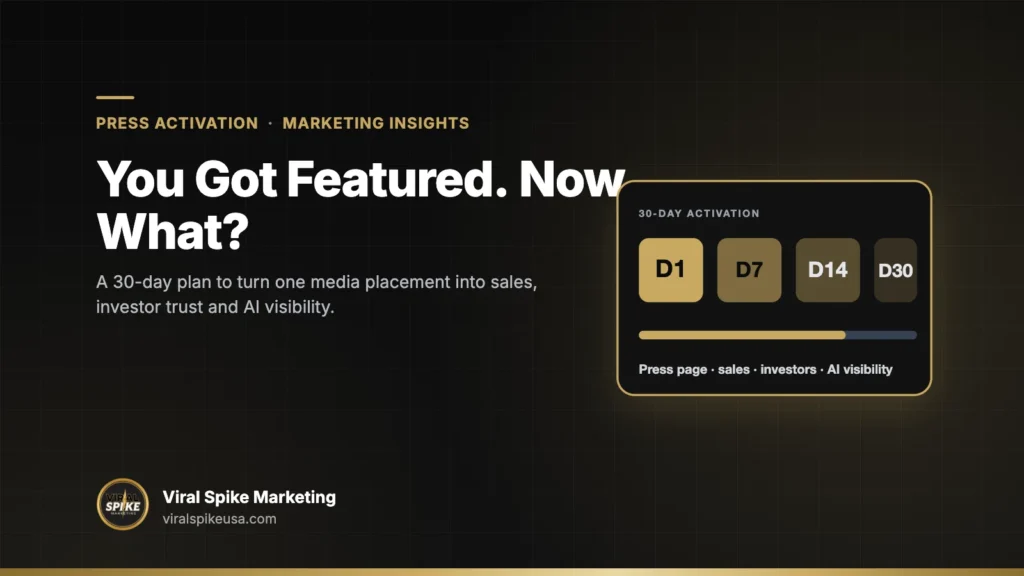
After getting press coverage, the return comes from what you do in the next 30 days, not from the article itself. Most features are read heavily for two or three days and then fade, so the job is to move the credibility into places where it keeps working: your website, your sales process, your founder profiles, your investor conversations, and the sources that Google and AI assistants read when they describe you. This guide lays out that 30-day activation plan, a checklist you can hand to your team, and the handful of things you must not do, starting with never presenting a sponsored feature as earned editorial.
Key takeaways
- A feature’s value decays fast unless you republish its credibility across your own channels within the first month.
- The highest-return uses are a press page with an as-seen-in bar, sales collateral, founder LinkedIn posts and investor or partner outreach.
- Paid amplification can extend reach, but ad platforms prohibit implying an endorsement or affiliation you do not have, so promote accurately.
- Correct entity facts in the article feed Google’s Knowledge Panel sources and the pages AI assistants cite.
- Sponsored coverage must keep its disclosure wherever you share it; the FTC says disclosures should travel with republished native ads.
What should you do after getting press coverage?
Start by capturing the asset, then distribute it in a deliberate order: owned channels first (press page, site, email signatures), then sales and investor channels, then social and paid amplification, then the slower entity and SEO work. That order means every later step points back to a page you control.
Before anything else, do four things on day one:
- Save a PDF and full-page screenshot of the live article, including the URL, date and any sponsored or contributor label.
- Confirm the facts about you in the piece are correct: legal name, title, company name, location, founding year, product description.
- Ask the publisher or your placement partner for the canonical URL and whether a follow link, image use rights or syndication apply.
- Log the placement in one shared document with the outlet, date, URL, label type and the audience it reaches.
If anything factual is wrong, request a correction immediately. Errors that stay live get copied into bios, databases and AI answers.
The 30-day activation plan
The plan below assumes one feature. If you have several, run the same sequence and stack them on the press page.
Week one: your website and owned channels
Build or update a press page. It should list each feature with the outlet logo, headline, date, a one-sentence summary and a link to the original. Mark sponsored or contributed pieces accurately. Add an as-seen-in bar near the top of your homepage and on key landing pages; the guide on how as-seen-in media badges turn visitors into customers covers placement and design.
Then push the credibility into daily touchpoints:
- Email signatures for founders and sales staff: one line, “Featured in [Outlet],” linking to the press page.
- Website footer or about page: a short press strip.
- Proposal and pitch deck templates: a credibility slide with the outlet logo and a pull quote.
- Customer onboarding and welcome emails: one mention with a link.
Week two: sales, investors and partners
A feature is most valuable in a conversation where trust is the bottleneck. Give your sales team a one-paragraph summary and a link they can drop into follow-ups. Add the piece to the objection-handling section of your playbook for prospects who ask “who else knows about you.”
For investors and partners, send a short, personal note rather than a mass email: what the article says, why it matters for the business right now, and one clear ask (a meeting, an intro, a renewal conversation). If you are in or approaching a raise, add the feature to your data room and the “traction and recognition” slide.
Update speaker kits, podcast one-sheets, conference bios and award applications, since organizers and juries scan for third-party recognition.
Week three: founder and company social
LinkedIn is where a feature earns the most organic attention for B2B founders. Post from the founder’s personal profile first, then from the company page a day or two later. The founder post should tell the story behind the story: what the article got right, what you learned, one useful takeaway for your audience, and a link in the first comment or the body depending on what performs for you. Tag the outlet and, if the piece is earned, the journalist.
Repurpose the article into a short carousel or a series of quote graphics over the following two weeks; a single link post fades within a day.
Week three: paid amplification, done honestly
Running ads that point to the article can extend reach to cold audiences at lower cost than sending them straight to a product page, because the outlet’s credibility does the warming. Two guardrails. First, respect the outlet’s terms about republishing content; link to the article or your press page rather than copying it. Second, describe the coverage accurately. Google’s misrepresentation policy states that “making misleading statements, obscuring, or omitting material information about your identity, affiliations, or qualifications is not allowed,” and specifically prohibits making it “seem like you’re supported by another brand, organization or government entity when you’re not.” Meta’s advertising standards likewise prohibit misrepresenting “an entity, industry association or news outlet” to mislead people. An ad that says “Featured in Forbes” for a labeled sponsored piece, with the label intact at the destination, is accurate; an ad implying the outlet endorsed your product is not.
Ad platform policies change and are enforced case by case, so review the current policy for each platform before you launch.
Week four: entity, SEO and AI visibility work
This is the slow-compounding part, and the part most companies skip.
Google Knowledge Panel and Google Business Profile: Google explains that knowledge panels are automatically generated from “various sources across the web” and update “as information changes on the web.” A feature in a recognized outlet that states your name, role and company correctly is exactly the kind of corroborating source that helps. Make sure the article’s facts match your website’s about page, your LinkedIn, and your Business Profile. For people, the step-by-step is in the guide to getting a Google Knowledge Panel for a person.
Wikipedia: only if you genuinely qualify. Wikipedia’s editors judge notability on independent coverage, and paid or sponsored articles are treated very differently from earned reporting, so one feature rarely changes the answer. Read whether you qualify for a Wikipedia page before anyone on your team touches it.
SEO reuse: link to the press page from your homepage, about page and relevant service pages so it accumulates internal authority. Add Organization or Person structured data to the site that lists your official name, URL, logo and social profiles, and reference the press page from your about page. If the feature includes a follow link to your site, point it, where you can, at a page that matters commercially rather than the homepage alone.
AI visibility reuse: AI assistants build their descriptions of your company from what trusted third-party pages say. Muck Rack’s May 2026 analysis of more than 25 million links found earned media accounts for 84% of AI citations and paid or advertorial content for 0.3%, so a sponsored feature is unlikely to be cited directly. Its role is different: it is a clean, published statement of your entity facts (who you are, what you do, where, since when) that reinforces the same facts everywhere else. Make sure those facts are consistent, then read how press coverage gets your brand recommended by ChatGPT for how earned and sponsored coverage play different roles.
30-day checklist
| Day | Action | Owner | Done when |
|---|---|---|---|
| 1 | Save PDF and screenshot; verify facts; request corrections | Founder or PR lead | Archive stored, corrections sent |
| 1 to 3 | Log placement (outlet, URL, date, label type, rights) | Marketing | Entry in press log |
| 2 to 5 | Build or update press page with accurate labels | Marketing or web | Page live, linked from footer |
| 3 to 7 | Add as-seen-in bar to homepage and key landing pages | Web | Bar live on top 5 pages |
| 3 to 7 | Update email signatures, decks, proposals, onboarding emails | Ops or sales | Templates updated |
| 8 to 12 | Brief sales team; add to playbook and follow-up sequences | Sales lead | Sequence includes link |
| 8 to 14 | Personal notes to investors, partners, key customers | Founder | Notes sent, replies tracked |
| 10 to 14 | Update speaker kits, bios, award and podcast applications | Marketing | Kits refreshed |
| 15 to 18 | Founder LinkedIn post, then company page post | Founder or social | Both posts live |
| 15 to 28 | Repurpose into carousel, quote graphics, short video | Social | 3 to 5 assets published |
| 18 to 25 | Launch accurate paid amplification to cold audiences | Paid media | Ads approved and running |
| 20 to 30 | Align Business Profile, about page, LinkedIn with article facts | Marketing | Facts consistent across sources |
| 22 to 30 | Add internal links and structured data referencing press page | SEO or web | Schema validated, links live |
| 25 to 30 | Assess Wikipedia eligibility (only if genuinely notable) | PR lead | Decision documented |
| 30 | Review results: traffic, leads, replies, mentions | Founder | Learnings feed next placement |
How do you measure ROI from a media placement?
Measure three layers: direct, assisted and durable. Direct is what you can attribute to the article: referral traffic, sign-ups or inquiries from the link, and replies to outreach that cited it. Assisted is where the feature helped a deal or conversation move: ask your sales team to tag opportunities where the prospect mentioned it. Durable is the slow stuff: branded search volume, Knowledge Panel changes, whether AI assistants describe you accurately, and the conversion rate of pages that gained an as-seen-in bar.
Most companies overweight the direct layer, find it modest, and conclude the placement did not work. The piece on why some media features fail to build lasting authority explains the pattern: the failure is almost always in activation, not in the article.
What should you not do after getting featured?
The mistakes below are common, and several carry legal or platform risk.
Do not misrepresent sponsored coverage as earned. If the piece is sponsored, contributed or paid, keep that status visible wherever you use it. The FTC’s native advertising guide for businesses states that “an ad is deceptive if it promotes the benefits and attributes of goods and services, but is not readily identifiable to consumers as an ad,” and that “disclosures should remain when native ads are republished by others in non-paid search results, social media, email, or other media.” In practice: a “Featured in” logo bar that links to a clearly labeled sponsored article is fine; a quote graphic that reads “Forbes says our product is the best” when the publication never made that judgment is not. The primer on sponsored article placement and FTC disclosure covers the rules in more depth.
Do not republish the full article on your site. It usually violates the outlet’s terms and can create duplicate content. Summarize, quote briefly, and link.
Do not fabricate or embellish quotes. Use the exact wording that appears in the article, with the outlet and date.
Do not imply endorsement. “As seen in” describes where you appeared. “Endorsed by,” “recommended by” or “rated best by” require that the outlet actually said so.
Do not create a Wikipedia article about yourself or pay someone to do it quietly. Wikipedia requires paid editors to disclose their relationship, and articles supported mainly by sponsored coverage tend not to survive review.
Do not let the moment pass. A feature activated for a week and forgotten is a receipt, not an asset.
Where a placement service fits
Viral Spike Marketing arranges guaranteed editorial placements in outlets such as Forbes, Entrepreneur, Business Insider, USA Today, Newsweek and Yahoo Finance through its get featured in Forbes and major publications service, on a pay-per-placement basis with a publish-or-refund guarantee. Clients approve the article draft before placement, which is exactly when to lock in correct entity facts for the activation work described here. These placements are guaranteed editorial features: the publication, article format, timeline and refund terms are named in writing before you pay, the article is published and indexed on Google, and the engagement is refunded in full if it never runs. They are valuable for credibility, entity signals, search presence and conversion rather than as a substitute for earned editorial. If you want a feature planned around a specific milestone, with the activation plan built in from day one, contact the team.
Turn this feature into the next one
Work the 30-day plan, measure the three layers, and note what moved: which sales conversations cited the piece, which posts drew replies, whether your Knowledge Panel or AI descriptions changed. Those learnings tell you which outlet and angle to pursue next, and how to write the next draft so it carries the exact entity facts you want repeated. If you would like help planning a placement around a launch, raise or rebrand with the activation built in from the start, contact Viral Spike Marketing and bring your press log.
Frequently asked questions
What should I do first after getting press coverage?
Save a PDF and screenshot of the live article, verify that every fact about you and your company is correct, and request corrections immediately if not. Then build or update your press page and add an as-seen-in bar to your homepage. Owned channels come first because every later step, from sales emails to ads, should point to a page you control.
Should I run ads to a press article about my company?
You can, and it often warms cold audiences more cheaply than a product page. Keep the promotion accurate: ad platform policies prohibit implying support or affiliation you do not have, and sponsored coverage must keep its label. Check the outlet’s terms on reusing content, link rather than copy, and review each platform’s current policy before launching.
Can press coverage help me get a Google Knowledge Panel?
It can contribute. Google says knowledge panels are generated automatically from sources across the web and update as those sources change. A feature in a recognized outlet that states your name, role, company and location correctly adds corroboration, especially when the same facts appear on your website, LinkedIn and Business Profile. Consistency across sources matters more than any single article.
Can I say a sponsored article is press coverage?
You can say you were featured in the outlet, but you cannot hide that the piece was sponsored or imply the outlet endorsed you. The FTC’s native advertising guidance says disclosures should remain when native ads are republished elsewhere. Keep the label visible in how you present it, and never describe a sponsored feature as an editorial award or recommendation.
How long does the value of a media placement last?
Attention lasts days; credibility lasts as long as you keep the placement visible and accurate. A press page, as-seen-in bar, updated bios and consistent entity facts extend the value for years. Direct traffic from a single article fades quickly, so measure assisted and durable outcomes such as sales conversations, Knowledge Panel changes and how AI assistants describe you.

More in Marketing Insights