Forbes Contributor vs Forbes Councils vs a Forbes Feature: What Each Byline Actually Signals
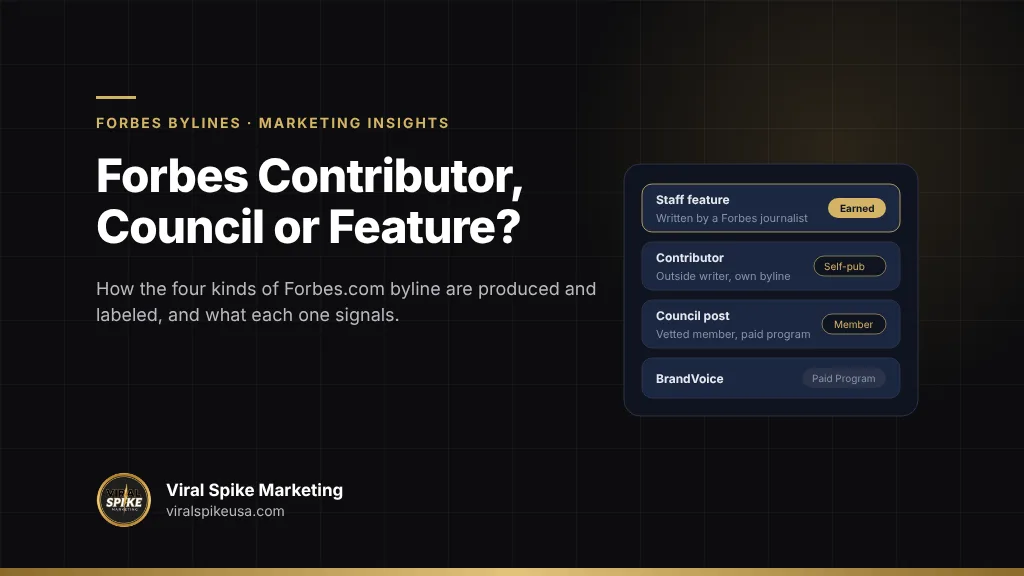
A Forbes contributor is an outside writer with a recurring byline on Forbes.com whose posts carry minimal editing and are labeled as the author’s own opinions; a Forbes Councils member is a vetted executive in a fee-based membership program who can submit bylined articles to Forbes.com after meeting revenue thresholds; and a Forbes feature is a story written by a Forbes staff journalist who chose to cover you. All three produce a Forbes.com URL, but readers, journalists, Wikipedia editors and AI systems distinguish them by the byline label, and only the staff feature is treated as independent coverage. Forbes also sells BrandVoice, labeled “Paid Program,” and licenses its name to dozens of international editions. This article explains how each byline is produced and labeled, how the contributor network changed in 2025, what Councils require, and which route fits which goal. For the mechanics of securing a feature, see our get featured in Forbes page; this piece is about what each byline means.
Key takeaways
- Forbes.com has four kinds of byline: staff, contributor, Councils member and BrandVoice (paid). The label under the author’s name tells you which.
- Wikipedia’s reliable-sources guidance treats contributor, Councils and other non-staff Forbes.com articles as self-published and generally unreliable, while staff-written articles are generally reliable. AI systems and journalists apply a similar discount.
- Forbes cut dozens of contributors in December 2025 and told the network it expects at least two articles a month, per Press Gazette. A contributor slot is a job, not a trophy.
- Most Forbes Councils require $1 million in revenue or financing; the Business Council requires $500,000 in annual revenue. Meeting the bar does not guarantee acceptance, and guaranteed-placement agencies are excluded from membership.
- For authority that transfers to search engines, AI answers, visa petitions and Wikipedia, a staff feature or an editorial feature in another recognized outlet beats a self-authored Forbes byline.
What is a Forbes feature (staff-written)?
A Forbes feature, in the sense most people mean when they say “featured in Forbes,” is an article written by a Forbes staff writer or editor, or published in the print magazine, in which you or your company are the subject or a quoted source. The byline reads “Forbes Staff,” the piece went through Forbes’s own editorial process, and you did not write, pay for or control it. This is earned media. It is also the rarest of the four, because a staff journalist has to decide your story is worth their time against everything else on their beat.
Why the distinction matters so much comes down to independence. The English Wikipedia community, which spends more effort than almost anyone on classifying sources, maintains a perennial-sources list that separates Forbes bylines explicitly. Its entry states that Forbes.com articles are “considered generally reliable if it is ascertained their authors were part of the Forbes staff at the time of the article’s writing,” and that print-issue Forbes articles are generally reliable, as recorded on Wikipedia’s perennial sources page. That standard is a reasonable proxy for how careful readers everywhere treat the byline.
A staff feature is what counts for notability, for immigration petitions that require major-media coverage, and for the entity signals search engines and AI assistants use. The badge question is covered in what “As Seen in Forbes” really means.
What is a Forbes contributor, and what changed in 2025?
The Forbes contributor network launched on August 5, 2010, when Forbes opened its site to outside writers publishing under their own bylines. Contributors are not staff. A 2014 Columbia Journalism Review examination of the model, published in CJR’s September/October 2014 issue, counted about 1,400 contributors against 125 editorial staff, found that roughly 80 percent of a day’s posts came from contributors, and reported that contributors could publish “without so much as a cursory edit.” Forbes said at the time that nearly 500 contributors were paid; most received nothing. Each contributor post carries a disclaimer that the opinions expressed are the author’s own.
Contributor posts range from excellent beat journalism to thinly disguised promotion, and the reader cannot tell which from the URL. Wikipedia’s perennial-sources entry for non-staff Forbes.com articles reflects this: it says most Forbes.com articles are written by non-staff “Contributors,” “Senior Contributors” or “Brand Contributors” with minimal editorial oversight, that there is consensus to treat them as self-published sources, and that they “should never be used for third-party claims about living persons.”
The December 2025 cuts
The network tightened in late 2025. Press Gazette reported on December 8, 2025 that Forbes had cut dozens of contributors the previous week, with their profiles updated to read “former contributor.” An email from assistant managing editor Jeffrey Marcus and executive editor Caroline Howard told remaining contributors that they are expected to publish at least two articles a month that make an impact, and said the company needed a “financially sound” contributor model. A Forbes spokesperson described the cuts as a regular review to align the network with its editorial strategy. Press Gazette also noted that Forbes had welcomed more than 200 new contributors during 2025.
Two implications. A contributor slot is an ongoing writing commitment with a production quota, not a one-time credential. And its value to third parties has not changed: it remains a self-published platform, however good the writer.
What are Forbes Councils?
Forbes Councils is a separate membership business. Its own site describes the councils as “invitation-only communities for executive leaders,” organized into nine groups: Agency, Business Development, Business, Coaches, Communications, Finance, Human Resources, Nonprofit and Technology. According to councils.forbes.com, members can “submit bylined articles to be published on Forbes.com,” each edited against publication guidelines, and can contribute short quotes to Expert Panels, which the editorial team curates into roundup pieces. Members receive an Executive Profile and an author page on Forbes.com.
Eligibility is defined on the qualification page. For the Agency, Business Development, Communications, Finance, Human Resources and Technology Councils, applicants need at least $1 million in business revenue or at least $1 million in financing received. The Business Council requires an owner, founder or executive of a business generating at least $500,000 in annual revenue. The Coaches Council requires three years as a publicly recognized coach, and the Nonprofit Council requires a 501(c) organization with at least $500,000 in annual contributions or revenue. Certain businesses are excluded regardless of size: MLM and direct sales, gambling, adult content, cannabis, ICO-linked cryptocurrency companies, and “link sellers or guaranteed media placement agencies.” Applications are reviewed by a selection committee within two to four business days, and meeting the minimum criteria does not guarantee acceptance.
Membership is paid. Forbes Councils’ public pages do not list the fee; the site says approved applicants “select the membership package that best suits” their goals. Ask for the current figure in writing before applying.
Council content is labeled as coming from the Councils program rather than from Forbes staff, and Wikipedia’s perennial-sources entry lists “Forbes Councils” among the non-staff Forbes.com bylines treated as self-published. In plain terms: a Council post is a well-presented contributed article on a prestigious domain, written by you, within a program you pay to belong to. That is a legitimate thing to have. It is not coverage.
How each byline is labeled on Forbes.com
The label is the whole story. Every Forbes.com article shows a byline and, beside it, a role or program label.
| Byline type | Who writes it | How it is labeled | Who pays whom | Editorial independence |
|---|---|---|---|---|
| Staff feature | A Forbes journalist or editor | “Forbes Staff”; print pieces note the magazine issue | Forbes pays the writer; subject pays nothing | Full. Subject has no control over the angle or publication |
| Contributor post | An outside writer with a recurring Forbes.com byline | “Contributor” or “Senior Contributor,” with a disclaimer that opinions are the author’s own | Some contributors are paid by Forbes; many are not | Minimal editing; writer selects topics within a beat |
| Councils post | A vetted executive member of Forbes Councils | Attributed to the Councils program with the member’s name, headshot and bio | Member pays Forbes Councils a membership fee | Edited to guidelines; member writes about their own expertise |
| BrandVoice | The advertiser or Forbes’s content studio for the advertiser | “BrandVoice | Paid Program” | Advertiser pays Forbes | None; it is advertising |
The BrandVoice label is visible across Forbes.com’s own navigation, where sponsored sections appear as, for example, “Xfinity BrandVoice | Paid Program” and “Acxiom Insights | Paid Program.” Sponsored content on a reputable outlet is a legitimate product with a clear disclosure; what the FTC requires is covered in sponsored article placement and FTC disclosure.
Before you cite, share or pay for anything with “Forbes” in the URL, find the byline, read the label, and for older pieces check an archived copy, since the label reflects the writer’s current role. The same discipline applies to any outlet; see how to verify a publication is real.
How readers, journalists and AI systems weigh each byline
Different audiences apply different discounts, but the ranking is the same everywhere: staff feature first, then contributor, then Councils, then paid.
Prospects and customers
Most buyers do not read bylines; a Forbes logo converts on recognition. The risk is the sophisticated buyer, investor or board member who clicks through, sees “Councils” or “Paid Program,” and concludes the company is dressing up self-promotion, a trust reversal with exactly the audience you most wanted to impress.
Journalists and editors
Reporters know the difference instantly and will not treat a contributor or Council post as prior coverage. A staff feature signals that a peer already judged you newsworthy, which lowers the bar for the next outlet.
Wikipedia and formal notability
Wikipedia’s guidance, cited above, is explicit that non-staff Forbes.com articles are self-published and cannot support claims about living people. If a Wikipedia page is part of your plan, contributor and Council posts count for nothing; see do you qualify for a Wikipedia page. Immigration adjudicators reviewing O-1 and EB-1A petitions apply similar scrutiny to whether coverage is independent.
Search engines and AI assistants
Google and the models behind ChatGPT, Gemini and Perplexity read the same labels a human does, plus the surrounding signals: whether the content is promotional and whether independent sources agree. A staff feature is strong corroboration for an entity. A Council post written by the founder is, to a model, a first-party claim on a third-party domain: useful for associating a person with a topic, but not the independent corroboration that drives recommendations, as explained in how press coverage gets your brand recommended by ChatGPT.
Forbes international editions and licensees
“Forbes” on a URL does not always mean Forbes.com. Forbes.com’s own site footer lists dozens of Forbes Licensees, from Forbes Africa, Forbes Australia and Forbes Argentina through Forbes Brazil, Forbes China, Forbes Colombia and Forbes Czech Republic. Each edition has its own editorial staff, domain, contributor arrangements and, often, its own labeled brand-content sections. Wikipedia’s perennial-sources page, for example, cites the Brand Connect section of Forbes India as an example of sponsored content that editors should not treat as independent.
A feature in a licensed edition is a real editorial feature in that market, but it is not a Forbes.com staff feature and should not be presented as one. Contributor and sponsored programs on licensed editions are separate from the US network and Forbes Councils. Identify the domain, the byline and the section before deciding what a licensed-edition article signals.
Comparison table and the decision matrix
The four routes side by side, by what they cost you, what they require and what they are good for.
| Route | What it requires | Time to publish | Control over content | Signals independent coverage? | Best used for |
|---|---|---|---|---|---|
| Staff feature | A story a Forbes journalist wants; usually a PR effort or a newsworthy moment | Weeks to many months, never guaranteed | None | Yes | Notability, credibility with sophisticated audiences, entity authority |
| Contributor byline | Acceptance into the network; sustained output of at least two articles a month | Ongoing | High, within Forbes rules; cannot promote your own company | No (self-published) | Writers building a beat and an audience; not for promoting your business |
| Councils post | Meeting the revenue or financing threshold, acceptance, and the membership fee | Typically weeks after joining, subject to editing | High, on your own expertise | No (member program) | Executives who want a polished bylined presence and peer network |
| BrandVoice | An advertising budget | Set by contract | Full | No (paid) | Large-brand campaigns where reach matters more than endorsement |
Which should you pursue?
- You need credibility that transfers (investors, enterprise buyers, Wikipedia, a visa petition, AI recommendations): pursue a staff feature or an editorial feature in another recognized outlet. Nothing self-authored substitutes.
- You are a subject-matter writer who wants an audience and can sustain two or more pieces a month on a beat unrelated to selling your own product: a contributor slot may fit, if Forbes is accepting in your area.
- You are a qualifying executive who wants a steady bylined presence and a peer network, and you understand the content will be read as yours, not Forbes’s: Councils can be worth the fee, provided you have the earned coverage to sit alongside it.
- You have an advertising budget and a mass-reach goal: BrandVoice is advertising with a prestige wrapper, and should be judged as advertising.
- You want “featured in Forbes” on your site next quarter and a Forbes journalist is not going to write about you yet: look at editorial features in other recognized outlets first, build the record, and let a Forbes staff feature become possible rather than buying a byline that careful readers will discount.
The common mistake is treating the four as a ladder with the same top rung. They are different products with different buyers, and a founder who buys a Council membership expecting press coverage will be disappointed by the first investor who reads the label.
Where Viral Spike fits
Viral Spike Marketing does not sell Forbes contributor slots or Council memberships, and it will tell you when neither is the right spend. Its guaranteed editorial placements across 1,600+ outlets work differently: you approve the draft, the article is published and indexed on Google, and the engagement is refunded in full if it never runs. Those placements are editorial features in recognized publications, chosen for the audience and the authority signal you need, and they are the fastest honest route to a coverage record that makes staff features at larger outlets possible. The Forbes-specific options, including what is realistic for a staff feature, are laid out on the get featured in Forbes page. For founders and executives who want the whole authority footprint, press, search and AI visibility together, the brand authority program sequences it. Not sure which byline you actually need? Ask us and we will say so.
Read the label before you chase the logo
Take the Forbes URL you are proudest of, or the one a competitor is bragging about, and look at the byline label. Staff, contributor, Councils or Paid Program. Then ask who you need to convince in the next twelve months and whether they will look at the same label. If the answer is investors, enterprise buyers, editors or an algorithm deciding whether to recommend you, build toward the staff-written kind, on Forbes or elsewhere, and treat everything self-authored as a supplement rather than a substitute.
Frequently asked questions
Is a Forbes contributor the same as a Forbes journalist?
No. Forbes journalists are staff, bylined “Forbes Staff,” and their work goes through Forbes editing. Contributors are outside writers with recurring bylines, labeled “Contributor” or “Senior Contributor,” whose posts carry a disclaimer that the opinions are their own and historically receive minimal editing. Wikipedia’s reliable-sources guidance treats contributor articles as self-published and generally unreliable, while staff-written articles are generally reliable.
What does it take to join Forbes Councils?
Most councils (Agency, Business Development, Communications, Finance, Human Resources, Technology) require at least $1 million in business revenue or $1 million in financing. The Business Council requires $500,000 in annual revenue; the Nonprofit Council $500,000 in contributions or revenue; the Coaches Council three years as a recognized coach. Applications are reviewed in two to four business days, meeting the criteria does not guarantee acceptance, and membership carries a fee that Forbes does not publish on its qualification page.
Does a Forbes Councils article count as being featured in Forbes?
Not in the sense readers, journalists, Wikipedia editors or immigration adjudicators mean. A Council post is a bylined article you wrote, published through a paid membership program and labeled as such. It is a legitimate thought-leadership credential, but it is not independent coverage. If you present it as “featured in Forbes,” expect careful audiences to check the label and discount it.
Can I pay to get a Forbes feature?
You cannot pay for a staff-written Forbes feature. What can be bought is BrandVoice, labeled “Paid Program,” which is advertising, or a Councils membership, which allows self-authored bylined posts. Editorial features in other recognized outlets can be arranged through guaranteed placement services, with the draft approved in advance and the article published and indexed. Any vendor promising a guaranteed Forbes staff feature for a fee should be asked exactly how.
How did the Forbes contributor network change in 2025?
In early December 2025, Forbes cut dozens of contributors, with their profiles relabeled “former contributor,” and told the remaining network it expects at least two articles a month that make an impact, according to Press Gazette. Forbes described the cuts as a routine review tied to its editorial strategy and a financially sound contributor model. The network added more than 200 new contributors during 2025, so slots exist, but they come with a production quota.
Do AI assistants treat Forbes contributor posts as credible sources?
They treat them as what they are: content on a trusted domain written by a non-staff author, often about the author’s own company. That can help establish that a person is associated with a topic, but it does not provide the independent corroboration that drives AI recommendations. Staff-written features and editorial coverage in other recognized outlets carry more weight, because the model is looking for sources that are not the brand describing itself.
Sources
Primary sources referenced in this article, in order of first use.
- Wikipedia's perennial sources page (en.wikipedia.org)
- published in CJR's September/October 2014 issue (cjr.org)
- Press Gazette reported on December 8, 2025 (pressgazette.co.uk)
- councils.forbes.com (councils.forbes.com)
- qualification page (councils.forbes.com)

More in Marketing Insights