
How to Remove Yourself From People-Search Sites and Data Brokers (and Keep Your Address Off Google)
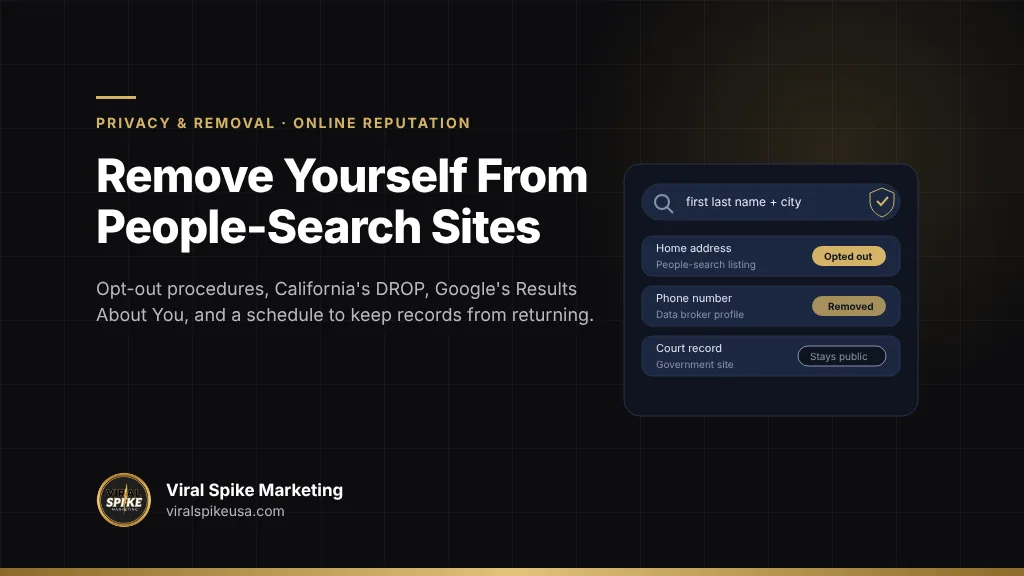
You cannot delete yourself from the internet, but you can remove your home address, phone number, email, relatives and age from the people-search sites and data brokers that publish them, and you can get those pages out of Google results for your name. The work has three layers. First, opt out of each people-search site directly: find your listing, submit the site’s removal form, verify by email or phone, and repeat for every listing and every site. Second, use the legal and platform tools that now exist: California’s Delete Request and Opt-out Platform lets residents send one deletion request to every registered data broker, and Google’s Results About You removes pages showing your address, phone or email from results for your name. Third, maintain it, because brokers refresh from public records and your information returns within months unless someone checks. What no process removes is a primary public record, a court filing, a property deed, a news article; those are managed by suppression rather than deletion.
Key takeaways
- People-search sites and data brokers compile public records, marketing data and scraped profiles into a page about you. Each site must be opted out of separately, and some require a separate request per listing.
- California’s Delete Act created DROP: residents can submit one deletion request, and since August 1, 2026, registered brokers must check the platform at least every 45 days and delete matching records.
- Google’s Results About You removes search results that show your address, phone number or email, but not the source page, and generally not government, educational or news pages.
- Subscription removal services automate the opt-outs and re-check on a schedule; they cover hundreds of sites but exclude social media, news and court records.
- Plan on a quarterly re-check. Spokeo, for one, says plainly that your information may reappear without notice as new records arrive.
What are people-search sites and data brokers?
California’s privacy regulator defines data brokers, for its registry, as businesses that consumers do not interact with directly but that buy and sell consumer information collected by other businesses, per the California Data Broker Registry. People-search sites are the consumer-facing slice: they compile public records (property, voter, court, licensing), marketing and purchase data, social profiles and older directory listings into a page per person, then sell access to it. A typical listing shows current and past addresses, phone numbers, emails, age, relatives and associates, and sometimes employer and estimated income.
Removal is tedious for two reasons. Brokers share and resell data, so the same facts appear on dozens of sites under different brands, often run by the same company. And they refresh from the same public sources continuously, so a deleted listing can be rebuilt. Why that matters for your search results and your safety is covered in reputation management for individuals.
The legal environment is shifting against the brokers. New Jersey’s Daniel’s Law lets law enforcement officers, judges and other covered persons demand removal of their home addresses and unpublished phone numbers, with penalties. In 2026 it produced a striking result: after a default judgment on August 27, 2026, the New Jersey Superior Court ordered the radaris.com domain transferred to the plaintiff, Atlas Data Privacy Corporation, and the site now displays a court-order notice in place of its people-search service. KrebsOnSecurity reported on September 16, 2026 that 14 Radaris-family domains had been transferred, that Radaris’s lawyers planned to challenge the judgment, and that at least 14 other states have passed similar laws. Most people are not covered by them, but they signal where enforcement is heading.
How to opt out of the major people-search sites
The procedure is similar everywhere: search for yourself on the site, open each listing that is yours, copy its URL, submit it through the opt-out page, and verify by email link or phone call. We fetched the opt-out instructions we could; where a site blocked access, the row says so, and the site’s own page governs.
| Site | What its opt-out page says (fetched October 2026) | Verification | Stated timing |
|---|---|---|---|
| Spokeo | Find your listing, copy its profile URL, submit it through the opt-out form. Each listing “must be opted out individually.” Opting out does not delete the original public-source data, and because Spokeo “regularly receives new records,” your information “may reappear without notice.” Source: Spokeo opt-out page | Email confirmation link | Typically 24 to 48 hours |
| Whitepages | Site blocked automated access. Norton’s June 2026 guide describes the process: search your name with city or ZIP, open each “View Details” listing that is yours, paste the profile URL into the suppression form, choose a reason and submit. Source: Norton | Automated phone call with an on-screen code | “A few days to a few months,” per Norton’s summary of Whitepages’ FAQ |
| BeenVerified | Site blocked automated access. Use the opt-out search on the site, locate your record and submit from there. | Email, per the site | Not verified |
| Intelius (and sister brands under the same parent) | Site blocked automated access. Use the opt-out link on the site; the parent company’s brands share one process. | Not verified | Not verified |
| MyLife | Site blocked automated access. Use its California-privacy request page or the removal contact in its privacy policy. | Not verified | Not verified |
| Radaris | No longer operating at radaris.com, which now shows the court-order notice. Sister sites may still carry data. | Not applicable | Not applicable |
A few practical rules that apply across all of them:
- Use a dedicated email address for opt-outs; some brokers add it to your profile.
- Search every variant of your name: maiden names, middle initials, nicknames, previous cities. Each produces a separate listing.
- Screenshot each listing and log the date, URL and confirmation. You will need the log for the re-check and for any complaint.
- Never pay a people-search site to remove you. Opt-outs are free.
- Enter the minimum the form requires. Some ask for a full date of birth or past addresses “to find your record.”
California’s Delete Act and DROP: one request, every registered broker
California’s Delete Act created the first US mechanism for deleting data from every registered broker at once. The California Privacy Protection Agency (now styling itself CalPrivacy) announced on November 13, 2025 that the implementing regulations had been approved and take effect January 1, 2026. Under them, Californians use the Delete Request and Opt-out Platform (DROP) to request deletion from multiple data brokers at once, and brokers must delete matching information, including inferences, unless a legal exemption applies.
The agency’s data broker page describes DROP as the Delete Act’s “accessible deletion mechanism”: one verifiable request directs every registered broker holding your information to delete it, including information held by the broker’s service providers. Brokers register each January and pay a $6,000 annual fee plus an access fee to download deletion lists; the consumer side is free. The registry is public and downloadable as a CSV, which makes it a useful checklist for non-Californians too, since each entry carries the broker’s contact details for deletion requests.
| Date | What happens under the Delete Act |
|---|---|
| January 1, 2026 | Regulations take effect; Californians can begin submitting deletion requests through DROP |
| January 1 to 31, 2026 (and annually) | Data brokers register with the agency and pay the annual fee |
| August 1, 2026 | Brokers must begin accessing DROP at least every 45 days and processing requests |
| Within 45 days of retrieval | Brokers must report the status of each request; matches are deleted unless exempt |
| Ongoing | Brokers keep a deletion list so your data stays deleted |
Limits: DROP covers brokers registered in California, applies to California residents, and has exemptions the agency’s pages do not enumerate. It does not touch primary public records, social media, news sites or companies you deal with directly. Other states have privacy laws with deletion rights and broker registries; whether one applies to you depends on where you live. This article is general information, not legal advice.
Google Results About You: getting your address out of search
Removing a listing from a broker takes it off that site; removing it from Google takes it out of the place most people would find it. Google’s Results About You tool does the second job for a narrow category of information: pages that show your phone number, home address or email address. You set up monitoring with your name and contact details (including nicknames and maiden names), review what Google finds, and request removal of each result; you can also start from a result’s “About this result” menu and choose “Remove result.” Requests are tracked as in progress, approved, denied or undone, with reasons for denials.
The limits matter as much as the feature. Google’s page says removal affects Google Search only and “doesn’t mean that the info is gone from the internet”; the source page is unchanged, so a broker page removed from Google still exists for anyone who goes to the broker directly, and a new broker page can appear in results later. Google generally does not remove pages from government or educational institutions or online newspapers, and business websites may lack the remove option. Information you control yourself, on your own social profile or blog, has to be removed at the source. Sometimes a URL is hidden only for searches that include your name.
So the sequence is: opt out at the broker, then request the Google removal, then re-run the monitoring every quarter. A fuller account, including the professional-information path, is in Google Results About You: what it removes and what it does not.
Subscription removal services vs doing it yourself
The DIY route costs nothing but time: a first pass across the major sites typically takes a weekend, and the quarterly re-check an hour or two. Subscription services automate the search, submit the requests, handle verification and re-scan on a schedule. Three whose pages we could fetch:
| Service | What its site says it does | Coverage and cadence stated | Stated exclusions |
|---|---|---|---|
| DeleteMe | Searches data broker and people-search sites for your information and submits opt-out and removal requests; notes that Google results change only after source sites remove the data. | “Hundreds of data brokers and people-search sites”; removes “regularly, all year long.” Pricing not shown on the page fetched. | Not listed on the page fetched |
| Optery | Free tier sends an exposure report with self-service opt-out links; paid plans (Core, Extended, Ultimate) submit removals with monthly automated scans. | Ultimate: automated removals from 630+ sites plus unlimited custom requests, 945+ total. Says some brokers comply within 24 hours and others take weeks or months, and removing every instance is unlikely. Pricing not shown on the page fetched. | Social media, blogs, news sites, legal records sites, the dark web |
| Incogni | Scans people-search sites and sends removal requests; for brokers with private databases, identifies likely holders by region and sends opt-outs under an authorization you sign. Re-scans on a schedule. | 420+ brokers with automated removals; 3,000+ more via custom removals on Unlimited plans. Annual pricing shown for Standard, Family and Unlimited tiers, with a 30-day money-back guarantee. | Not listed on the page fetched |
Do it yourself if your exposure is modest and you will actually do the quarterly re-check. Use a service if you have a common name, many past addresses, a family to cover, or a safety reason to want it done fast and kept done; the recurring re-scan is the part most people fail to sustain. Either way, the service does the broker layer only. Google removals, public records, news articles and social media remain yours to handle or to hand to a reputation specialist.
What cannot be removed
Opt-outs and DROP delete copies. They do not reach originals.
- Public records at the source. Property deeds, voter registration (where public), court dockets, professional licenses, business filings and campaign contributions are published by government bodies, and Google generally will not remove government pages. Some states let specific groups restrict address records; the general public cannot.
- News articles. A newspaper story that mentions your address, arrest or lawsuit is editorial content; Google does not remove online newspaper pages through Results About You, and the publisher decides whether to update or unpublish. Your options are covered in can you remove negative articles from Google.
- Mugshots and arrest records follow their own rules, partly set by state law and partly by Google policy; see how to remove a mugshot or arrest record from Google.
- Your own posts and profiles have to be deleted or locked at the source; removal services exclude them.
- Information held by companies you deal with. Your bank, employer and retailers are not data brokers; DROP and opt-outs do not reach them.
- Cached and archived copies can persist on obscure sites. They rarely rank, which is why the Google layer matters more than chasing every copy.
For what cannot be removed, the strategy shifts to suppression: making sure that what people and AI assistants find first for your name is accurate, current and controlled by you. That is a different discipline, explained in how to suppress negative search results the right way.
Executives and public figures: extra considerations
For a CEO, a physician, a judge, a public founder or anyone who has been harassed, the broker problem is a safety problem, and the standard approach needs four additions.
- Cover the household. Listings link relatives; removing yourself while your spouse’s listing still shows the shared address removes nothing. Run the process for every family member and any entity registered at the home.
- Separate the public identity from the private one. Use a business or registered-agent address for every filing, domain registration, license and professional profile you can. Future broker records are built from these.
- Prioritize by findability. Executives are searched by name constantly, so the Google layer comes first, then the brokers that still rank, then the long tail. The broader picture is in reputation management for CEOs.
- Monitor monthly, not quarterly, with alerts for new listings and mentions. If your profession is covered by a Daniel’s Law-style statute in your state, use it; it carries penalties that voluntary opt-outs do not.
The goal for a public figure is not absence but control: the professional footprint prominent, the private one gone.
A maintenance schedule that keeps records from returning
Every source above says the same thing: the data can come back. Spokeo says your information may reappear without notice; Norton notes removed information can return after brokers update; Optery says removing every instance is unlikely. Treat removal as housekeeping with a calendar.
| When | What to do |
|---|---|
| Week 1 | Set up Results About You for yourself and family. Search your name variants on the major sites, screenshot every listing, submit opt-outs and log each one. In California, submit a DROP request. |
| Weeks 2 to 6 | Complete verifications as they arrive. Re-search each site and submit missed listings. Request Google removal for broker pages still showing your address or phone. |
| Month 3, and every quarter | Re-run the searches and the Google monitoring. Re-submit any listing that returned. Escalate sites that never confirmed, by email or, in California, by complaint to the agency. |
| Annually | Check the California registry for new brokers. Move what public filings you can to a business or agent address. Re-check family members. |
| After any move, name change or new public role | Restart from Week 1. A new address generates new records within months. |
A full monthly routine for everything that shows up for your name, not only broker listings, is set out in how to monitor your online reputation.
Where Viral Spike fits
Viral Spike’s reputation management service handles the three layers together: broker and people-search opt-outs, including the household and the long tail of sister sites; Google removal requests under Results About You and the other policies that apply to specific content; and the monitoring that catches returns. Where something cannot be removed, the same team builds the accurate, current presence that outranks it, so what a search engine or AI assistant shows first for your name is the version you control. Pricing by type of problem is explained in how much reputation management costs. To find out what is currently exposed, contact us and we will run the first search for you.
Start with the search, then the log
Open a private browser window and search your full name with your city, then your name with “address,” then your phone number in quotes. Screenshot everything that shows your home address or number, and put the URLs in a spreadsheet with a date column. That log is the whole project: each row gets an opt-out, a verification, a Google request where it still ranks, and a re-check date three months out. The sites will refill, which is why the spreadsheet, not any single removal, is what keeps your address off the open web.
Frequently asked questions
Can you completely delete yourself from the internet?
No. You can remove your contact details from people-search sites and data brokers, get those pages out of Google results for your name, and delete your own accounts and posts. You cannot remove primary public records held by governments, news articles published by independent outlets, or information held by companies you have a direct relationship with. The realistic goal is to take your home address, phone and family details off the open web and keep them off with a quarterly re-check.
How long does it take to opt out of people-search sites?
Individual sites vary from about a day to several weeks. Spokeo says requests are typically processed within 24 to 48 hours; Whitepages’ FAQ, as summarized by Norton, says a few days to a few months. A first pass across the major sites usually takes a weekend, with verification emails and calls arriving over the following weeks. Because brokers refresh from public records, repeat the searches every three months.
Is it free to remove yourself from data brokers?
Yes. Every legitimate people-search site offers a free opt-out, California’s DROP platform is free for consumers, and Google’s Results About You is free. A site that charges you to remove your own listing should be treated with suspicion. Paid subscription services are a different thing: they charge to do the opt-outs and re-checks on your behalf across hundreds of sites, which is a convenience, not a requirement.
What is California’s Delete Act and who can use it?
The Delete Act requires data brokers to register with the California Privacy Protection Agency and created DROP, a platform where a California resident submits one verifiable deletion request that covers every registered broker. Consumers could begin using it in January 2026; from August 1, 2026, brokers must check DROP at least every 45 days, delete matching records unless an exemption applies, and keep a list so the data stays deleted. It applies to California residents and registered brokers, not to public records or news.
Does Google remove my address from search results?
Google’s Results About You tool removes search results that show your home address, phone number or email address, once you request it and Google approves. It removes the result from Google Search only; the source page still exists, and government, educational and online newspaper pages are generally not removed. Opt out at the broker first, then request the Google removal, then keep monitoring, because a new broker page can appear later.
Are data broker removal services worth it?
They are worth it if you have a common name, many past addresses, a family to cover, or a safety reason to want the work done quickly and kept done. The value is the recurring re-scan, which most people never sustain on their own. They cover the broker and people-search layer only; Optery, for example, lists social media, news sites and legal records as exclusions, and Google removals and public records remain separate tasks.
Sources
Primary sources referenced in this article, in order of first use.
- California Data Broker Registry (cppa.ca.gov)
- a court-order notice (radaris.com)
- KrebsOnSecurity reported on September 16, 2026 (krebsonsecurity.com)
- Spokeo opt-out page (spokeo.com)
- Norton (us.norton.com)
- announced on November 13, 2025 (cppa.ca.gov)
- data broker page (cppa.ca.gov)
- Results About You (support.google.com)
- DeleteMe (joindeleteme.com)
- Optery (optery.com)
- Incogni (incogni.com)

More in Online Reputation
 How to Remove Facebook Reviews and Recommendations: Reporting, Turning Recommendations Off, and What to Do When a Page Is Attacked
 How to Remove Google Reviews: Step by Step Through Flagging, the Reviews Management Tool, Appeals and Legal Requests
 How to Remove Negative Google Autocomplete Suggestions: Policy Reports, Legal Requests and Suppression