Yahoo Finance Press Release vs Editorial Feature Explained
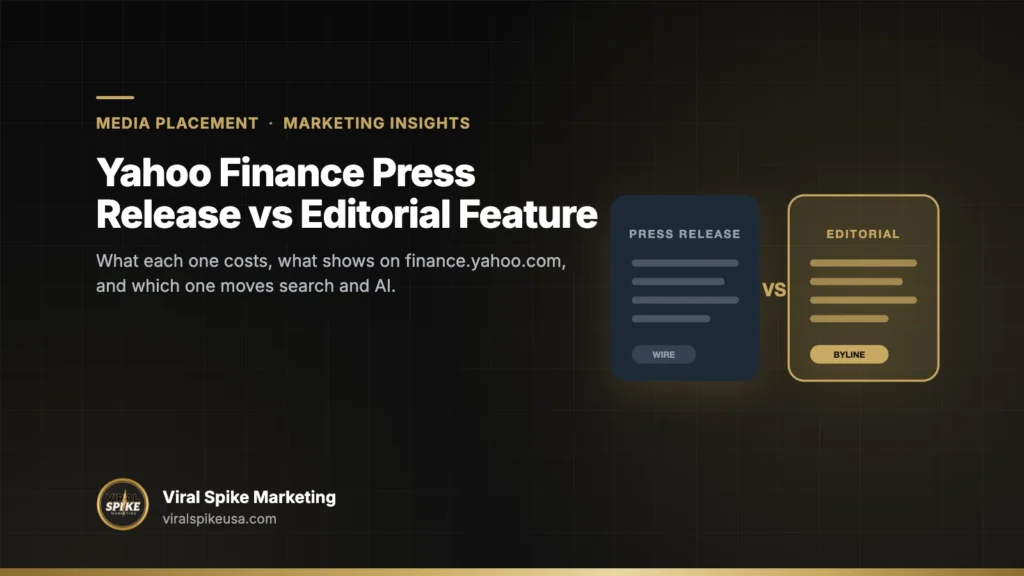
A press release that shows up on finance.yahoo.com is paid wire syndication: you pay a newswire, the wire pushes your release to partner sites including Yahoo Finance, and the page carries your own words under a wire label. An editorial feature on Yahoo Finance is a story a Yahoo journalist or syndicated newsroom partner chose to write. They look similar in a screenshot and behave differently in search, in AI answers, and in a buyer’s mind. If your goal is a logo for a landing page, the wire release is cheap and does the job. If your goal is rankings, links, AI citations, or credibility with a skeptical buyer, it will disappoint you.
Key takeaways
- A Yahoo Finance press release is wire syndication you pay for, typically in the low hundreds to low thousands of dollars depending on the wire and the word count.
- Syndicated releases on Yahoo Finance and MSN accounted for 0.04% of more than 4 million AI citations in BuzzStream’s 2026 study, and wire pages carry no editorial endorsement.
- Google’s spam policy names optimized links in distributed press releases as link spam unless they are marked nofollow or sponsored, so expect no ranking credit.
- Genuine Yahoo Finance editorial coverage is earned through a reporter or a syndicated newsroom partner, not bought from a wire.
- A Yahoo badge is fine as a visual trust cue on a sales page, and a waste if you expect it to move rankings, visa cases, or AI visibility.
How do I get on Yahoo Finance?
There are three doors, and only one of them is what most buyers picture when they say “featured on Yahoo Finance.”
Door one: wire syndication. You submit a press release to a newswire that has a distribution agreement with Yahoo. The release appears on finance.yahoo.com, often within hours, labeled with the wire’s name. This is what most “get on Yahoo Finance from $X” offers are selling.
Door two: editorial coverage. A Yahoo Finance reporter writes about your company, or a partner newsroom whose content Yahoo syndicates (many major business publishers appear this way) covers you and the story flows through. You cannot buy this. You earn it with news, data, or a source relationship.
Door three: contributor and partner content. Some content on Yahoo Finance is syndicated from partners, including outlets that run sponsored or contributor programs. A labeled sponsored feature in a partner publication may or may not be picked up by Yahoo’s feed, and you should never pay on the assumption that it will.
For the broader difference between distribution and placement, see our guide on press placement services vs press release distribution.
How much does a Yahoo Finance press release cost?
Wire distribution is priced by the wire, the geography, and the word count, not by Yahoo. Everything-PR’s 2026 PR cost guide puts newswire distribution at $600 to $3,000 per release. Prezly’s PR Newswire pricing guide estimates a $195 annual membership, about $350 per release for most state and local distribution, and about $805 for US national distribution of a 400-word release, with roughly $140 to $245 for each additional 100 words. Prezly notes these are industry estimates rather than an official rate card, because the wire does not publish pricing.
Budget wires and resellers charge less, and their Yahoo pickup depends on which distribution agreements they hold. A “guaranteed Yahoo Finance” promise bundled into a low flat fee is usually real in the narrow sense (the release appears on a finance.yahoo.com URL) and hollow in every other sense. None of these are Viral Spike prices; they describe the wire market so you can budget.
Does a Yahoo Finance press release help SEO?
Not in the way vendors imply. Three things work against it.
Links. Google’s spam policies list “links with optimized anchor text in articles, guest posts, or press releases distributed on other sites” under link spam, and say such links are acceptable only when qualified with rel=”nofollow” or rel=”sponsored.” Wires and Yahoo comply by qualifying the links, so a link from a syndicated release is not a ranking signal.
Duplication. The same release appears on the wire’s site, on Yahoo, on MSN, and on dozens of smaller partner pages. Search engines consolidate duplicates and typically surface one version, often the wire’s original. Your own newsroom copy can end up being treated as the duplicate if the wire publishes first.
Persistence. Wire pages on Yahoo Finance sit in a high-volume feed, drop off ticker and topic pages quickly, and rarely rank for anything other than the exact headline. Some stay crawlable for a long time, others become hard to find within weeks. Do not build a plan around either outcome.
What a release can do for search is modest: a dated record of an announcement, a short ranking window for your brand name plus the announcement keyword, and something for journalists to cite. Treat it as documentation, not link building.
What is the difference between a Yahoo Finance press release and an editorial feature?
| Route | Cost type | What appears on finance.yahoo.com | Indexation and link value | Credibility with buyers | AI citation likelihood |
|---|---|---|---|---|---|
| Wire press release | Paid distribution fee (roughly $600 to $3,000 per release per Everything-PR; national PR Newswire about $805 base per Prezly’s estimate) | Your own text, labeled with the wire name, in the press release feed | Often indexed but duplicated across many sites; links qualified as nofollow or sponsored, so no ranking credit | Low among journalists and sophisticated buyers; adequate as a logo cue for consumers | Very low: 0.04% of citations for syndicated releases on Yahoo Finance and MSN in BuzzStream’s 2026 dataset |
| Editorial coverage | Earned (time, story, relationships) | A reporter’s story about you, under a Yahoo or partner newsroom byline | Indexed as original journalism; links at the editor’s discretion | High: an independent third party chose the story | Highest of the three: original editorial made up 81% of news citations in the same study |
| Partner or contributor content | Paid or earned depending on the partner outlet | A syndicated article that may carry a sponsored or contributor label from the source outlet | Depends on the source outlet’s indexation; Yahoo copy is usually canonicalized to the original | Medium, and dependent on how clearly the label is disclosed | Low to moderate: paid and advertorial content is 0.3% of AI citations per Muck Rack |
The BuzzStream figures come from an analysis of more than 4 million AI citations across ChatGPT, Google AI Overviews, AI Mode and Gemini, summarized by ALM Corp: syndicated press releases on Yahoo Finance and MSN were 0.04% of all citations, direct wire citations were 0.21%, and original editorial content accounted for 81% of all news citations. Muck Rack’s May 2026 analysis of more than 25 million citations points the same direction: earned media is 84% of AI citations, paid and advertorial content is 0.3%.
Do AI tools cite Yahoo Finance press releases?
Rarely enough that you should assume they will not. The 0.04% figure above is the clearest data point available. AI assistants pull from pages that look like independent reporting, reference documents and community discussion, and a syndicated release is your own marketing copy republished on a high-authority domain.
A release can still do two supporting jobs: it creates a consistent, dated statement of facts about your company (founding date, leadership, product names, funding) that models and knowledge graphs may draw on, and it can trigger the original story a journalist writes and an AI later cites.
If AI recommendations are your real goal, our explainer on how press coverage gets your brand recommended by ChatGPT covers which coverage types move the needle and which do not.
When is a Yahoo Finance badge fine, and when is it a waste?
A badge is a visual promise. It works when the promise matches what a visitor would find if they clicked, and it backfires when it does not.
A Yahoo badge is fine when:
- It is one of several logos in an “as seen on” strip on a consumer-facing page, and the underlying page is a real release on finance.yahoo.com.
- Your buyers are consumers or small businesses who recognize the logo and will not audit the source.
- You are documenting a genuine announcement and understand you are buying distribution, not endorsement.
A Yahoo badge is a waste when:
- You expect it to improve rankings or pass link equity.
- You expect it to count as published material about you for an O-1 or EB-1A petition. Paid distribution of your own announcement is not independent coverage, as we explain in what press coverage counts for O-1 and EB-1A visas.
- Your buyers are journalists, investors, enterprise procurement teams or anyone who will click through and see a wire label.
- You are paying a premium because the vendor described it as a “feature” or “article” on Yahoo Finance. Insist on seeing the exact URL pattern and the label on it first. Our guide to verifying a publication before you pay shows how.
For how to use logos honestly and effectively on your own site, see how “as seen in” media badges turn visitors into customers.
How do you get real editorial coverage on Yahoo Finance?
You earn it through the newsrooms that feed it. A step-by-step approach:
- Identify who covers your category. Yahoo Finance runs its own reporting on markets, personal finance, companies and the economy, and syndicates business coverage from partner publishers. Find the reporters and partner outlets that covered your competitors in the last six months.
- Build a story with a number in it. Funding, revenue milestones, proprietary data, a contrarian forecast with evidence, or a founder story with specifics. “New product launch” is a release, not a story.
- Publish the release on your own newsroom page first, then wire it. Your page stays the canonical source and reporters have a link to cite.
- Pitch the reporter directly, not the wire. Two short paragraphs, a proposed headline, and an offer of an interview or exclusive data.
- Layer in labeled placements where they help. Buy a disclosed sponsored feature for its own value, not for a Yahoo pickup you cannot control.
- Measure the right thing. Indexed as original journalism, ranking for your name, appearing in AI answers about your category. Not logo impressions.
The difference between this approach and buying a wire slot is the difference between digital PR and distribution, which we break down in understanding digital PR vs press release distribution.
Where a placement service fits
Viral Spike Marketing is a digital PR agency that sells guaranteed editorial press placements in 1,600+ outlets on a pay-per-placement basis: you approve the draft, the article is published and indexed on Google, and the engagement is refunded in full if it never runs. We do not sell wire releases dressed up as features, and whether a placement is syndicated to Yahoo Finance is the publisher’s and the feed’s decision rather than part of the deliverable. We name the publication, article format, timeline and refund terms in writing before you pay, place the article only after you approve the draft, and are plain about what a guaranteed placement does (credibility, entity signals, search presence, conversion) and what it does not (earned-level AI citations, visa evidence). If you are deciding between a wire release, a guaranteed placement or an earned campaign, our public relations team will tell you which fits, and you can book a call to start.
Pick the route that matches the job
If you need a dated record and a logo, wire the release, publish it on your own site first, and spend the rest of your budget elsewhere. If you need credibility that survives a click, a guaranteed placement in a real business outlet is the honest middle option, provided you confirm in writing how the article will be presented and which URL pattern it will use. If you need rankings, AI citations, or evidence for a visa or Wikipedia case, only earned editorial coverage does that job, and it takes months of pitching real stories. Tell us what the coverage needs to accomplish and we will tell you which route earns it. Contact Viral Spike Marketing to talk it through.
Frequently asked questions
Is a Yahoo Finance press release worth it?
For a few hundred to a couple thousand dollars, it is worth it if you want a dated record of an announcement and a recognizable logo for a consumer landing page. It is not worth it if you expect ranking gains, followed links, AI citations or credibility with journalists and investors, all of which require independent editorial coverage.
Can I say I was “featured on Yahoo Finance” after a press release?
You can say your announcement appeared on Yahoo Finance, and you can show the logo with a link to the actual page. Calling a wire release a “feature” invites embarrassment when a buyer clicks through and sees a wire label. Accurate language protects the credibility you are trying to build.
How long does a press release stay on Yahoo Finance?
Wire pages usually remain live for an extended period, but they fall off topic and ticker pages within days as the feed refreshes, and they rarely rank for anything but the exact headline. Keep a screenshot and your own newsroom copy so the record survives regardless of what happens to the syndicated page.
Do Yahoo Finance press release links help my domain authority?
No. Google’s spam policies name optimized links in distributed press releases as link spam unless they carry nofollow or sponsored attributes, and wires comply by qualifying the links. Third-party authority scores may tick up briefly from the volume of syndicated copies, but that is not the same as a ranking signal.
What counts as real Yahoo Finance coverage?
A story written by a Yahoo Finance journalist, or by a partner newsroom whose original reporting Yahoo syndicates, that discusses your company on its own merits. It carries a reporter’s byline rather than a wire label, is indexed as original journalism, and is the kind of page AI assistants and journalists cite.

More in Marketing Insights