
What Makes a Founder Newsworthy Before a Major Win
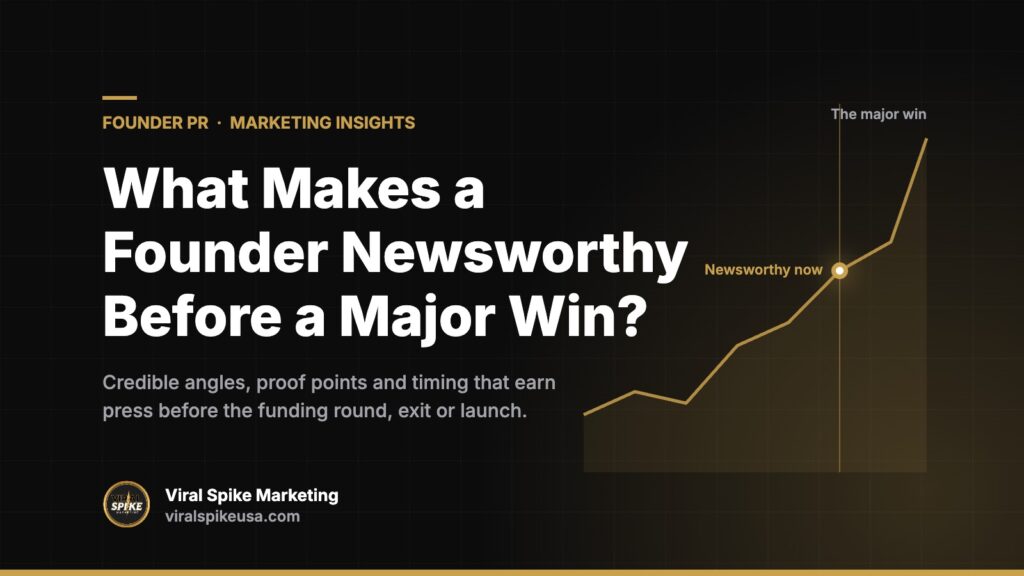
You do not need a funding round, an acquisition, a bestseller, or a viral launch to earn media attention. A founder becomes newsworthy the moment they can offer a credible angle, proof behind it, and a clear reason readers should care right now. That is the same standard an editor at Business Insider, Forbes, or Entrepreneur applies to every pitch, and it is available to you long before the “big win.”
Most founders wait. Then a launch, an investor meeting, a Q4 campaign, or a conference slot arrives and there is no story, no media assets, and no public record of authority for anyone to find. The stronger play is to build that foundation while your momentum is already taking shape, so the coverage exists before you need it.
What makes a founder story worth covering?
A company description is not a story. Neither is calling your product “disruptive,” your team “visionary,” or your business “the next big thing.” Editors need something useful for their readers, not a polished version of your About page.
When we shape a founder story, we test it against four questions:
- Is there a timely reason to publish it now?
- Does it give a specific audience a useful takeaway?
- Can the main claims be backed by accurate evidence?
- Does the founder bring a distinct point of view?
Timeliness can come from a market shift, changing customer behavior, a regulatory change, or a seasonal business concern. Late summer, for example, is when many companies begin planning Q4 demand, hiring, and holiday campaigns; a founder with direct knowledge of those pressures has an insight worth publishing.
Proof does not have to mean an exit or a large raise. Documented customer retention, waitlist demand, a patented process, a strong niche community, a meaningful partnership, or hard-earned lessons from a failed launch all count. The key is accuracy: if you cannot document a claim, it should not lead your pitch.
How can founders get featured in Business Insider early?
Founders who want to get featured in Business Insider should start with the publication’s audience, not with a request for a profile. Its readers care about entrepreneurship, leadership, careers, technology, consumer behavior, finance, and lessons that apply beyond one company.
You have a strong angle if you can speak clearly about a real business problem, a shift in your industry, or an operating lesson others can learn from. A narrow, evidence-backed insight carries more weight than a broad claim about changing the world.
There are two routes into a publication like this, and it helps to understand both before you commit time to either:
- Earned editorial pitching. You (or a publicist) pitch reporters directly. Coverage is decided by the newsroom, there is no timeline, and most pitches go unanswered. It works best when you already have a public track record.
- Guaranteed editorial placement. The outlet, article format, publish window, and refund terms are agreed in writing before you pay, and the piece runs as a full editorial feature that is indexed on Google. This is the route most early-stage founders use to get the first major feature on the record. Our guaranteed PR placements page explains exactly what is included.
Whichever route you take, prepare media-ready assets first: a concise bio, documented company facts, professional photos, product or service visuals, customer or market data, and a quote that says something specific. Vague claims, inflated metrics, and unclear sourcing can kill a story before it starts. If budget is part of the decision, our guide to press placement cost by outlet tier gives real 2026 ranges.
Why does proof beat hype in founder PR?
Hype grabs attention for a moment; proof gives a founder story staying power. Editors, investors, customers, search engines, and AI assistants all respond better to details that can be checked.
Instead of saying you are an “industry leader,” show what supports that position. Instead of calling your method “revolutionary,” explain what makes it different and what problem it solves. Strong evidence includes documented growth, customer outcomes, recognized credentials, research, community impact, proprietary methods, or a distinctive operating model.
Personal stories work too, when they connect to a larger lesson. A career pivot, a business setback, or a nontraditional path into entrepreneurship is worth covering if it helps readers understand a real challenge. Keep the focus on the lesson, not the biography.
Accurate coverage keeps working after publication. It strengthens the search results people see when they Google your name, supports investor due diligence and partnership outreach, and gives AI tools like ChatGPT and Gemini credible sources to cite when someone asks about you. That is the brand authority flywheel: press earns trust, trust earns search visibility, visibility earns more press.
What should you pitch before a major milestone?
The strongest founder pitches do not announce that a company exists. They offer a useful idea tied to a timely business conversation.
“We launched a new service” gives an editor nothing to work with. “What serving hundreds of small-business customers taught us about preparing for holiday demand” has timing, a defined audience, and a reader benefit. Before a milestone, the angles we see land most often are:
- An informed take on an emerging market trend
- Data-backed insight from serving a specific customer group
- A contrarian operating lesson that challenged common advice
- A customer problem the business sees firsthand
- A seasonal prediction tied to Q4 planning, hiring, or consumer demand
Keep the pitch short. Lead with the angle, explain why it matters now, give one or two documented proof points, and offer yourself as a source with a clear perspective. Do not send the same generic pitch to every publication; fit matters, and tier-1 and tier-2 outlets want different things.
A thoughtful press plan pairs targeted earned-media outreach with guaranteed placements where publication timing matters, so you have a public narrative in place before a launch, a raise, or a reputation issue forces the conversation.
Turn founder credibility into press coverage
Viral Spike Marketing helps founders turn credible proof points into clear, publication-ready stories, then places them in the outlets that matter for their market. Every guaranteed placement is a full editorial feature with the publication, format, timeline, and refund terms named in writing before you pay. Book a free consultation to talk through your angle, supporting assets, and the outlets that fit your goals.
Frequently asked questions
Do I need revenue or funding to be newsworthy?
No. Revenue and funding help, but they are not the only forms of proof. Credible expertise, useful customer data, a differentiated solution, a timely industry view, or a business lesson others can apply all qualify. What matters is whether your story is accurate, relevant, and useful to a defined audience.
Can you guarantee a Business Insider feature?
Yes, through our guaranteed placement program. The outlet, article format, and publish window are agreed in writing before you pay, and the feature runs as full editorial content or you receive a full refund. Independent pitches to a newsroom, by contrast, can never be guaranteed by anyone.
How long does founder press placement take?
Guaranteed placements typically publish within a few weeks, depending on the outlet’s editorial calendar and how quickly assets and approvals are ready. Earned pitching has no fixed timeline. Either way, build your bio, proof points, visuals, and message well before a launch, fundraise, or Q4 campaign.
What proof do founders need for a media pitch?
Claims you can document: verified customer data, market research, partnership details, product performance, or operational results. A major exit or funding round is not required, but vague claims and inflated metrics weaken credibility with every editor who checks them.
Why is timing important in founder public relations?
Timing gives a founder’s insight a reason to be published now. Strong hooks include market shifts, changing customer behavior, new regulations, seasonal planning cycles, hiring trends, or a challenge businesses are actively facing this quarter.

More in Marketing Insights


Related services