
Press Kit vs Media Kit: What to Include, a Template You Can Copy, and the Mistakes That Get Yours Ignored
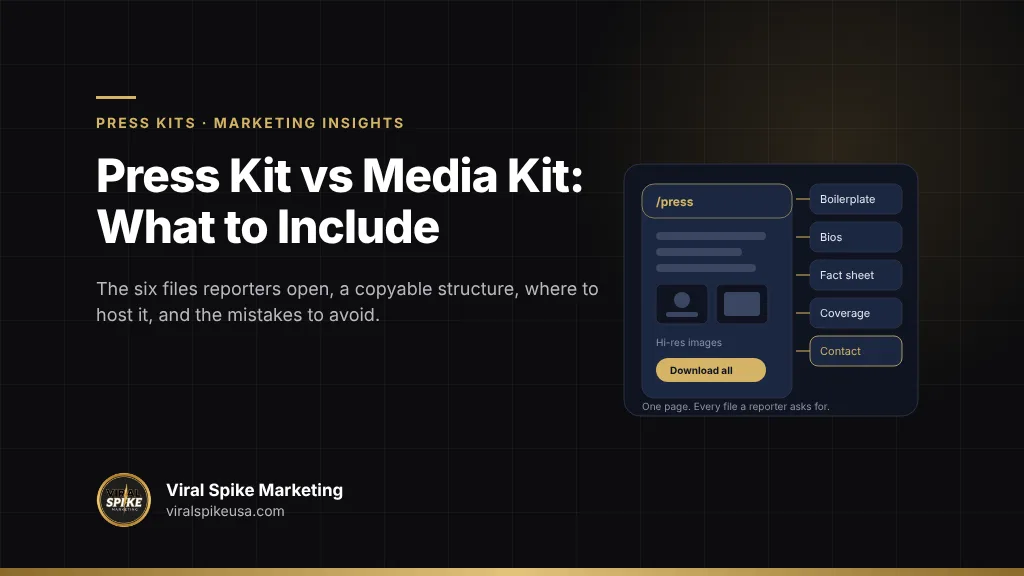
A press kit is a single, public package of the facts and files a journalist needs to write about you without emailing back: a company boilerplate, short and long bios of the people who will be quoted, hi-res images and logos, a one-page fact sheet, links to past coverage, and a named contact who answers. A media kit is a different document aimed at a different reader: it tells advertisers and sponsors what your audience looks like and what a placement costs. The two get confused because both are “kits,” but a reporter never needs your ad rates and an advertiser never needs your founder’s headshot. If you are deciding what to build first, build the press kit, host it as a page on your own domain at a URL like yoursite.com/press, and keep it current. Reporters working under deadline open four things in order: the boilerplate (to describe you accurately), the bio (to introduce the person quoted), the images (to run the piece at all) and the contact (to confirm a detail). Everything else in the kit exists to make those four faster. Below is what to include, a structure you can copy, where to host it and the mistakes that get kits ignored.
Key takeaways
- A press kit serves journalists; a media kit serves advertisers. Most small companies need the first and only build the second once they sell sponsorships or ad space.
- Muck Rack’s 2026 survey of nearly 1,100 journalists found 37 percent value high-resolution images in a pitch and 40 percent value original data; both belong in the kit, not in a follow-up email.
- The minimum viable kit is one web page: boilerplate, bios, fact sheet, image folder, coverage links and a contact. It can be built in an afternoon.
- Host it on your own domain, not only in a shared drive. A /press page is indexable, linkable from every pitch, and under your control when a link in an old article is clicked three years from now.
- The most common failures are not design problems. They are a missing contact, low-resolution images, an out-of-date boilerplate and a PDF nobody can copy text from.
What is a press kit?
A press kit (also called a media kit by some PR teams, which is where the confusion starts, or an electronic press kit, EPK, in music and film) is a prepared set of background materials that lets a journalist, producer, podcast host or event organizer cover you accurately with no back-and-forth. The test is simple: could a reporter who has never heard of you write three accurate paragraphs, choose a photo and credit the right person from your kit alone, at 11 p.m., with your office closed? If yes, the kit works. If they would need to email you for a headshot or ask how to spell the founder’s title, it does not.
A press kit is not a pitch. The pitch is the two-paragraph email that explains why your story matters to that reporter’s readers this week. The kit is what the reporter opens after the pitch has done its job. Keeping those two separate is the first discipline: a kit stuffed with persuasion reads like marketing and gets closed; a pitch that tries to carry every fact reads like a brochure and gets deleted. How the pitch side works is covered in how to get your story in local news and, for a wider program, in what a publicist does.
Who needs one: any company, founder, author, artist or professional who expects to be written about more than once. The format varies slightly by field; the contents do not.
Press kit vs media kit: what is the difference?
The words are used interchangeably in casual speech, and some agencies call the journalist-facing package a “media kit.” In practice two different documents exist, and the cleanest way to keep them apart is by reader.
| Dimension | Press kit | Media kit |
|---|---|---|
| Who it is for | Journalists, editors, producers, podcast hosts, event organizers | Advertisers, sponsors, brand partners, affiliate managers |
| What question it answers | “Who are you, what are the facts, and what can I use?” | “Who is your audience and what does it cost to reach them?” |
| Core contents | Boilerplate, bios, fact sheet, hi-res images and logos, past coverage, press releases, contact | Audience demographics, traffic or follower numbers, engagement rates, ad formats, rate card, case studies |
| Tone | Neutral, factual, written so it can be pasted into an article | Persuasive, written to sell inventory |
| Where it lives | Public /press or /newsroom page, linked from every pitch | Often gated or sent on request; sometimes a PDF deck |
| Who typically needs it | Any business or person who will be covered | Publishers, creators, influencers, event properties, podcasts selling sponsorships |
| Update cadence | Whenever a fact, title, photo or figure changes | Quarterly, with fresh audience numbers |
A creator or publisher may need both. A software company, a law firm or a restaurant almost never needs a media kit; if a vendor’s “media kit” deliverable is a rate card, you have bought the wrong document.
A press kit is also not a press release. A release announces one piece of news on one date. The kit is the standing reference that every release links back to. The cost side of releases and what distribution does and does not buy is in press release distribution cost.
What do reporters actually open?
Muck Rack’s State of Journalism 2026, based on responses from nearly 1,100 journalists, asked what they value in a pitch. As summarized by the University of Minnesota’s marketing communications team, 70 percent said clear relevance to their beat, 58 percent said interview access to relevant sources, 40 percent said original data or research and 37 percent said high-resolution images. The same survey found 69 percent prefer pitches under 200 words, which is exactly why the kit exists: the pitch stays short because the detail lives at a link.
Cision’s 2025 State of the Media report, drawn from more than 3,000 journalists in 19 markets, found 72 percent still call press releases the most useful resource PR teams provide, and notes that impact rises when releases are paired with multimedia. It also found 86 percent will reject a pitch that does not match their beat, which no kit can fix; relevance is the pitch’s job.
Translate those findings into the order a reporter uses a kit:
- Boilerplate. One accurate sentence describing what you are. If it is missing, the reporter writes their own, and it will be less accurate.
- Bio of the person quoted. Name, exact title, one line of background. Title errors in print almost always trace back to a kit that lacked this.
- Images. A story without a usable image runs smaller, later or not at all on many digital outlets.
- Fact sheet. Founding year, headquarters, headcount, customers, funding: the numbers that make a sentence concrete.
- Past coverage. Reporters check whether others have covered you, to judge credibility and to avoid repeating a competitor’s story.
- Contact. A real person, email, phone number and response time, for the one question the kit did not answer.
Absent from that list: a mission statement, a founder’s letter, a list of values. Reporters skip those.
Press kit checklist: exactly what to include
Use this table as a build list. The “format” column matters as much as the item; a bio locked in a PDF is a bio the reporter has to retype.
| Item | What it contains | Format | Priority |
|---|---|---|---|
| Boilerplate | One paragraph (60 to 100 words) describing the company: what it does, for whom, where, since when, and one proof point. Plus a one-sentence version. | Plain text on the page, copyable | Required |
| Bios | For each spokesperson: full name, exact title, 50-word short bio, 150-word long bio, pronunciation if needed, social handles | Plain text, with the headshot beside it | Required |
| Headshots | Two per spokesperson, one formal and one environmental, 2,000 px or larger on the long side, with photographer credit if required | JPG, individually and as a zip | Required |
| Logos | Primary logo in color, white and black; horizontal and stacked; with a note on minimum clear space | SVG or EPS plus PNG with transparent background | Required |
| Product or location images | Five to fifteen hi-res photos of the product, space, team at work or event. Captioned. | JPG, 2,000 px or larger, captions in a text file | Required for consumer, hospitality, retail, music |
| Fact sheet | Founded, HQ, locations, headcount, leadership, customers or units served, funding, key dates | Short table on the page | Required |
| Past coverage | Eight to twelve links to the strongest pieces, newest first, with outlet and date. No screenshots of headlines without links. | Linked list | Strongly recommended |
| Media contact | Name, role, email, phone, time zone, typical response window | Plain text at the top and bottom of the page | Required |
| Video and audio | B-roll for TV, a 60-second explainer, a short interview clip; for musicians, streaming links and a sampler | Downloadable MP4 or a link to a shared folder; embedded player for preview | Optional; required for TV pitching and EPKs |
| Story angles or expert topics | Three to five topics the spokesperson can speak to, phrased as a reporter would | Bulleted list | Recommended for expert commentary |
For a solo professional, author or artist, the “company” boilerplate becomes a short third-person description of you and your work, and the fact sheet becomes a list of releases, books, credentials or notable engagements with dates. The structure is otherwise identical.
Press kit template: a structure you can copy
Build the page in this order. Each heading becomes an anchor so you can link a reporter straight to the section they need (yoursite.com/press#images).
1. Header: who you are in one line
The one-sentence boilerplate, the media contact’s name, email and phone, and a “Download all assets” button that pulls a zip of logos and headshots. The contact goes at the top because it is the thing a reporter on deadline is looking for.
2. About (boilerplate)
The full boilerplate, written in third person, present tense, with no adjectives you could not defend in court. A workable pattern:
[Company] is a [category] company based in [city] that [what it does] for [whom]. Founded in [year] by [founder title, no name needed here if the bio section covers it], it [one concrete proof point: customers served, locations, a documented result]. [Company] is [one distinguishing fact: certification, methodology, ownership structure]. More at [URL].
Write a 25-word version directly beneath it. Reporters paste the short one; the long one is for profiles. Lead with the category (“a commercial roofing contractor serving New Jersey”), use only claims the fact sheet can back with a link or a number, write in third person and present tense, and name clients or partners only with written permission.
3. Leadership and spokespeople
Headshot left, text right. For each person: full name and exact title as it should appear in print, then the short bio, then an expandable long bio. A short-bio pattern that avoids the usual fluff:
[Full name] is [title] of [Company], where [he/she/they] leads [function]. Before [Company], [surname] spent [N] years in [field] at [type of organization]. [Surname] speaks and writes on [topic one], [topic two] and [topic three], and holds [credential] from [institution].
Never list a board member or investor as a spokesperson unless they have agreed to take calls.
4. Fact sheet
A two-column table: Founded, Headquarters, Other locations, Employees, Leadership, Customers or units, Funding (if disclosed), Pricing (if public), Key milestones with dates. Dates and numbers only; the narrative belongs in the boilerplate.
5. Images and logos
Thumbnails that open the full-resolution file, grouped as Headshots, Logos, Product or Location, Events. Each image carries a caption and a credit line in the filename and beside the thumbnail. Google’s image guidance is written for search, but its rules are good press-kit hygiene too: descriptive filenames instead of IMG_0023.jpg, descriptive alt text, sharp files, and the same stable URL for the same image everywhere.
6. In the news
Outlet, headline, date, link. Newest first, eight to twelve items. If you have earned or guaranteed features in recognized outlets, this is where they work hardest.
7. Story angles and expert topics
Three to five topics, each one sentence, phrased as a question a reporter would ask (“What does the new overtime rule mean for restaurants with under 50 staff?”). This section turns a static kit into a sourcing tool, and it is the section that gets founders quoted between announcements. How to turn that into a sustained profile is in how to become a thought leader in your industry.
8. Contact (repeated)
Same contact as the header, plus the hours you answer and a backup.
Where should you host a press kit?
There are three common choices, and they are not mutually exclusive. The ranking below is by what serves the reporter and what serves you over time.
| Option | Pros | Cons | Verdict |
|---|---|---|---|
| A page on your own domain (/press or /newsroom) | Indexable, permanent URL, text is copyable, you control updates, links from coverage point to your site, supports your entity data for search and AI answers | Needs a CMS page and image hosting; large files need a download link | Primary home. Build this first. |
| Shared folder (Google Drive, Dropbox, Box) | Easiest way to deliver 50 hi-res files; zip downloads; easy to update | Not indexable, permissions break, links expire or get reorganized, no context around the files | Use for the heavy assets, linked from the /press page |
| Single PDF | Portable, looks finished, works as an attachment | Text is hard to copy cleanly, images are compressed, it goes out of date the day it is exported, it cannot be linked to by section | Optional one-page fact sheet only; never the whole kit |
The reason to favor your own domain is not only convenience. A /press page states consistent facts about your entity, names its people and links to independent coverage, and search engines and AI assistants read it when they decide what you are. The same consistency helps a knowledge panel; see how to get a Google Knowledge Panel for a business.
Practical notes: name image files descriptively, include a captions file in the zip, keep full-size originals behind compressed previews, and gate nothing. Reporters will not fill in a form to get your logo; they will use a screenshot or skip the image.
Common press kit mistakes
Most kits fail on logistics, not on design.
- No contact, or a contact form. A reporter with one question at 5:40 p.m. will not submit a form. Put a name, an email and a phone number at the top.
- Low-resolution or watermarked images. A 600-pixel logo pulled from your website header cannot be printed or run as a lead image. Supply originals.
- Everything in a PDF. Copying a bio from a PDF introduces line breaks and odd characters. Put text on the page.
- Stale facts. An old headcount, a departed executive still listed as CEO, a 2023 funding figure. Review the page every quarter and after every announcement.
- Marketing language. Mission statements and superlatives are skipped and lower trust in the facts around them.
- Coverage as screenshots. A wall of outlet logos without links reads as a claim, not evidence. Link each piece, and leave off any badge that refers to a syndicated press release rather than an article.
- Gated downloads. Requiring an email to download a headshot loses the image placement and annoys the one audience the page exists for.
- Dead links and a hidden page. Check shared-drive links quarterly, and link /press from the footer, every release and every email signature.
Measure two things: how often a reporter asks for an asset the kit should have contained (target: zero), and how often coverage uses your boilerplate unchanged. Folding that into a scorecard is covered in how to measure PR results.
Where Viral Spike fits
A press kit is the first deliverable in most Viral Spike public relations engagements, because every pitch, interview request and feature that follows draws on it: the boilerplate, spokesperson bios, fact sheet, image library and story angles are written once and then used across outreach. For companies that need coverage on a date rather than when an editor gets around to it, the same materials feed guaranteed editorial placements across 1,600+ outlets, where you approve the draft, the article is published and indexed on Google, and the engagement is refunded in full if it never runs. Those features then go into the kit’s “In the news” section, which is where a kit starts to do its own persuading. If you already have a kit and want it reviewed before a launch, send us the link.
Build the page this week, then keep it true
Open a blank page at yoursite.com/press. Paste in a 90-word boilerplate and a 25-word version. Add one spokesperson with an exact title, a 50-word bio and two headshots at full resolution. Add a six-row fact sheet, your logo in three formats, your contact details at the top and bottom, and links to whatever coverage you have, even if it is two local pieces. Put “Updated October 2026” at the bottom. That is a working press kit, and it will outperform a designed 40-page PDF because a reporter can use it in ninety seconds. Expand it as you go, and review it the day after every announcement.
Frequently asked questions
What is the difference between a press kit and a media kit?
A press kit is for journalists: a boilerplate, bios, a fact sheet, hi-res images and logos, past coverage and a media contact, so a reporter can cover you accurately without emailing back. A media kit is for advertisers and sponsors: audience demographics, traffic or follower numbers, ad formats and a rate card. Some PR teams use ‘media kit’ to mean the journalist version, so check which document a vendor is proposing before you pay for it.
What should a press kit include?
At minimum: a one-paragraph and a one-sentence boilerplate, a bio and headshots for each spokesperson with exact titles, logos in vector and PNG formats, a fact sheet with founding year, location, headcount and key figures, eight to twelve links to past coverage, an archive of press releases and a named media contact with email and phone. Add product or location photos, b-roll and a list of expert topics where relevant.
Where should I host my press kit?
On your own website at a stable URL such as yoursite.com/press, with text on the page and large files available through direct download links or a linked shared folder. A page on your domain is indexable, can be linked by section, stays under your control and supports the entity information search engines and AI assistants read. Use a PDF only for an optional one-page fact sheet, not for the whole kit.
How long should a press kit be?
One web page. A reporter should find the boilerplate, a bio, an image and the contact within a minute. The boilerplate runs 60 to 100 words with a 25-word version, bios run 50 and 150 words, and the fact sheet is a short table. Depth comes from links: to releases, to coverage, to a full image folder. A kit that scrolls for ten screens is a kit a reporter will leave.
Do I need a press kit if I am a solo professional or artist?
Yes, in a lighter form. Replace the company boilerplate with a third-person description of you and your work, and the fact sheet with a list of releases, books, credentials or notable engagements with dates. Keep two headshots at full resolution, a short and long bio with your exact professional title, links to past coverage or interviews, and a direct contact. Musicians usually add streaming links, a sampler and a stage plot to form an electronic press kit.
How often should I update a press kit?
Review it after every announcement and at least once a quarter. Update the headcount, leadership titles, funding, locations and coverage list, replace headshots older than two to three years, and check that every download and shared-folder link still works. Put an ‘Updated [month year]’ line at the bottom of the page so reporters can see the facts are current rather than assuming they are not.
Sources
Primary sources referenced in this article, in order of first use.
- State of Journalism 2026 (muckrack.com)
- University of Minnesota's marketing communications team (umarcomm.umn.edu)
- 2025 State of the Media report (cision.com)
- image guidance (developers.google.com)

More in Marketing Insights

Related services