
How to Remove Trustpilot Reviews: Flagging Rules, What Trustpilot Deletes, and What to Do When It Says No
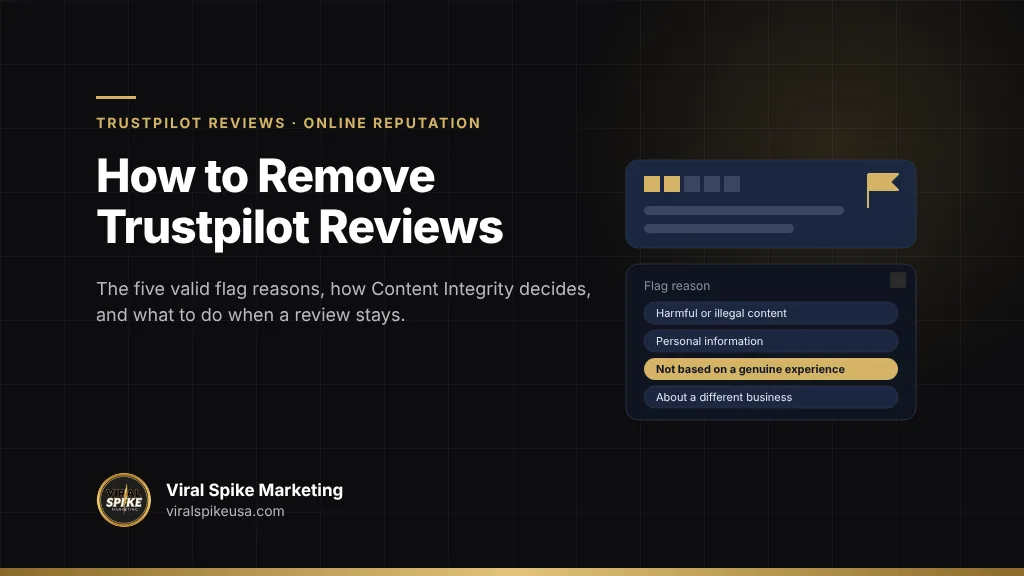
You can remove a Trustpilot review only by flagging it for one of the reasons Trustpilot’s guidelines recognize and letting its Content Integrity team decide. The valid reasons are harmful or illegal content, personal information about someone, advertising or promotional material, content not based on a genuine experience, and a review about a different business. “Not liking a star rating or disagreeing with a negative review is not a valid reason for flagging,” the business guidelines say, and Trustpilot adds that “businesses have no control over review removal” and cannot pay for it. Flag from your business account, pick the one reason that fits, and supply what Trustpilot can check: an order lookup that returns nothing, a screenshot of a review-trading post, a sentence that names an employee. A flagged review usually stays visible during investigation, and you are told the outcome. For the reviews that remain, the levers are a public reply, a neutral invitation program that brings in all customers, and the surfaces beyond Trustpilot where your reputation is actually decided.
Key takeaways
- Trustpilot removes reviews for five guideline breaches, not for being negative; if a review does not breach the rules, the advised route is a public reply.
- Trustpilot removed 4.5 million fake reviews in 2024, about 7 percent of reviews posted, with 90 percent caught by automated systems; businesses flagged 61 thousand reviews that year.
- Misusing the flag tool, including flagging for the wrong reason or only on one-star reviews, is itself a breach that can cost a business its flagging rights and earn a Consumer Warning.
- Reviews flagged as harmful or illegal are hidden while investigated; every other flag leaves the review online until a decision.
- The FTC’s 2024 rule makes buying, selling or suppressing reviews with baseless threats a federal violation with civil penalties, so the fix has to be policy-based, not pressure-based.
What does Trustpilot remove, and what does it refuse to remove?
Trustpilot publishes two rulebooks: Guidelines for Reviewers (version 2.3, September 2026) and Guidelines for Businesses (version 7.3, September 2026). Removal is only ever about a breach of one.
On the reviewer side, a review must be based on a “genuine experience” with the business (a purchase, call, email, chat or store visit) and should be recent, which Trustpilot defines as “typically” within the last 12 months. Owners, immediate family, employees, shareholders and competitors may not review the business, and anyone offered an incentive is ineligible. Prohibited content includes hate speech, threats, obscenity and defamation; other people’s personal details such as employees’ names or photos; promotional links and codes; and reviews about a different company. Reviewers can edit or delete their own reviews at any time, and only a person’s most recent review counts toward the TrustScore.
| Flag reason | What qualifies | What you need to show | Review visible during investigation? |
|---|---|---|---|
| Harmful or illegal content | Hate speech, threats, obscenity, defamation (only a business can report defamation) | Quote the sentence and explain the harm; for defamation, a specific false statement of fact | No, hidden while reviewed |
| Personal information | Names, phone numbers, emails or photos of staff or others not already public on your profile or site | Point to the detail and confirm it is not published by you | Yes |
| Advertising or promotional | Links, calls to action or codes for another business; spam; impersonation | Identify the promotional element | Yes |
| Not based on a genuine experience | No record of the reviewer as a customer; incentivized; written by someone with a special relationship; fake | Searched records (order, email, phone) with no match; evidence of a review-trading post or conflict | Yes; may be run through detection software, and reviewer may be asked for documentation |
| About a different business | The experience was with another company or domain | Identify the business actually described | Yes; may be moved rather than removed |
Trustpilot is explicit about what falls outside those five: it “does not remove reviews simply because a business considers them unfair or critical,” and businesses “can respond to feedback but cannot delete it.” It also will not delete a business profile page on request. A one-star review that accurately describes a late delivery is permanent in the sense that matters, and planning should start there.
How does a business flag a Trustpilot review?
Flagging is available on free and paid business accounts alike; the FTC’s guide to reporting suspicious online reviews (updated February 2024) describes the route as the flag icon in the Service Reviews section of the business account, with consumers using the same icon on the public review after confirming they are not affiliated with the company.
- Search your records first. For a “no genuine experience” flag, Trustpilot expects you to have looked: reviewer name, reference number, email or phone. The guidelines let you ask the reviewer for a reference number; sharing is optional for them, but a refusal supports your flag.
- Choose exactly one reason from the five. A flag filed under the wrong category is a misuse, not a near miss.
- Write the explanation for an investigator with no context. Which rule, which sentence, what you checked, what you found.
- Attach evidence where the tool allows it: screenshots of review-trading posts, the search you ran, correspondence showing a conflict of interest.
- Wait for the outcome. Flags are screened automatically first; Content Integrity specialists handle challenges. Reviewers may be asked to edit or provide documentation within three days. You are notified of the result and can dispute a decision on a “not genuine” flag.
Flag what breaches the rules, in both directions; the guidelines require “flagging 5-star reviews for the same reasons you flag 1-star reviews.” The evidence discipline is the same on every platform; our Google review removal guide shows what a policy-matched report looks like in full.
What happens inside the Content Integrity process?
Trustpilot’s Trust Centre describes a layered system. Every submitted review is screened automatically against behavioral signals, content, IP address, device, location and timestamps, and suspicious reviews never appear. Flagged reviews pass through the same screening before a person looks at them. Content Integrity teams step in when a business or consumer challenges an automated decision, and a Fraud and Investigations function handles coordinated abuse.
The scale is in the Trust Report 2025, covering calendar 2024: 301 million active reviews on the platform, 4.5 million fake reviews removed (about 7 percent of reviews posted that year), 90 percent of them detected automatically, 61 thousand reviews flagged by businesses, 9 thousand active Consumer Warnings (up 24 percent), 5 thousand cease-and-desist letters issued (up 12 percent), and legal action against 11 businesses since 2022, including a UK High Court win in November 2024 against three review-selling websites.
Read those numbers from a business owner’s chair: the system is mostly catching fakes before anyone sees them. A flag that adds information the machine did not have (a record search, a conflict of interest, a trading post) gets a human decision in your favor. A flag that restates “we disagree” is screened out at the first layer.
Trustpilot’s Action We Take policy spells out what happens to businesses that misuse the system, in escalating steps: an educational email, a warning, a cease-and-desist notice, account restrictions (including losing the ability to flag), a Consumer Warning on the profile that hides the TrustScore, ends paid subscriptions and usually lasts about six months, and finally legal action or referral to regulators. Triggers include fake or procured reviews, biased invitations and “misuse of the flagging tool.” Flagging every one-star review you receive is the quickest route onto that ladder.
Do paid and free business accounts get treated differently?
Not on removal. Trustpilot’s Trust Centre says “no one can buy a higher score,” the guidelines say businesses have no control over removal, and the Action We Take policy applies the same enforcement ladder regardless of plan; a Consumer Warning ends a paid subscription rather than being avoided by one. What a paid plan changes is collection and workflow, not moderation.
Per Trustpilot’s pricing page (October 2026), the free plan includes 50 automated review invitations a month and one user login; paid tiers raise invitation volume (100, 300, 1,000 and unlimited across Starter, Plus, Premium and Enterprise) and add users, domains and analytics. A business with a large customer base on the free plan collects a thin, self-selected sample, usually more negative than its customers; a paid plan can invite everyone.
| Capability | Free business account | Paid plans |
|---|---|---|
| Flag reviews under the five reasons | Yes | Yes, same process and same outcomes |
| Reply publicly to reviews | Yes | Yes; AI-assisted replies on higher tiers |
| Automated invitations | 50 per month | 100 to unlimited by tier |
| Influence on removal decisions | None | None |
| Protection from Consumer Warnings | None | None; a warning ends the subscription |
Whether a paid plan is worth it is a collection question: if you serve thousands of customers a month and have a few dozen reviews, your angriest customers are setting the rating and an invitation program is the fix.
What do ‘Verified’ and ‘Invited’ labels mean for removal?
Trustpilot labels reviews by how they were collected. Reviews that arrive through invitations sent by Trustpilot’s own system carry a verified label, while organic reviews written without an invitation do not; a 2022 guide to the platform describes reviews from automatic invitations as “labeled as ‘verified’ on Trustpilot” and notes that organic reviewers are not asked for proof of purchase. Trustpilot’s reviewer guidelines confirm the split: reviewers do not need an invitation to post, and businesses may invite customers neutrally.
For removal, the label matters in one way. A review that came through your own invitation is tied to a customer record, so “not based on a genuine experience” is almost never available; the remaining flag reasons are content-based. An organic review with no matching record is the opposite case: your record search is the evidence and the “genuine experience” flag is the right tool.
The label also shapes the fix. Trustpilot bars cherry-picking: inviting only customers believed to be happy, timing invitations to exclude unhappy ones, or steering dissatisfied customers away from reviewing. Invite everyone the same way at the same point in the journey, with no incentives and no “if you like us, leave five stars” phrasing. Done properly, an invitation program is the most effective way to move a TrustScore, because it replaces a self-selected sample with the real customer base.
What legal routes exist, and how does the FTC fake review rule apply?
Start with the constraint. The FTC’s final rule on fake reviews and testimonials, announced August 14, 2024, bans creating, buying or selling fake or AI-generated reviews; paying for reviews conditioned on sentiment; undisclosed insider reviews; and “review suppression” through baseless legal threats or intimidation, with civil penalties for knowing violators. Trustpilot’s guidelines echo it: “fake reviews undermine trust and are illegal.”
So a business cannot buy positives to dilute a bad review, gate unhappy customers out of the invitation flow, or threaten a reviewer over an honest opinion without federal exposure. What remains is narrow:
- Defamation. Trustpilot allows only businesses to flag defamation, and the standard is a specific, false, damaging statement of fact, not a harsh opinion. If a review says you were “fined by the regulator” and you were not, flag it under harmful or illegal content with the proof. A legal notice should quote the statement and explain why it is false and provable; a complaint about tone is a dispute, and Trustpilot stays neutral in disputes.
- Extortion. A demand for a refund or payment to delete or change a review breaches the guidelines and can be reported through Trustpilot’s Community Reporting form with screenshots.
- Court orders. Where a court has found content unlawful, Trustpilot acts on the order. Slow and public.
The Consumer Review Fairness Act, described in the FTC’s business guidance, adds that a business cannot use its terms and conditions to prohibit or penalize customer reviews. This is general information, not legal advice; a lawyer in your jurisdiction should review any specific dispute.
How should you reply to a Trustpilot review you cannot remove?
Trustpilot’s business guidelines encourage replies “to build trust, answer questions, resolve issues, and say thanks,” warn that replies containing personal information, threats or aggressive language may be removed, and instruct businesses to reply with their side of the story when a review does not breach the rules. Three templates cover most cases; fuller versions are in our negative review response templates.
Accurate complaint: “Thank you for the detail. The delay you describe happened, and it was caused by [one-line reason]. We have [specific change] as of [month]. If you would like us to make this right, please email [address] with your order number and we will handle it personally.”
No record of the customer: “We want to look into this but have not found an order or conversation matching this review. Could you contact us at [address] with a reference number so we can investigate?”
Review that breaches guidelines but is still live: Reply to the substance only. “We have reported this review to Trustpilot” invites a public argument and tells future readers nothing.
Reply within days, keep it under a hundred words, name a real contact route, and never confirm personal details about the reviewer.
What should you do when the review stays?
If the review is accurate or unprovable, the goal shifts from deleting it to changing the sample it sits in and the surfaces around it. On Trustpilot, that means the neutral, universal invitation program described above and a reply to every review. Only a reviewer’s most recent review counts, so a steady flow from new customers matters more than a burst.
Off Trustpilot, the review matters to the extent the profile ranks for your brand name and feeds AI assistants’ summaries. Check both. If the page sits in the top results, your own site, press coverage and controlled profiles should outrank it, using the method in how to suppress negative search results the right way. If an assistant answers “is [company] legitimate” by quoting the Trustpilot profile, the fix is independent corroboration elsewhere; the mechanics are in what ChatGPT says about your company. The relative cost of each layer is laid out in how much reputation management costs, and if the same reviewer has posted on Google or Yelp, the parallel rules are in our Yelp review removal guide.
Where Viral Spike fits
Viral Spike’s reputation management service starts with an audit of every negative review on your profile against the five flag reasons: which have a record-search or conflict-of-interest basis, which are content breaches, and which no flag will touch. We prepare the flags and evidence, draft replies, and set up the neutral invitation program that moves the TrustScore. Around the profile, we build the layer that decides what prospects and AI assistants conclude about you: your own pages ranking for your name, consistent profiles across the directories buyers check, and guaranteed editorial placements in recognized outlets, where you approve the draft, the article is published and indexed on Google, and the engagement is refunded in full if it never runs. The reviews we take on are removed or you receive a full refund: we assess every review against Trustpilot’s policy in writing first and only take on the ones with a basis, with the terms in your agreement before any work starts. We do not buy reviews or contact reviewers on your behalf. To find out which of your reviews are flaggable, contact us with the profile link.
Flag what breaches a rule, reply to the rest, and invite everyone
This week, run a record search on every negative review from the past year and sort them: no matching customer, content breach, or accurate complaint. Flag the first two groups, one reason and one piece of evidence each, and reply to the third with a specific fix and a contact route. Then turn on a universal invitation at the point every customer completes a purchase or service, with no incentive and no star guidance. Check the TrustScore in ninety days; the invitations will have done more than the flags.
Frequently asked questions
Can a business remove a Trustpilot review?
Not directly. A business can flag a review for one of five guideline breaches (harmful or illegal content, personal information, promotional content, no genuine experience, or wrong business), and Trustpilot’s Content Integrity process decides. Trustpilot says businesses have no control over removal, cannot pay for it, and that disliking a rating is not a valid flag reason. Reviews that do not breach the guidelines stay up, and the advised route is a public reply.
How long does Trustpilot take to decide on a flagged review?
Trustpilot does not publish a fixed turnaround. Flagged reviews are screened by automated technology first, then by Content Integrity specialists when a decision is challenged. If the reviewer is asked to edit the review or provide documentation, they have three days to do so. Businesses are notified of the outcome and can reply to dispute a decision on a review flagged as not based on a genuine experience.
Does a flagged Trustpilot review stay visible?
Usually yes. Trustpilot keeps flagged reviews online during investigation, with one exception: a review flagged by a business as harmful or illegal content (hate speech, threats, obscenity, defamation) is hidden while it is reviewed. Flagging a review under that category to get it hidden when it does not qualify counts as misuse of the flag tool, which can lead to restrictions on the business account.
Can a paid Trustpilot plan get reviews removed faster?
No. Trustpilot states that no one can buy a higher score, that businesses cannot pay to remove reviews, and its enforcement policy applies to every account; a Consumer Warning ends a paid subscription rather than being avoided by one. Paid plans change collection and workflow, mainly the number of automated invitations per month (50 on the free plan, more on paid tiers) and analytics, not moderation decisions.
Is it legal to pay for positive Trustpilot reviews to offset a bad one?
No. The FTC’s final rule on fake reviews, announced in August 2024, bans buying or selling fake reviews and paying for reviews conditioned on sentiment, with civil penalties for knowing violators. Trustpilot’s guidelines prohibit incentivized reviews and cherry-picking who is invited, and it issued about 5 thousand cease-and-desist letters in 2024. Invite every customer neutrally at the same point in the journey instead.
What if a reviewer demands a refund to delete a Trustpilot review?
Do not pay. Trustpilot’s guidelines prohibit pressure, blackmail or threats to write, edit or delete reviews, by anyone. Screenshot the demand with the sender and date, report it through Trustpilot’s Community Reporting form, and flag the review with the evidence. The FTC’s 2024 rule treats buying review changes as a violation on the business side too, so a refund-for-deletion deal exposes you, not just the reviewer.
Sources
Primary sources referenced in this article, in order of first use.
- Guidelines for Reviewers (corporate.trustpilot.com)
- Guidelines for Businesses (corporate.trustpilot.com)
- reporting suspicious online reviews (consumer.ftc.gov)
- Trust Centre (corporate.trustpilot.com)
- Trust Report 2025 (corporate.trustpilot.com)
- Action We Take (corporate.trustpilot.com)
- pricing page (business.trustpilot.com)
- 2022 guide to the platform (trustsignals.com)
- final rule on fake reviews and testimonials (ftc.gov)
- business guidance (ftc.gov)

More in Online Reputation
 How to Remove Facebook Reviews and Recommendations: Reporting, Turning Recommendations Off, and What to Do When a Page Is Attacked
 How to Remove Google Reviews: Step by Step Through Flagging, the Reviews Management Tool, Appeals and Legal Requests
 How to Remove Glassdoor Reviews: What Glassdoor Removes, What It Never Will, and How Employers Should Respond
Related services