
Ripoff Report Removal: What Actually Works, What Is Sold, and What to Do When the Report Stays
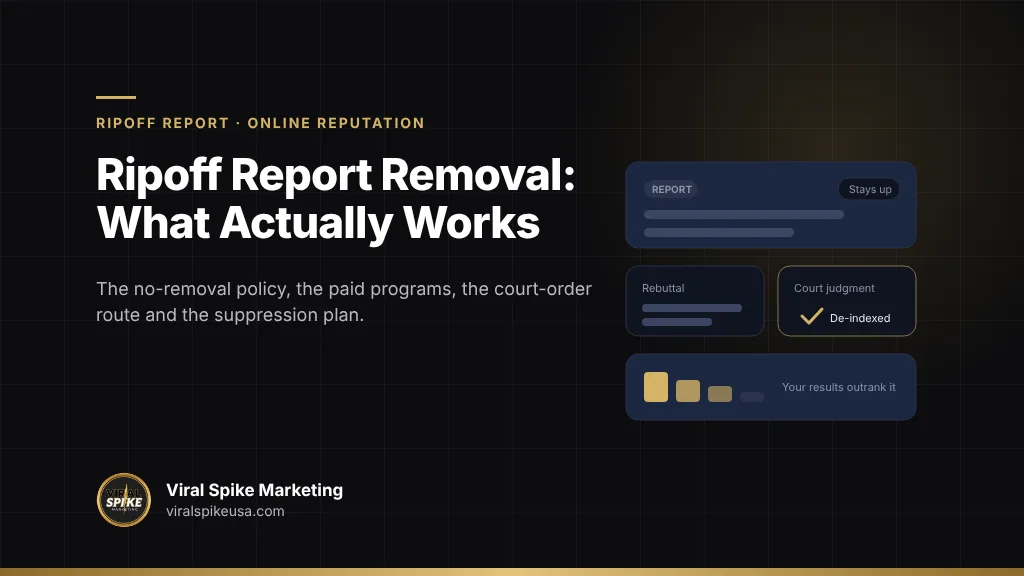
Ripoff Report removal, in the sense of the page being deleted at your request, almost never happens. The site’s position, repeated in its terms and in court filings, is that once a report is submitted it will not be taken down, even by the person who wrote it. What a business can do falls into four lanes. It can post a rebuttal on the report, which is free and immediate. It can pay for one of the site’s own programs, which change what the page says or how it is handled but do not delete it. It can sue the author for defamation, win a judgment with specific findings, and present that judgment to Google to de-index the URL, which removes the page from search results while leaving it on the site. Or it can suppress the report by ranking stronger pages above it for the searches that matter. For most businesses the realistic plan is a careful rebuttal, a legal review of whether the statements are provably false, and a suppression program that treats the report as one URL to outrank rather than a page to delete.
Key takeaways
- Ripoff Report’s stated policy is no removal. Its terms say reports “will NOT be removed even at your request,” and a 2023 federal court order summarized its position as “once a Report is submitted, R[ipoff] will not take it down.”
- The site’s paid options, the Corporate Advocacy Program and the VIP Arbitration Program, add findings or redact statements an arbitrator finds false; they do not delete the report.
- Section 230 of the Communications Decency Act generally shields the site from liability for what users post, so lawsuits target the author, not Ripoff Report.
- A court judgment with specific findings that statements are false is the basis for a Google legal removal request; Google removes the URL from its results, not from the web.
- Suppression is the route that works regardless of the report’s merits, and it is where most of the money and time should go.
What is Ripoff Report’s actual policy on removing reports?
Ripoff Report has published user complaints since December 1998. It is operated by Xcentric Ventures, LLC of Tempe, Arizona, founded by Ed Magedson, and it describes itself as publishing “unedited, uncensored” complaints. Its removal stance is the most consistent thing about it. According to the site’s terms of service as quoted on Wikipedia’s entry on Ripoff Report, reports “will NOT be removed even at your request,” a rule that applies to the author as much as to the subject. The only stated exception is a report decided against the complainant in the site’s own arbitration.
Courts have recorded the same position. In Selker v. Xcentric Ventures (S.D. Cal., order of February 28, 2023), the court summarized the complaint’s description of the site: “no matter the circumstances, once a Report is submitted, R[ipoff] will not take it down,” and the subject’s only free option is a rebuttal. The same order describes a fee-based “NoIndex” service the plaintiff said he paid for, after which the report stayed on the site. This is general information, not legal advice; a lawyer licensed in your state should review any specific dispute.
Why the site can hold this line is a matter of federal law. 47 U.S.C. § 230(c)(1) provides that “No provider or user of an interactive computer service shall be treated as the publisher or speaker of any information provided by another information content provider.” A business that sues Ripoff Report for a user’s report usually loses on that ground, which is why the realistic legal defendant is the author. The one qualification, from a 2015 Ninth Circuit decision noted in the Wikipedia entry, is that the statute “does not immunize Xcentric for the content it creates and posts,” such as its own headings or categories, a narrow exception that has not changed the overall picture.
What are Ripoff Report’s paid programs, and do they remove anything?
The site sells programs to businesses that are the subject of reports. None deletes the report. The descriptions below come from the court order and the Wikipedia entry linked above, each of which quotes or summarizes the site’s own materials; confirm current terms with the site before paying for anything.
| Program | What it does, per the sources | Effect on the report | What it costs |
|---|---|---|---|
| Corporate Advocacy Program (full name: Corporate Advocacy Business Remediation and Customer Satisfaction Program) | The business pays for the site to investigate, and the site edits the report pages to add its findings, which can be favorable to the business | Report stays; the page gains the site’s added text | Not published here; the site quotes fees individually |
| VIP Arbitration Program (“Voluntary, Impartial, and Private”) | An arbitrator reviews specific statements the business says are false; statements found false are redacted | Report stays; false statements are struck, the rest remains | Per the complaint summarized in Selker, $2,000 per challenged report, split between the site and the arbitrator, non-refundable |
| NoIndex service | Described in Selker as an offer to de-index a report from search engines for a fee | Report stays on the site; search visibility may change | The plaintiff in Selker said he paid a discounted $2,500 |
The programs have drawn criticism precisely because they are sold by the site hosting the complaint. The Wikipedia entry records Bloomberg Businessweek’s description of the model as “how to make money rebuilding reputations: have them destroyed first,” a 2015 Utah federal court finding that the fee-based programs undercut the site’s claim to be a neutral publisher, and a March 2017 ruling by Italy’s data protection authority that requests for money to edit pages were illegal there. If you consider one, get the scope in writing: which statements will be reviewed, what “redaction” means on the page, and whether the report title and URL stay as they are.
One route that does not apply: Google’s policy for sites with “exploitative removal practices.” Google said in a June 2021 post on protecting people from harassment that it removes pages from sites that “require payment to remove content” and ranks those sites lower. But the request form’s conditions, as reported by Search Engine Journal in April 2019, include that “the website is not a business review site.” Ripoff Report is a complaint site about businesses, so a business is unlikely to qualify; an individual named in a report may have a stronger argument and should try.
Should you post a rebuttal on the report?
Usually yes, and carefully. A rebuttal is the one free action that changes the page, and it is read by the same prospects who found the report. It also stays up permanently and is quoted back to you in any later dispute, so it is a public statement, not a reply.
- State facts you can prove, briefly. Dates, what was delivered, what was refunded. Do not characterize the complainant.
- Do not identify the customer beyond what they disclosed, and never include transaction or personal details. For regulated practices, confirming the relationship can be a breach on its own.
- Do not threaten litigation in the rebuttal. It reads badly to prospects and can be used against you.
- Explain what changed if anything did. A process fix is more persuasive than a denial.
- Keep it to a few sentences. Long rebuttals signal that the report hit home.
Write it after a lawyer has looked at the report, because a rebuttal that concedes a disputed fact weakens a later defamation claim. Adaptable wording for calm, specific responses is in our negative review response templates; the same principles apply here with a lower word count.
How does the court-order route work?
This is the only route that produces something like removal, and it has two stages: a judgment against the author, then a request to Google. Because Section 230 protects the site, the defendant is the person who wrote the report. If they are anonymous, the case begins with identifying them, which Ripoff Report resists.
Stage one: the judgment
A defamation claim requires a false statement of fact, not opinion, that damaged you. “They ripped me off” is opinion; “they charged my card twice and refused a refund” is a factual claim that is true or false. A 2016 analysis by the law firm Vorys describes the working method: the order should declare the specified statements at the listed URLs false and defamatory, mandate removal, and include language covering identical or substantially similar content found later. Where the author never answers, a default judgment is possible after court-approved service.
Stage two: Google
Google’s legal removal troubleshooter lists “Court order: Report content that a court decision has determined is unlawful” as a category for Google Search. Google’s legal removal guidance asks for the specific URL, a description of what is unlawful and why, and it notes the limit that matters most: removal from Google “may still exist elsewhere on the web.” The Ripoff Report page remains live; it stops appearing in Google results for the URLs covered. Vorys adds that Google “will generally remove search results linking to defamatory content in response to a valid court order,” while expecting the plaintiff to show they notified or tried to notify the poster and could not get the site to act.
What Ripoff Report itself does with a judgment
Less than you would hope. Search Engine Watch reported in July 2014 that the site had begun making “appropriate edits” to reports in response to court judgments, but only with “the specific findings of the court,” a ruling that references the site, and the poster’s real name and the post URL, and that default judgments were not honored because both sides had not argued the facts. Vorys’s 2016 summary matches: the site may redact specific false statements where the order is “supported by admissible evidence, including reasonably corroborated affidavits under oath,” but does not remove entire postings. The court order is therefore mostly a Google tool.
| Route | What you need | Result if it works | Typical duration | Who it suits |
|---|---|---|---|---|
| Rebuttal | Facts, restraint, legal review | Your statement on the page | Days | Everyone |
| Site’s paid programs | Fee, agreement on the site’s terms | Findings added or false statements redacted; report stays | Weeks to months | Businesses with many reports and a resolution story |
| Judgment plus Google request | Provably false statements of fact, an identifiable or servable author, counsel | URL removed from Google results; page stays live | Many months | Specific, damaging, provable falsehoods |
| Suppression | Content, profiles, press, time | Report pushed below your own results | Three to twelve months | Everyone, in parallel with the above |
What about services that promise guaranteed Ripoff Report removal?
Be skeptical of any vendor that guarantees deletion. The site’s policy, Section 230 and the court-order mechanics above leave no lever that an outside firm can pull to make a report disappear. A vendor that will not explain which of the four lanes it is using is either reselling the site’s own programs at a markup or planning something you do not want your name attached to.
What legitimate firms actually do:
- Assess, in writing, whether the statements are provably false and whether the author can be identified, then refer you to counsel if a judgment is realistic.
- Draft the rebuttal and manage the submission.
- Prepare the Google legal request once a judgment exists, with the URLs and findings matched.
- Run the suppression program, which is most of the work.
What the red flags look like: a flat fee for “removal” with no legal step, a promise of a specific date, a request that you stop responding to the complainant, or vagueness about who files what and where. Our checklist for vetting any firm is in questions to ask a reputation management agency first.
How do you suppress a Ripoff Report page in search?
Ripoff Report pages rank for business names because the domain is old, heavily linked and built around the subject’s name in the title and URL. Google has said since 2021 that it ranks sites with pay-to-remove practices lower; that helps at the margin but does not remove the page from a branded search. Suppression therefore means outranking the report with pages Google trusts more for your name.
- Own the top results. Your site’s home page and an about page, Google Business Profile, LinkedIn, and the two or three directories that already rank for your name should be complete, consistent and current.
- Publish pages that answer the query the report creates. People who saw the report search “[company] complaints” or “[company] reviews.” A reviews page, a service guarantee page and a plain-language account of how disputes are handled give Google an answer to rank.
- Earn coverage that ranks. Editorial articles in recognized publications outrank a complaint page because they carry the trust signals Google rewards: domain authority, editorial review and real engagement. They also become what AI assistants cite when someone asks whether you are legitimate. This is the layer that moves the report from position two to position eight.
- Keep the cadence. One article is a blip; a quarterly rhythm of coverage, interviews and new owned pages holds the position.
- Track the exact queries monthly. Your name, your name plus “ripoff report”, “complaints”, “reviews” and “scam”, in an incognito window on desktop and mobile.
The method in full is in how to suppress negative search results the right way, and the content side in pushing down negative results with content that outranks them. If the report also fuels an autocomplete prediction for your name, the options are in how to remove negative Google autocomplete suggestions.
What should you do in the first week after finding a report?
- Preserve it. Screenshot the report, its URL, date and any updates. Note the search queries where it appears and its position.
- Do not contact the author with threats or offers. Threats become the next report; payment confirms the tactic.
- Check whether the report describes a real transaction. If it does, resolve the underlying complaint through your normal channels and document it.
- Get a legal read. Have counsel identify any statements of fact that are provably false and advise whether a judgment is worth pursuing.
- Draft the rebuttal after that read, and post it.
- Start suppression now. It is the slowest lever, and it works whether or not the legal route succeeds. Fold the report into a monthly reputation audit so copies and follow-up reports are caught early.
Where Viral Spike fits
Viral Spike’s reputation management service begins with a written assessment of the report: which statements are opinion, which are factual claims that could support a defamation action, whether the author is identifiable, and what the page currently costs you in search. We draft the rebuttal, prepare the Google legal removal request where a judgment exists, and run the suppression program: owned pages that answer the queries the report creates, consistent profiles, and guaranteed editorial placements in recognized outlets, where you approve the draft, the article is published and indexed on Google, and the engagement is refunded in full if it never runs. Our public relations team builds the ongoing coverage that holds the position. Removal work we take on is guaranteed or refunded in full: we assess the report against the platform’s policy and the legal options in writing first, so we only take on cases with a basis, and the terms are in your agreement before any work starts. Removal-related work is scoped and paid upfront with the assessment first. To find out where your report stands, contact us with the URL.
Treat the report as a URL to outrank, not a page to delete
Search your business name today in an incognito window and note where the Ripoff Report page sits and for which queries. Send the report to a lawyer for a one-page read on provable falsehoods. Write a three-sentence rebuttal you would be comfortable seeing quoted. Then list the pages you own and the coverage you have earned, and ask which of them should be ranking above the report and is not. That gap is the plan, and it starts this week.
Frequently asked questions
Can you get a Ripoff Report removed?
Rarely. Ripoff Report’s stated policy is that reports are not removed, even at the author’s request, and Section 230 generally shields the site from liability for user posts. A business can post a rebuttal, pay for the site’s own programs (which add findings or redact statements found false but keep the report), or win a defamation judgment against the author and present it to Google to de-index the URL from search results. The page itself usually stays online.
Does Ripoff Report remove reports with a court order?
Not as a rule. Reporting from 2014 and 2016 indicates the site may redact specific statements when a court has made specific findings that they are false, with the ruling referencing the site and supported by sworn evidence, and that it does not honor default judgments or remove whole reports. The court order’s main use is with Google, which generally removes search results for URLs a court has found to contain unlawful content. This is general information, not legal advice.
What is the Ripoff Report Corporate Advocacy Program?
It is the site’s paid program for businesses, described in its materials as the Corporate Advocacy Business Remediation and Customer Satisfaction Program. The business pays for the site to investigate, and the site edits the business’s report pages to add its findings. The reports are not deleted. Fees are quoted by the site individually and are not published here. Critics, including courts and regulators cited on Wikipedia’s entry, have questioned a model in which the host of a complaint sells the remedy.
Can I sue Ripoff Report for defamation?
Usually not successfully. Under 47 U.S.C. § 230, a website is generally not treated as the publisher of information provided by its users, so claims over a user’s report are directed at the author. A narrow exception applies to content the site itself creates, such as its own headings, which a 2015 Ninth Circuit decision said is not immunized. In practice, a defamation action targets the person who wrote the report, who may need to be identified first. This is general information, not legal advice.
How long does Ripoff Report suppression take?
Three to twelve months for most businesses, depending on how entrenched the report is and how much ranking material you already have. The sequence is owned pages and profiles first, pages that answer the queries the report provokes next, then editorial coverage in recognized outlets to supply the authority that outranks the complaint domain. Positions are tracked monthly for your name and your name with ‘complaints’, ‘reviews’, ‘scam’ and ‘ripoff report’.
Should I respond to a Ripoff Report?
In most cases yes, with a short factual rebuttal written after a lawyer has reviewed the report. State what you can prove, do not identify or characterize the complainant, do not threaten legal action and say what changed if anything did. The rebuttal is permanent and public, so treat it as a statement to prospects rather than an argument with the author. Pair it with a resolution of the underlying complaint where one is possible.
Sources
Primary sources referenced in this article, in order of first use.
- Wikipedia's entry on Ripoff Report (en.wikipedia.org)
- Selker v. Xcentric Ventures (govinfo.gov)
- 47 U.S.C. § 230(c)(1) (law.cornell.edu)
- protecting people from harassment (blog.google)
- Search Engine Journal (searchenginejournal.com)
- Vorys (vorys.com)
- legal removal troubleshooter (support.google.com)
- legal removal guidance (support.google.com)
- Search Engine Watch (searchenginewatch.com)

More in Online Reputation
 Google Review Removal Services: What’s Legitimate, What’s a Scam, and What You Can Expect
 How to Remove Facebook Reviews and Recommendations: Reporting, Turning Recommendations Off, and What to Do When a Page Is Attacked
 Reputation Management for Hotels and Restaurants: Reviews at Scale, Response SLAs, Staff Playbooks and Removal Routes by Platform
Related services