
What Does a Publicist Do? Roles, Costs, and When You Need One Instead of a PR Agency
A publicist is a media relations professional whose job is to get a person, company, product or release covered by the press and to manage how that coverage comes out. Day to day, that means identifying newsworthy angles, writing and sending pitches to reporters, editors, producers and podcast hosts, preparing the client for interviews, coordinating photo and asset requests, following up until a story runs, and handling the reporter’s call when something goes wrong. A publicist does not buy coverage, does not manage your social media and is not your agent or manager; those are separate jobs that are often confused with it. In the United States, independent publicists and boutique firms typically charge a monthly retainer of roughly $3,000 to $20,000 depending on the client’s profile and the scope, with celebrity-level work at the top of that range and project or per-campaign fees as alternatives.
Key takeaways
- A publicist’s core output is earned media: coverage a journalist chose to run. The publicist controls the pitch, not the outcome.
- Publicist, PR agency, agent and manager are four different roles. The publicist handles press; the agency adds strategy, content and multiple specialists; the agent sells your work; the manager runs your career.
- Retainers of $3,000 to $20,000 a month are typical for independent and boutique publicists; book publicists have reached $10,000 a month and celebrity publicists sit at the high end.
- Hire a publicist when you have a steady flow of news and a story worth telling repeatedly. Buy a guaranteed editorial placement when you need a specific outlet on a specific date.
- The best indicator of a good publicist is not promises but process: a written pitch plan, a target media list you can see, and a clear statement of what cannot be guaranteed.
What does a publicist actually do all day?
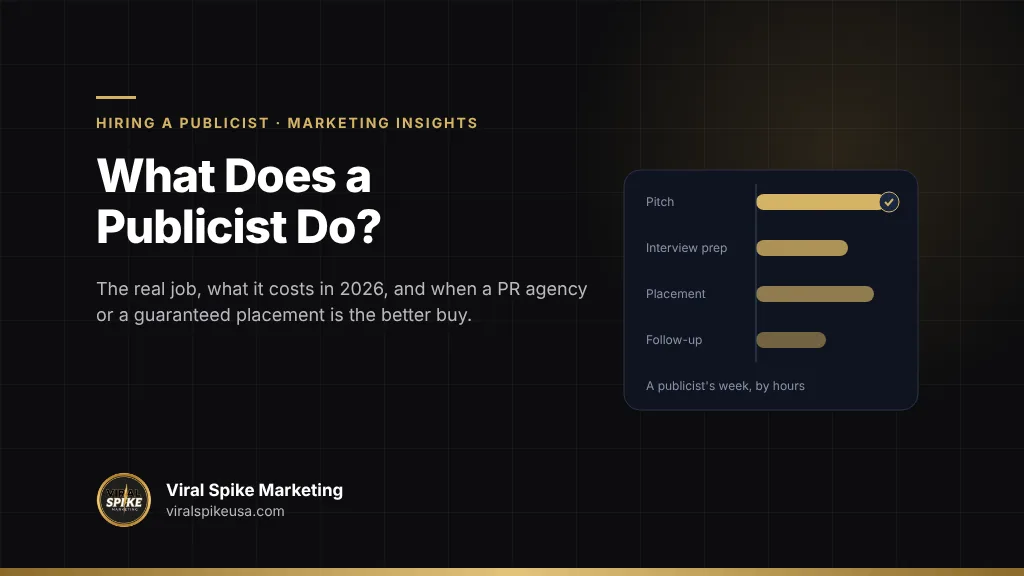
The job is more research and writing than parties. A working week for a publicist handling three or four clients usually breaks down into five kinds of work.
Finding the angle
Journalists cover stories, not companies. The first task is turning what a client has (a launch, a milestone, a data point, an opinion, a founder’s background) into something a specific reporter would want to write about this month. Much of this is reading: the reporter’s last ten pieces, the outlet’s editorial calendar, what competitors have been covered for, and what is in the news that the client can credibly comment on.
Pitching
A pitch is a short, personalized email or message to one journalist proposing one story, with the hook in the subject line and the proof in the first three sentences. Publicists send dozens a week and track every one. Response rates are low even for good pitches, which is why the follow-up cadence and the quality of the media list matter more than the writing style.
Preparing the client
When a reporter says yes, the publicist briefs the client on who the journalist is, what the piece is likely to be about, the two or three messages to land, and the questions to expect, including the uncomfortable ones. For broadcast and podcasts this includes format, timing and technical logistics.
Managing the coverage
Supplying headshots, product images, bios and fact-checks; arranging interview times; confirming quotes where the outlet allows it; and, after publication, requesting corrections if facts are wrong. Then the publicist makes sure the client actually uses the coverage, a step most people skip (see what to do after you get featured).
Protecting the client
When a negative story is coming, the publicist is the one the reporter calls for comment. Drafting statements, deciding whether to respond at all, and keeping a small issue from becoming a large one is part of the role, even for publicists who are hired for positive coverage.
What a publicist does not do, unless the engagement specifically includes it: run your social media accounts, buy advertising, write your website, manage your schedule, negotiate your deals or guarantee that any particular outlet will cover you.
Publicist vs PR agency vs agent vs manager
These four roles are routinely confused, partly because large firms bundle some of them. The distinctions matter when you are deciding who to hire.
| Role | Primary job | How they are paid | Typical client | What they do not do |
|---|---|---|---|---|
| Publicist | Earn press coverage and manage media relations | Monthly retainer or project fee | Founders, executives, authors, artists, small brands | Buy coverage, sell your work, run your career |
| PR agency | Publicity plus strategy, messaging, content, events, crisis planning, often digital PR and SEO | Monthly retainer, usually higher, sometimes per project or per placement | Companies with ongoing communications needs and budget for a team | Represent you in deal negotiations |
| Agent (talent, literary, booking) | Sell your work: book deals, roles, bookings, endorsements | Commission, commonly 10 to 20 percent of what they sell | Actors, authors, musicians, speakers, athletes | Pitch journalists for coverage |
| Manager | Run the career: strategy, team, scheduling, business decisions | Commission, commonly 10 to 20 percent of income | Artists, performers, athletes, some creators | Day-to-day media pitching (they hire the publicist) |
A useful shortcut: the agent and manager make you money; the publicist and agency make you known. Musicians and actors often need all four at different stages. A founder usually needs a publicist or an agency and neither of the others. The full breakdown by career stage, including how each is paid and who hires whom, is in publicist vs PR agency vs manager vs agent. Where a publicist stops and an agency starts is covered in more depth in boutique PR firm vs big agency and digital PR agency vs traditional PR firm.
How much does a publicist cost in 2026?
Publicists price three ways: a monthly retainer for ongoing work, a flat fee for a defined campaign, or a per-item fee for a narrow service such as podcast booking (how that channel works on its own is covered in how to get booked as a podcast guest). Rates track the client’s profile and the difficulty of the beat more than the publicist’s hours.
| Model | Typical range (US, 2026) | What it usually covers | Best for |
|---|---|---|---|
| Monthly retainer, independent or boutique | About $3,000 to $10,000 per month | Ongoing pitching, media list, interview prep, monthly reporting; usually a 3 to 6 month minimum | Founders, authors, experts with a steady news flow |
| Monthly retainer, celebrity or entertainment | Up to $20,000 per month and beyond | Daily media management, red-carpet and premiere logistics, crisis response, 24/7 availability | Public figures, touring artists, talent with constant press demand |
| Flat campaign fee | Often $10,000 to $20,000 for a launch window, paid in installments | A defined push around a book, album, product or funding announcement, typically 6 to 12 weeks | One-time launches with a hard date |
| À la carte service | From about $5,000 for a podcast or newsletter pitching package | A single channel, a fixed number of pitches or bookings | Testing PR before committing to a retainer |
| Guaranteed editorial placement | Quoted per outlet, flat | A published, indexed feature in a named outlet by a committed date, draft approved in advance | Anyone who needs a specific outlet now, or wants coverage to feed search and AI visibility |
The retainer figures above are consistent with what working publicists disclose. Book publicist Kathleen Schmidt, writing in May 2025, puts independent retainers at “as low as $3K and as high as $20K monthly,” with the top of that range for celebrity publicists and book retainers reaching $10,000 a month; she also describes a $15,000 campaign billed in two installments and a $5,000 minimum for a podcast and newsletter package (Publishing Confidential). For context on what the people doing this work earn, the US Bureau of Labor Statistics reports a 2025 median annual wage of $74,750 for public relations specialists; a solo publicist’s retainers have to cover that, their tools and their unbilled pitching time.
Agency retainers run higher because you are paying for a team. We break those down separately in how much a PR agency costs, and the music-specific version is in before hiring a music publicist.
Two things a retainer does not buy: a guaranteed article, and a specific outlet. An honest publicist will say so in writing. If an individual publicist guarantees Forbes or the New York Times for a monthly fee, ask exactly how, because earned coverage cannot be promised and contracted placements are a different product with a different price.
When do you need a publicist?
Hire a publicist when all three of these are true.
- You have a story that renews. A publicist earns their retainer by pitching month after month. If you have one announcement a year, a campaign fee or a placement is a better fit than a retainer.
- You can be available. Interviews happen on the reporter’s schedule. A founder who cannot take a call within a day will lose stories a publicist worked weeks to set up.
- You can wait. Earned coverage usually takes three to six months to build momentum. If you need coverage before a funding round next month, see the timelines in how long PR takes to work and consider a placement for the near-term need.
Situations that typically justify a publicist: a book launch with a tour (see PR for authors), a company with regular product news and an opinionated founder, an expert building toward speaking and board roles, an artist with a release calendar, a professional practice (medical, legal, financial) that wants steady local and trade coverage. Specific guidance for several of these is in PR for entrepreneurs, PR for doctors and music publicists for independent artists. Real estate is one field where the publicist model often gives way to monthly market commentary and expert-request platforms, a path we lay out in PR for real estate agents and brokers.
Situations where a publicist is usually the wrong first hire: a brand with no website, no reviews and no clear positioning (fix those first); a one-off need for a specific outlet; a reputation problem that is really a search-results problem, which is reputation management work rather than publicity.
Publicist, agency or guaranteed placement: choosing the route
Most people asking “what does a publicist do” are really asking “which of these should I pay for.” The answer depends on what you need the coverage to do.
| You need… | Best route | Why |
|---|---|---|
| Ongoing visibility and relationships with reporters in your field | Independent publicist on retainer | Senior attention, lower cost than an agency, relationships compound over time |
| Press plus messaging, content, events and crisis planning | PR agency | Multiple specialists and capacity you cannot get from one person |
| A feature in a specific major outlet by a specific date | Guaranteed editorial placement | Earned pitching cannot promise an outlet or a date; a contracted placement can, with the draft approved before it runs |
| Coverage that feeds search rankings and AI recommendations | Placements plus a light earned-media layer | Indexed features in trusted outlets are what search engines and AI assistants read when deciding whether to recommend you |
| To test whether PR works for you before committing | À la carte project or a single placement | Fixed cost, measurable result, no long minimum |
The routes are not exclusive. A common structure for a growth-stage company is a modest publicist retainer for earned coverage and expert quotes, with contracted placements used for launches and for building the authority footprint that search and AI systems reward. The trade-offs between earned and contracted coverage are examined in earned media vs paid placements.
How to vet a publicist before you sign
Ask for five things and judge the answers more than the portfolio.
- A target media list. Twenty to fifty named outlets and journalists they intend to pitch for you, with a sentence on why each fits. A publicist who cannot produce this does not know your beat.
- Recent, relevant placements. Coverage they secured in the last twelve months for clients like you, with links. Verify the outlets are real and the articles are editorial, using the checks in how to verify a publication is real.
- A written statement of what is and is not guaranteed. The right answer for earned media is “nothing is guaranteed; here is what I will do and how often I will report.”
- A reporting format. Monthly, listing pitches sent, responses, interviews scheduled, coverage secured and next month’s plan.
- The minimum term and exit terms. Three months is reasonable; twelve months with no exit is not.
Walk away from anyone who guarantees specific earned coverage, will not name outlets, charges a large upfront fee with no deliverables schedule, or cannot explain the difference between earned, contributed and sponsored coverage. More vetting questions are in how to vet PR firms for small business budgets.
Where Viral Spike fits
Viral Spike Marketing runs public relations engagements that cover the publicist’s job, pitching, interview preparation and media management, and it adds the one thing an individual publicist cannot: guaranteed editorial placements across 1,600+ outlets, where you approve the draft, the article is published and indexed on Google, and the engagement is refunded in full if it never runs. For clients whose goal is to be found and recommended, those placements also feed the search and AI visibility work described in the press-SEO-AI flywheel. If you are weighing a retainer against a placement, tell us the goal and we will recommend the cheaper route when that is the right answer.
Decide what the coverage is for, then hire for that
Write down the three outcomes you want from press in the next six months: a funding round, a book launch, more inbound leads, a cleaner name search, an invitation to speak. If the list is about ongoing relationships and a story that keeps renewing, hire a publicist and give them six months. If it is about a specific outlet, a specific date or a visible authority footprint, start with placements. If it is both, structure both. The worst outcome is paying a retainer for a need a retainer cannot meet, and that is avoidable before you sign anything.
Frequently asked questions
What is the difference between a publicist and a PR agent?
In everyday use they overlap: a publicist is an individual who handles media relations for clients, while “PR agent” is an informal term for the same role. The meaningful distinctions are with a PR agency, which provides a team and services beyond publicity, and with a talent or literary agent, who sells your work for a commission rather than pitching the press.
How much does a publicist cost per month?
Independent and boutique publicists in the US typically charge monthly retainers of about $3,000 to $10,000, with celebrity and entertainment publicists reaching $20,000 a month or more. Flat campaign fees of $10,000 to $20,000 for a launch window and à la carte packages from about $5,000 are common alternatives. Most retainers carry a three to six month minimum.
Do publicists guarantee coverage?
Reputable publicists do not guarantee earned coverage, because the decision to run a story belongs to the journalist and editor. What they guarantee is effort and process: a target list, a pitching cadence and reporting. Guaranteed coverage in a named outlet is a separate product, a contracted editorial placement, and it is priced per outlet rather than by retainer.
Do I need a publicist or a PR agency?
Choose a publicist when you need senior, hands-on media relations and your story renews regularly; the cost is lower and the attention is personal. Choose a PR agency when you also need messaging, content, events, crisis planning or digital PR, or when the volume of work exceeds one person. Many companies start with a publicist and add agency services as they grow.
What does a publicist do for a musician or an author?
For a musician, a publicist pitches album and single coverage, premieres, interviews, features and reviews to music press, radio and podcasts, and manages press around tours. For an author, a book publicist pitches reviews, excerpts, interviews, podcast appearances and op-eds timed to the publication date, and coordinates with the publisher’s in-house team. In both cases the publicist handles press, not bookings or deals.
How long should I hire a publicist for?
Plan for at least three to six months. Earned media builds slowly: the first month is research and list-building, pitches go out in month two, and placements typically appear from month three onward. Judge the engagement at the six-month mark on coverage secured, interviews completed and the quality of the relationships built, not on month one.
Sources
Primary sources referenced in this article, in order of first use.
- Publishing Confidential (kathleenschmidt.substack.com)
- public relations specialists (bls.gov)

More in Marketing Insights



Related services