How Long Does PR Take to Work? Realistic Timelines
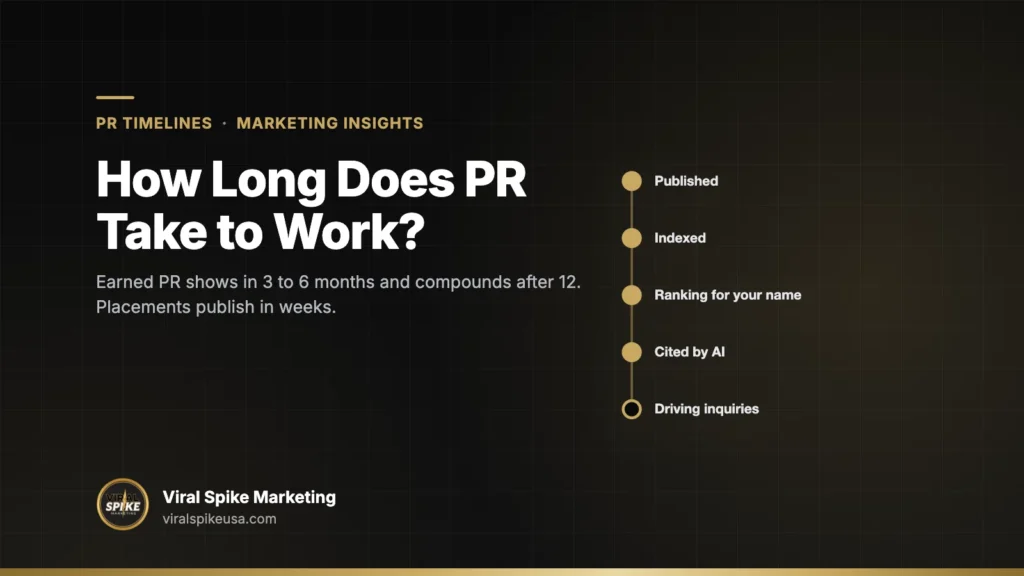
PR takes different amounts of time depending on which kind you are buying and what you mean by “work.” Earned PR typically shows first results in three to six months and its biggest gains after a year of sustained effort, according to Axia Public Relations. A sponsored or contracted placement moves faster: draft, your approval, the publisher’s editorial review, then publication, usually within days to a few weeks depending on the outlet. But “published” is only the first of five stages. Coverage then has to be indexed, rank for your name, get referenced by AI assistants, and drive inquiries, and each stage has its own clock.
Key takeaways
- Earned PR usually delivers first visible results in 3 to 6 months, with compounding gains after 12 months, per Axia PR.
- Sponsored placements typically publish within days to a few weeks after you approve the draft, with the outlet’s editorial review setting the pace.
- “Working” means five different things: published, indexed, ranking for your name, referenced by AI, and driving inquiries.
- Google says crawling alone “can take anywhere from a few days to a few weeks,” so even fast placements need patience before they show in search.
- Slow approvals, weak stories, wrong outlets and no measurement plan are the most common reasons PR appears not to work.
How long does PR take to work?
The honest answer is that it depends on the route, and the two main routes run on different clocks.
Earned PR means persuading journalists to cover you because the story merits it. Axia PR’s analysis of PR timelines puts it plainly: “Results often begin to appear within the first three to six months, but the most significant visibility and trust gains occur after a full year of sustained activity.” Axia describes PR as a flywheel, slow to start and cumulative once it turns, because each mention makes the next one easier to win.
Sponsored or guaranteed placements mean a publisher agrees in advance to run a labeled feature once the draft is approved. There is no persuasion phase, so the timeline collapses to production: writing, your approval, the publisher’s review, and a publication slot. Depending on the outlet and how quickly you approve drafts, that typically takes days to a few weeks. Some publishers have queues, some review more strictly, and holidays and news events shift slots. Treat any vendor’s exact date as a typical range unless the contract says otherwise.
What does it mean for PR to “work”?
Most disappointment with PR comes from expecting stage five results on a stage one timeline. Separate them.
- Published. The article is live at a URL you can share. This is the only stage a placement service can guarantee, and even earned PR delivers it in bursts rather than on a schedule.
- Indexed. Search engines have crawled and stored the page. Google’s own documentation on asking Google to recrawl states that “crawling can take anywhere from a few days to a few weeks,” and that a request does not guarantee inclusion. Pages on major publishers are usually crawled faster than average, but not instantly.
- Ranking for your name. When someone searches your name or brand, the coverage appears on page one. For a lightly searched name this can happen within days of indexing. For a crowded name, or when you are trying to move something else down, it can take months. Our guide on pushing down negative search results with positive press covers that slower case.
- Referenced by AI. ChatGPT, Gemini, Perplexity and Google’s AI features begin citing or drawing on the coverage when users ask about your category. This depends heavily on the type of coverage. Muck Rack’s May 2026 analysis of more than 25 million citations found earned media accounts for 84% of AI citations and paid or advertorial content for 0.3%, so earned journalism reaches this stage far more often than labeled placements do.
- Driving inquiries. Prospects mention the coverage, conversion rates on pages that display it improve, or partners and investors reference it. This is the stage that justifies the spend, and it usually arrives weeks to months after publication as the coverage accumulates and gets reused in sales material.
A placement that is published, indexed and ranking for your name within a month is working, even if inquiries have not moved yet. An earned campaign with no coverage at month two is not failing if the pitches are landing meetings.
How long does a guaranteed placement take, week by week?
The timeline below is the typical range we see for a single guaranteed placement in a major outlet. It is drawn from our own campaigns, not a published study. Individual outlets are faster or slower, and your own approval speed is the biggest variable you control.
| Week | Stage | What happens | What can slow it |
|---|---|---|---|
| Week 0 | Scoping | Outlet selected, angle agreed, URL pattern and label confirmed in writing | Indecision on outlet; unrealistic expectations about editorial framing |
| Week 1 | Interview and draft | Writer interviews you or works from your materials; first draft delivered | Missing bios, facts, photos or approvals from your side |
| Week 1 to 2 | Client approval | You review the draft, request edits, sign off | Multiple stakeholders; legal review; rewriting the piece into an ad |
| Week 2 to 3 | Publisher editorial review | Outlet checks the piece against its guidelines and label requirements | Claims that need substantiation; prohibited categories; queue depth |
| Week 2 to 4 | Publication | Article goes live at the agreed URL with the agreed label | Holiday slots, breaking news, publisher backlog |
| Week 3 to 6 | Indexing | Search engines crawl the page; it appears for exact-title searches | Publisher noindex on sponsored sections (ask before you buy) |
| Week 4 to 8 | Name ranking | Coverage appears in results for your name or brand | Crowded name; weak entity signals; page lacks your full name in title or body |
| Week 4 to 12 | Reuse and conversion | Coverage added to site, decks, bios, ads; conversion lift measured | No plan to actually use the coverage |
| Month 3 and beyond | AI referencing | Placement contributes to entity consistency; AI citation remains unlikely for labeled content on its own | Expecting paid content to behave like earned journalism |
The fastest path from week 0 to publication is measured in days, and only when the client approves quickly and the outlet has an open slot. Every stage from week 3 onward depends on choices made at week 0, especially confirming that the page will be indexable and the label is one you can live with. Our roundup of how to get featured in major publications, with costs and timelines compares outlets on those points.
How long does earned PR take, month by month?
Earned PR is a program, not a project. Here is what a realistic first year looks like for a company that starts with little or no coverage, based on Axia’s three-to-six-month and twelve-month markers and our own experience in between.
| Month | Focus | Typical outputs | What “working” looks like |
|---|---|---|---|
| Month 1 | Foundation | Messaging, story angles, spokesperson prep, media list, owned newsroom page | Clear narrative that a reporter can repeat in one sentence |
| Month 2 | First pitches | Trade and niche outlets, expert-source offers, one data or founder story | Replies, interviews, first small mentions |
| Month 3 | Early coverage | First trade features or quotes; refinement of angles based on what got traction | One to three pieces of genuine coverage, indexed and ranking for your name |
| Month 4 to 6 | Momentum | National business or vertical media pitches using early coverage as proof | Larger placements, inbound requests from reporters, coverage cited by others |
| Month 6 to 9 | Compounding | Repeat coverage from the same reporters, speaking and podcast invitations | Coverage appearing in AI answers about your category; leads referencing press |
| Month 9 to 12 | Authority | Regular inclusion as a source, profile-level features, coverage used across sales and hiring | Measurable lift in branded search, referral traffic and inquiry quality |
| Month 12 and beyond | Flywheel | Sustained cadence with less effort per placement | Per Axia PR, the most significant visibility and trust gains typically arrive after a full year |
This is the pattern Axia’s flywheel description predicts, and it is why retainers judged at month two so often get cancelled right before they would have paid off. Our comparison of PR agency costs, retainers vs pay-per-placement explains how the two pricing models line up with these two timelines.
What slows PR down?
Most delays are self-inflicted or structural, and most are fixable.
- Slow approvals. In a placement campaign, client review is the most common bottleneck. A draft that sits for two weeks with three stakeholders adds two weeks to everything downstream.
- No story. “We launched a product” is not news. Reporters need a number, a conflict, a first or a trend, which is why launches without a narrative stall, as we explain in why product launches stall without a clear press narrative.
- Wrong outlets. Pitching national media before any trade coverage exists usually produces silence. Trade first, then national, is faster in total.
- Unusable claims. Superlatives without proof get stripped in publisher review or rejected. Bring evidence for every figure.
- Indexation surprises. Some publishers noindex sponsored sections or place them on low-authority subdomains. If you did not ask before buying, you find out at week four.
- News cycles and seasons. Major news events push feature slots back; late December and August are slower at many outlets.
- No reuse plan. Coverage that is not added to your site, decks and outreach cannot drive inquiries.
- Judging too early. Axia notes that many executives feel early excitement followed by doubt during quieter months, and that programs often hit their biggest breakthroughs right after the first plateau. Set the evaluation date before you start.
How do you measure whether PR is working?
Measure each stage with its own metric and its own timeline, and write the plan down before the first pitch or placement.
- Published: number and quality of pieces, with URL, date, outlet, label and whether you were the subject or a source.
- Indexed: check each URL with a site: search or a URL inspection tool within two to four weeks of publication. Flag anything still missing at week four.
- Ranking for your name: track page-one results for your name and brand monthly, and note what the coverage displaced.
- Referenced by AI: once a quarter, ask ChatGPT, Gemini, Perplexity and Google’s AI Mode the five to ten questions a buyer would ask about your category, and record whether you are named and what is cited.
- Driving inquiries: add a “how did you hear about us” field, tag leads that mention press, and compare conversion rates on pages with and without coverage displayed.
For launch campaigns specifically, PR and paid ads work on different clocks and do different jobs, which we cover in press for product launch vs paid ads.
Where a placement service fits
Viral Spike Marketing works on both clocks. For clients who need credible coverage on a known timeline (a launch, a raise, a hiring push, a reputation problem), we place guaranteed editorial press placements in 1,600+ outlets on a pay-per-placement basis: you approve the draft, the article is published and indexed on Google, and the engagement is refunded in full if it never runs, with the publication, article format, timeline and refund terms named in writing before you pay. We describe publication timing as a typical range for the outlet, not a promise, and we are clear that guaranteed placements build credibility, entity signals, search presence and conversion rather than earned-level AI citations. For clients who want the compounding returns of earned coverage, our public relations team builds the story and outreach on the month-by-month plan above. To talk through which clock fits your goal, contact us.
Set the clock before you start
Decide what “working” means for this campaign, pick the route that matches that definition, and write the evaluation date down. If you need visible, credible coverage within weeks, a guaranteed placement with confirmed indexation is the honest option, and you should have it published, indexed and ranking for your name inside a month or two. If you need coverage that compounds into rankings, AI visibility and inbound demand, commit to earned PR for at least six months and judge it at twelve. If you are not sure which clock you are on, contact Viral Spike Marketing and we will map the timeline against your goal before you spend anything.
Frequently asked questions
How long does earned media take to show results?
Axia Public Relations reports that results often begin to appear within the first three to six months of sustained effort, with the most significant visibility and trust gains after a full year. Trade and niche coverage usually arrives first, national coverage follows once there is proof, and the returns compound as reporters begin to come to you.
How long does a sponsored placement take to publish?
Typically days to a few weeks after you approve the draft, depending on the outlet. The sequence is drafting, your approval, the publisher’s editorial review, then a publication slot. Client approval speed is the largest variable you control, and publisher queues, holidays and substantiation requests are the most common external delays.
How long until press coverage shows up in Google?
Google states that crawling can take anywhere from a few days to a few weeks, and major publishers are generally crawled on the faster end. Appearing for a search of your own name can follow within days for an uncrowded name or take months for a crowded one. Confirm before buying that the page will be indexable.
Why does my PR not seem to be working?
Usually because the wrong stage is being measured too early, the coverage is not being reused in sales and marketing, or the plan skipped trade outlets and went straight for national media. Check whether pieces are indexed and ranking for your name, then whether they are displayed where prospects can see them, before concluding PR failed.
When will AI assistants start mentioning my company?
There is no fixed timeline, and the type of coverage matters more than the amount of time. Muck Rack’s May 2026 analysis found earned media makes up 84% of AI citations and paid content 0.3%, so earned journalism reaches this stage far more reliably. Audit AI answers quarterly and treat labeled placements as a supporting layer.

More in Marketing Insights