
How to Remove Negative Google Autocomplete Suggestions: Policy Reports, Legal Requests and Suppression
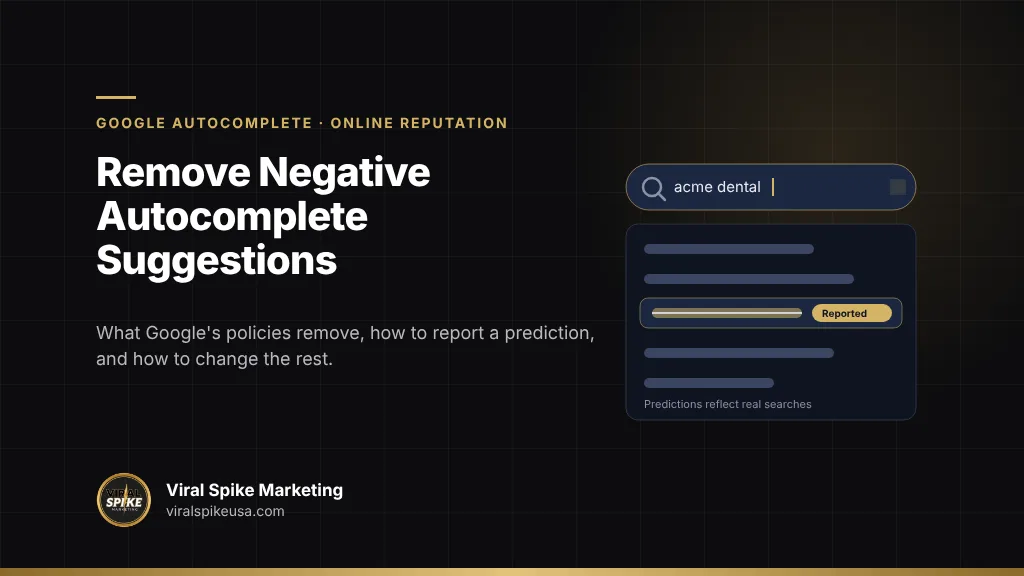
You can remove a negative Google autocomplete suggestion in one of three ways, and which one applies depends on what the prediction says. If it pairs your name or brand with a disparaging or sensitive term (fraud, scam, arrested, lawsuit), it may violate Google’s autocomplete policies for named individuals or for accusations without established evidence, and you report it from the search box: touch and hold or hover over the prediction, choose Report this, and name the policy. If it is unlawful where you live (a court has found the underlying claim defamatory, or local law gives you a right to removal), you file through Google’s Legal Help troubleshooter instead. If it is neither, meaning people really do search “your brand complaints” and the phrase breaks no rule, Google will not remove it. Predictions reflect real searches, so the remaining route is to change the pattern of searches around your name and to make sure the results behind the prediction are ones you can live with. Most predictions that hurt businesses fall into that third category, which is why suppression, not reporting, is where the work usually ends up.
Key takeaways
- Google’s autocomplete policies block predictions that are dangerous, harassing, hateful, sexually explicit, violent or vulgar, plus predictions that attach disparaging terms to named people or accuse someone of serious acts without well-established evidence.
- Google says predictions “reflect real searches that have been done on Google,” shaped by your language, location, trending interest and past searches, and that predictions “aren’t assertions of facts or opinions.”
- The report tool is a policy complaint, not a legal one. Google says it looks at every report but “might not remove the prediction.”
- Legal removals go through a separate troubleshooter and are typically limited to the country where the content is unlawful.
- A prediction that breaks no policy and reflects what people search stays until the searches change, which takes months of deliberate work on the search results behind it.
How do Google autocomplete predictions work?
Autocomplete is a prediction of the query you are about to type, not a recommendation and not a statement about you. Google’s autocomplete policies page says it plainly: “Once you start to type, autocomplete predictions reflect real searches that have been done on Google.” Four factors shape which of those searches appear: the language of the query, the searcher’s location, trending interest in a topic, and, for signed-in users with personalization on, their own past searches. Google adds that some predictions come from “word patterns found across the web” rather than from query logs alone.
The design intent matters for anyone trying to change a prediction. In Google’s 2018 explainer How Google autocomplete works in Search, Danny Sullivan wrote that “Autocomplete is designed to help people complete a search they were intending to do,” that it cuts typing by about 25 percent, and that desktop shows up to ten predictions while mobile shows about five. A prediction appears because enough people, relative to other completions of the same characters, have already typed it. “acme dental” followed by “lawsuit” is on the list because, among people who typed “acme dental”, a meaningful share went on to type “lawsuit.”
Three practical consequences follow:
- The prediction is downstream of behavior. News coverage, a viral post, a competitor’s campaign or one persistent complainant can all create the searches that create the prediction.
- Predictions vary by location and device. Check in an incognito window, on mobile, and from the places your customers are before deciding there is a problem.
- Removing a prediction removes nothing else. Google notes that “autocomplete doesn’t prevent anyone from completely typing out a search query to get results.” The pages behind the query are what the prospect reads next.
Which autocomplete predictions does Google remove?
Google runs automated systems that try to block predictions violating its policies, and enforcement teams remove the ones that get through, along with “closely-related variations.” The policies fall into two groups: the general Search policies that apply across features, and autocomplete-specific rules. Both are on the same policy page.
| Policy category | What Google says it blocks or removes | Typical business or personal example | Reportable? |
|---|---|---|---|
| Dangerous, harassing, hateful, sexually explicit, terrorist, violent or vulgar content | Predictions in any of these general categories | A slur or threat attached to a name | Yes, with good odds |
| Named individuals | Predictions “linking disparaging or sensitive terms” to named people, including terms tied to harassment, bullying, threats or exposure of private information | “[founder name] affair”, “[person] home address” | Yes, for people; weaker for company names |
| Serious malevolent acts | Predictions accusing individuals or groups of serious acts “where there is a lack of well-established or expert supporting evidence” | “[person] fraud” with no charge, finding or credible reporting behind it | Yes, when the evidence gap is real |
| Health | Predictions about potentially medically hazardous health claims | Rarely relevant to a reputation case | Narrow |
| Elections | Predictions that take a side on a political figure or party, or make claims about electoral integrity | Candidates and officials only | Narrow |
| Unreliable predictions | Predictions “unlikely to return much reliable content,” such as “unconfirmed rumors after a news event” | A rumor that spiked for a day and has no coverage | Sometimes, by the automated systems |
Two features of the rules decide most cases. First, the named-individuals policy protects people, not companies. “[CEO name] scam” is a stronger report than “[company] scam”, because a business is expected to tolerate criticism of its products and services. Second, the serious-acts policy turns on evidence. If a newspaper reported the lawsuit, the prediction “[company] lawsuit” has well-established support and will stand; if “[person] fraud” exists because of a smear campaign and nothing in the results substantiates it, you have a policy argument. Google also notes exceptions for artistic, educational, historical, documentary and scientific context and for content that “furthers understanding of current events.”
How do you report an autocomplete prediction to Google?
The report is filed from the search box, not from a form, and it takes under a minute. Google’s help page on managing and reporting predictions gives the steps:
- Go to google.com or open the Google app and type the query until the prediction appears.
- Touch and hold the prediction. Google’s steps are written for the Google app and google.com; in a desktop browser, the report link appears with the prediction list.
- Choose Report this and select the policy the prediction violates.
- Add a short explanation when the form allows it: which policy, why the term is disparaging or unsupported, and that the prediction attaches to a named person if it does.
Set expectations before you file. The same help page says, “Google looks at what you said, but might not remove the prediction.” There is no case number, no reply and no appeal; if the prediction disappears over the following days or weeks, the report worked or the automated systems caught up. If it stays, the prediction has been judged within policy and repeating the report changes nothing.
What improves the odds: match one policy exactly, describe the person affected if the named-individuals rule applies, and report the variations too (“acme dental fraud”, “acme dental scam”, “is acme dental a scam”), since Google removes “closely-related variations” when it acts. The report tool is for policy issues only; the page directs suspected legal problems to a separate legal troubleshooter, covered next. For the broader picture of what Google will and will not take out of its results, see what Google removes about you and what it does not.
What is the legal route for removing an autocomplete suggestion?
When a prediction is not a policy violation but is unlawful, you file through Google’s legal removal troubleshooter, choosing Google Search as the product and the legal reason that applies. The two reasons that fit autocomplete cases are defamation (“content that defames you or your business/organization”) and court order (“content that a court decision has determined is unlawful”). Google’s legal removal guidance asks you to flag the content in the product first, include the specific URL or query, explain what is unlawful and why, and expect an email confirmation with a reference number. This is general information, not legal advice; a lawyer licensed where you live should review any specific dispute.
Three limits apply:
- Jurisdiction. The troubleshooter states that for legal removals Google typically removes or restricts “only in the country/region where it is deemed to be illegal.” A removal won in Germany does not clear the prediction in the United States.
- Standard of proof. In the US, a bare assertion that a prediction is defamatory rarely succeeds; Google is in the strongest position to act when a court has already found the underlying statement false. Winning that judgment against an anonymous poster, and then presenting it to Google, is the route described in your real options for removing negative content from Google.
- Separate filings. A policy report “does not serve as legal notice,” and each Google product needs its own report. If the same claim appears in Search results and on YouTube, that is two filings.
Outside the US, courts have been more willing to hold Google responsible for predictions. In May 2013 Germany’s Federal Court of Justice ruled, in a case brought by a supplements company and its founder whose names autocompleted to Scientology and fraud, that Google must remove defamatory autocomplete results once notified, as JURIST reported. In the US, Section 230 and the First Amendment make an equivalent claim against Google itself much harder, so the practical legal path runs through the person who made the false statement.
Why will Google not remove most negative predictions?
Because most of them are accurate descriptions of what people search. The policies page states that “Predictions aren’t assertions of facts or opinions, but in some cases, they might be perceived as such,” and the 2018 explainer sets the guiding principle as not shocking users “with unexpected or unwanted predictions.” Neither principle covers a business whose customers search its name with “reviews”, “complaints”, “lawsuit” or “alternatives”.
| Prediction | Likely status | Why | Realistic route |
|---|---|---|---|
| “[company] complaints” / “[company] reviews” | Stays | Common consumer research pattern; no policy applies | Own the results for those queries |
| “[company] lawsuit” when a suit was reported | Stays | Well-established supporting evidence | Publish the outcome; outrank the coverage |
| “[company] scam” with no substantiation | Possible removal | Serious-acts policy if evidence is lacking; weaker for brands than people | Report with variations; suppress in parallel |
| “[person] arrested” with no record or reporting | Good removal odds | Named-individuals and serious-acts policies | Report; legal route if a source page is false |
| “[person] + slur, threat or private detail” | Strong removal odds | Harassment, hate or privacy policies | Report immediately |
| Prediction that a court has found defamatory | Removable in that jurisdiction | Court order category | Legal troubleshooter with the judgment attached |
The hard case is the true-but-old prediction: a dispute from six years ago that still autocompletes because the handful of pages about it still draw clicks. Google has no “outdated” category for predictions. The prediction follows the content, and the content is where the leverage is.
How do you suppress an autocomplete suggestion you cannot remove?
Suppression means changing the inputs Google reads. Predictions reflect the relative frequency of completions, so a negative completion loses its slot when other completions for the same characters grow and when fewer people have a reason to type the negative one. That takes months, and it has a legitimate version and an illegitimate one.
The legitimate version
- Fix what people find when they do type it. Searchers repeat a query when the results are inconclusive. If “acme dental lawsuit” returns a clear page from you explaining the matter and its resolution, plus coverage that moved on, fewer people search it twice, share it or come back to it. The method is in how to suppress negative search results the right way.
- Give people other things to search. Name your locations, services, products, people and programs consistently, and promote them where your customers are. “acme dental invisalign”, “acme dental hoboken” and “acme dental reviews” are completions you want to be large.
- Create news that earns searches. Press coverage, awards, hires, openings and interviews each produce their own query spikes and their own completions. A steady cadence of coverage in recognized outlets does more for the prediction list than any single page, and it ranks for the queries you cannot stop people from making. See pushing down negative results with content that outranks them.
- Starve the negative query of fresh reasons. Resolve the complaint publicly, respond to the review, correct the record where the original claim lives. Every unresolved thread is a prompt for the next search.
- Measure monthly. Log the predictions for your name and brand in an incognito window from two or three locations, desktop and mobile, as part of a monthly reputation audit. Judge direction over a quarter, not a week.
The illegitimate version
Vendors sell “autocomplete optimization” that floods Google with scripted searches for the completions you want. Google’s 2018 explainer lists spam among the reasons predictions are removed, and purchased search volume tends to produce nothing, or a prediction that appears and vanishes. Anyone promising a specific prediction will appear or disappear by a specific date is selling something Google does not sell.
Business names versus personal names: does the approach change?
Yes, in two ways. The named-individuals policy gives a person a stronger report than a company has, so a founder or executive whose name autocompletes to a disparaging term should file under that policy and describe themselves as the individual affected. Companies rely mainly on the serious-acts and harassment policies, which have a higher bar.
The suppression math also differs. A business name has many natural completions (locations, services, hours, careers), so growing them is realistic. A person’s name has fewer, and a negative completion can hold a slot with very few searches. For individuals, the work is to build an owned and earned footprint that gives searchers positive completions to make: a personal site, professional profiles, interviews and bylines, speaking and press. That footprint is the same one that fixes the results page, which is covered in reputation management for individuals.
One more difference: a prediction that exposes a person’s private information (an address, a health condition, a family member’s name) is reportable under the privacy strand of the named-individuals policy and should be reported immediately, before any suppression work.
Where Viral Spike fits
Viral Spike’s reputation management service starts with a written assessment of the predictions attached to your name or brand: which ones match an autocomplete policy, which have a legal basis in your jurisdiction, and which reflect searches that no report will change. We file the policy reports and prepare the legal troubleshooter submissions where they apply, through Google’s official channels, with the removal work scoped and paid upfront. The deliverables in your agreement are guaranteed: delivered as scoped or refunded in full. For the predictions that stay, we build the footprint that changes them over time: pages that answer the negative query so it stops repeating, consistent naming of the things you want people to search, and guaranteed editorial placements in recognized outlets, where you approve the draft, the article is published and indexed on Google, and the engagement is refunded in full if it never runs. That coverage is what fills the results for the queries you cannot stop, and it is what AI assistants quote when someone asks about you. To find out which category your prediction falls into, contact us with the exact query and a screenshot.
Screenshot the prediction, classify it, then start on the results behind it
Open an incognito window today and type your brand name and the names of your senior people, one character at a time, on desktop and on a phone. Screenshot every negative prediction with the date. Sort them: policy violation, legal basis, or accurate reflection of what people search. Report the first group this week with their variations, hand the second to a lawyer, and for the third, run the negative query yourself and look at what a prospect sees. That page of results is the real problem, and improving it is the only thing that changes the prediction for good.
Frequently asked questions
Can you remove a Google autocomplete suggestion?
Only in defined cases. Google removes predictions that violate its autocomplete policies, including harassing, hateful, violent, sexually explicit or vulgar predictions, predictions linking disparaging or sensitive terms to a named person, and accusations of serious acts without well-established evidence. It also acts on valid legal requests in the relevant jurisdiction. A prediction that breaks no rule and reflects real searches, such as a brand name with ‘reviews’ or ‘complaints’, is not removed on request.
How do I report a Google autocomplete prediction?
Type the query at google.com or in the Google app until the prediction appears, touch and hold it (or use the report link beneath the predictions on desktop), choose Report this and select the policy it violates. Google says it reviews what you submit but might not remove the prediction. There is no case number or appeal. For suspected legal issues, Google directs you to its separate Legal Help troubleshooter rather than the report option.
How long does it take Google to remove an autocomplete suggestion?
Google publishes no timeline for prediction reports and does not notify you of the outcome. In practice, predictions that clearly violate a policy can disappear within days, while borderline reports may never be acted on. Legal requests through the Legal Help troubleshooter generate an email confirmation and reference number, and Google says it tries to respond to valid notices as soon as it can, which in practice means weeks rather than days.
Why does Google show a negative autocomplete suggestion for my business?
Because enough people who typed your business name went on to type that term, relative to other completions. Google says predictions reflect real searches, shaped by language, location, trending interest and the searcher’s own history. A news story, a viral post, a persistent complaint or a competitor’s campaign can all generate the searches. The prediction is a symptom of the searches and the pages behind them, which is why fixing those pages is the durable remedy.
Can a reputation company guarantee removal of an autocomplete suggestion?
No. Removal decisions are Google’s, made against its published policies or a valid legal request, and nobody outside Google can force or schedule them. A legitimate firm will tell you in writing which predictions match a policy, file the reports and legal submissions through Google’s official channels, and build the search footprint that changes the rest over months. Anyone promising a specific prediction will vanish by a specific date, or offering to buy search volume, should be avoided.
Does removing an autocomplete suggestion remove the search results too?
No. Google states that autocomplete does not prevent anyone from typing the full query and getting results. Removing a prediction only stops Google from suggesting the phrase; the pages that appear when someone searches it are unaffected and are handled separately, through Google’s content removal policies, a legal request against the publisher, or suppression with stronger content. Most reputation plans work on both at once.
Sources
Primary sources referenced in this article, in order of first use.
- autocomplete policies page (support.google.com)
- How Google autocomplete works in Search (blog.google)
- managing and reporting predictions (support.google.com)
- legal removal troubleshooter (support.google.com)
- legal removal guidance (support.google.com)
- JURIST (jurist.org)

More in Online Reputation



Related services