
Publicist vs PR Agency vs Manager vs Agent: Who Does What for Your Career
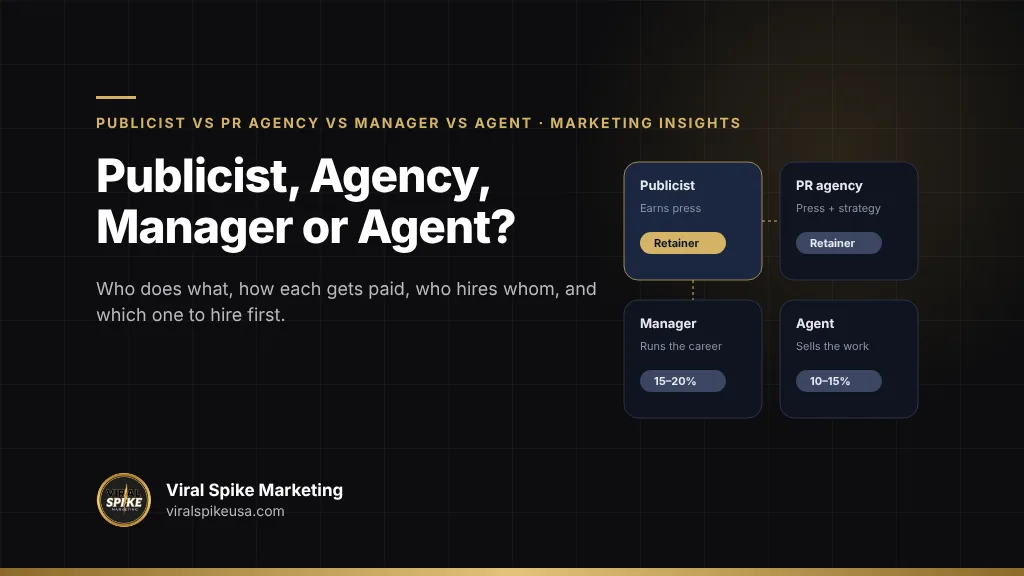
A publicist earns you press coverage, a PR agency does that plus strategy, messaging and content with a team, a manager runs your career and builds the team around you, and an agent sells your work for a commission. The cleanest way to separate them is by how they are paid. Publicists and agencies bill a monthly retainer or a project fee and do not touch your income. Managers and agents take a percentage of what you earn: literary agents almost universally 15 percent, SAG-AFTRA franchised talent agents capped at 10 percent, music managers commonly 15 to 20 percent, NFL contract advisors capped at 3 percent. Agents are licensed in states such as California because they procure employment; managers are not, which is why a manager who books your gigs can be breaking the law. Who you hire first depends on what you are: a founder almost never needs an agent or a manager, an author needs an agent before a publicist, a musician usually needs a manager first, and an actor needs an agent before a publicist has anything to pitch.
Key takeaways
- Payment model is the fastest tell. Retainer or project fee means publicity or PR. A percentage of your income means representation, and representation that procures work is regulated.
- Commission norms are stable and documented: 15 percent for literary agents, 10 percent for SAG-AFTRA franchised agents, 15 to 20 percent for music managers, 3 percent maximum for NFL agents.
- In California, anyone who procures employment for an artist needs a talent agency license; an unlicensed manager who books work can see the contract voided and commissions ordered returned.
- The manager usually hires the publicist, the agent usually does not, and the PR agency is hired by the business, not the person, in most founder and executive engagements.
- A guaranteed editorial placement is a fifth option that none of the four roles can deliver on their own: a specific outlet, a committed date, a draft you approve.
What does each role actually do?
The four jobs overlap at the edges, which is why they are confused, but each has a core function the others do not perform. The daily work of a publicist is covered in detail in what does a publicist do; this article is about where the publicist stops and the other three begin.
Publicist: earns coverage
A publicist pitches journalists, editors, producers and podcast hosts, preps you for interviews and handles the press when something goes wrong. The output is earned media. A publicist does not sell your work, negotiate your deals or run your calendar.
PR agency: coverage plus communications strategy
An agency does the publicist’s job with a team and adds the work around it: messaging, press materials, thought leadership content, events, crisis planning, and often digital PR tied to search and AI visibility. Agencies suit organizations with a steady communications load rather than individuals with a single story.
Manager: runs the career
A manager is the long-term strategist and general contractor: they decide what you should be doing in two years, assemble and supervise the team (agent, publicist, lawyer), vet opportunities and handle business decisions you do not have time for. In music the manager is usually the first professional an artist hires; in film and television the manager develops the career while the agent fields the offers.
Agent: sells the work
An agent procures employment. A talent agent submits actors for roles and negotiates the contract; a literary agent sells a manuscript and negotiates the advance and rights; a booking agent sells live dates; a sports agent negotiates player contracts. Agents work on commission and in several states must be licensed. An agent is paid when you are paid, which aligns incentives but also means an agent spends time where the money is.
How is each one paid?
Payment model is the most reliable way to tell the roles apart, because it is set by law, union rules or long-standing industry norms rather than by what a given person calls themselves.
| Role | How paid | Documented norm or cap | Source |
|---|---|---|---|
| Publicist | Monthly retainer or project fee | Independent retainers roughly $3,000 to $20,000 a month; campaign fees and à la carte packages as alternatives | Working publicist disclosure, May 2025 |
| PR agency | Monthly retainer, project fee, or per placement | Higher than a solo publicist because you pay for a team | Agency pricing guides |
| Literary agent | Commission on what they sell | 15 percent of gross on domestic deals; 20 percent on foreign rights sold through a sub-agent, split 10/10 | Promise Legal, June 2026 |
| Talent agent (film, TV, commercials) | Commission | 10 percent cap for SAG-AFTRA franchised agents; no other fees may be collected from the performer | SAG-AFTRA, November 2024 |
| Music manager | Commission on gross or net income | Usually 15 to 20 percent, with 15 more common; extremes of 10 to 25 percent need special circumstances | Erin M. Jacobson, Esq. |
| Creator or influencer manager | Commission on brand deals | Typically 15 to 20 percent for a manager, 10 to 20 percent for an agency; stacked, 25 to 40 percent of a deal can go to representation | Make Influence |
| Sports agent (NFL) | Commission on playing contract | 3 percent maximum set by the NFL Players Association | Front Office Sports, May 2025 |
Two details inside those numbers matter in practice.
Gross versus net. A manager commissioning 20 percent of gross touring income can take home more than the artist on a tour that loses money. Music management agreements routinely exclude certain categories (recording costs, tour support, some producer fees) from commissionable income, and whether the percentage applies to gross or net is one of the first points an entertainment lawyer will check, as Jacobson’s analysis notes.
What is not commissionable. SAG-AFTRA’s franchise rules state that an agent must negotiate above scale to commission session work at all (“scale plus 10”), and that franchised agents may collect no other miscellaneous fees or commissions from the performer or the employer. Literary agents who charge reading fees are a red flag; the standard position among reputable agencies is that they earn nothing until the book sells.
Who is regulated, and why it matters
Agents are regulated because they procure employment. California’s Talent Agencies Act requires anyone who solicits or procures artistic employment for an artist to hold a talent agency license. Managers are not licensed under the Act, and the Labor Commissioner has voided management contracts whose central purpose turned out to be procuring work and ordered managers to disgorge commissions earned through the violation, as summarized by Boesch Law Group. The safe harbor is narrow: a manager may help procure work only alongside a licensed agent, at that agent’s request. This is general information, not legal advice; rules differ by state. The practical point is the common early-career trap: the friend who “manages” a musician and books the shows is doing the agent’s job without the license, and the artist is the one in a commission dispute when the career takes off. Publicists sit outside this frame because pitching a journalist is not procuring employment; their rule is disclosure when coverage is paid rather than earned, covered in sponsored article placement and FTC disclosure.
Who hires whom?
The four roles are not peers. They sit in a rough hierarchy that varies by industry, and knowing it tells you who to call first.
| Career type | First hire | Who then hires or recommends the others |
|---|---|---|
| Musician | Manager (often informal at first) | Manager brings in booking agent, lawyer, publicist; label may supply a publicist for the release cycle |
| Actor | Agent (commercial, then theatrical) | Manager is added as the career grows; publicist is hired when there is something to publicize (a series, a film, an awards campaign) |
| Author | Literary agent | Agent sells the book; the publisher assigns an in-house publicist; the author may hire an independent publicist to supplement |
| Athlete | Agent (contract advisor) | Agent or agency typically provides marketing and PR staff; a personal publicist is rare below star level |
| Creator or influencer | Manager (brand-deal representation) | Manager handles deals; a publicist or PR firm is added for press, launches or reputation issues |
| Founder or executive | Publicist or PR agency | No agent or manager; a speaker bureau may act like an agent for paid talks; the company’s marketing lead supervises the agency |
Two patterns stand out. In entertainment the publicist is almost always the last hire and is usually recommended by the manager. For founders the order is reversed: there is no manager or agent, so the founder hires the publicist or agency directly and the “manager” functions are done in-house or absorbed by the agency, which is why agencies serving founders often look like a publicist-manager hybrid.
When in a career arc is each one hired?
Hiring too early wastes money; hiring too late loses the window. The sequence below is the typical one for each type of career, and the signal that it is time.
Founder
Pre-launch: nobody; build the positioning, the site and the proof first. First funding or real traction: a publicist or small agency on a modest retainer, or a guaranteed placement if you need a specific outlet before a raise. Growth stage: an agency, because the communications load exceeds one person. The decision points are in PR agency for startups.
Author
Querying: a literary agent. On a signed deal: the publisher assigns an in-house publicist, usually meeting four to six months before publication. Same window: an independent book publicist if you want more than the standard in-house effort, which for most mid-list titles is thin. Self-published: no agent and no in-house publicist, so an independent publicist or a placement is the only press option. The full picture is in PR for authors.
Musician
Early: a manager, often someone from your circle who formalizes later. Once you can draw: a booking agent. Around a release with real distribution: a publicist for a 6 to 12 week campaign, a project hire rather than a retainer. Signed: the label supplies publicity during the campaign. See when to hire a music publicist.
Actor
First credits: a commercial agent, then a theatrical agent. Recurring work: a manager. Series regular, lead or awards contention: a publicist, often hired per project or per awards season rather than year-round.
Athlete
Draft eligibility: a certified agent. Established: the agency’s marketing arm handles endorsements and basic PR. National profile, a book or a controversy: a personal publicist or crisis firm.
Creator
Monetization begins: a manager for brand deals, typically at 15 to 20 percent. Mainstream crossover (a show, a product line, a book): a publicist. Account suspension: a specialist, which is a different job again.
Where do the conflicts of interest sit?
Each role has a built-in conflict you should know about before you sign, because the contract is where you manage it.
Agents are paid on volume, not fit. An agent earning 10 or 15 percent is rewarded for closing deals, not for turning down the wrong ones. Large agencies also “package” several of their own clients on one project, where the agency’s interest in the package can outweigh its interest in any one client. Ask how conflicts are handled in writing.
Managers commission everything, including what they did not create. A 20 percent commission on gross applies to the deal you brought in yourself unless the contract carves it out. A manager who also owns a label or production company that does business with you has a second conflict; the standard protection is disclosure plus independent counsel on any affiliated deal.
Publicists and agencies on retainer are paid whether or not coverage runs. There is no financial penalty for a quiet month. The protection is monthly reporting and a short minimum term with an exit.
Agencies that sell placements and earned media together have an incentive to recommend the higher-margin product. Ask which route they recommend and why, and expect the cheaper one when it fits.
The “one-stop” representative who offers to manage, book and publicize you for a single percentage is usually breaking a rule in states that license agents, and is certainly under-delivering on at least one function. Separate the roles, even if two end up at the same company.
Contracts and terms: what to expect from each
The paperwork reflects the payment model. Anything far outside these ranges deserves a question.
| Term | Publicist / PR agency | Manager | Agent |
|---|---|---|---|
| Length | 3 to 6 month minimum is typical; 12 months without an exit is not | 1 to 3 years, often with options tied to income targets | 1 to 3 years for talent agents; literary agreements often at-will with 30 days’ notice, sometimes a 6 to 12 month minimum so the agent can shop the work |
| Compensation | Fixed retainer or fee; expenses (wire fees, travel, clipping) billed separately with approval | 15 to 20 percent of commissionable income, with exclusions listed | Capped by union or association rules where they apply (10 percent SAG-AFTRA, 3 percent NFLPA); 15 percent literary by convention |
| Exit | 30 days’ notice after the minimum; no tail | Sunset clause: declining commission on deals made during the term, often for 2 to 5 years after | Commission continues on contracts the agent negotiated; union agreements include out clauses if the agent produces no work in a set period |
For publicity contracts specifically, the deliverables worth insisting on in writing are the target media list, the reporting cadence and the definition of a completed placement. For a guaranteed placement, add the outlet, the committed publication window, your draft approval, indexing, and the refund condition; the list is in guaranteed media placement contract deliverables.
Decision matrix: which one do you hire for your goal?
Start from the outcome, not the title. The matrix pairs common goals with the role that owns them and the role that is usually hired by mistake.
| Goal | Hire | Commonly hired by mistake | Why |
|---|---|---|---|
| Sell a book to a publisher | Literary agent | Publicist | No publicist can get you a deal; publishers acquire through agents |
| Get cast, booked or signed | Agent (talent, booking, sports) | Manager | Procuring work is the agent’s licensed job |
| Decide what your career should be in three years and build the team | Manager | PR agency | Agencies execute communications; they do not run careers |
| Steady press coverage and journalist relationships | Publicist | Agent | Agents do not pitch journalists |
| Press plus messaging, content, events, crisis readiness | PR agency | Solo publicist | The load exceeds one person |
| A feature in a specific outlet before a specific date | Guaranteed editorial placement | Publicist on retainer | Earned media cannot promise an outlet or a date |
| Fix what Google or an AI assistant says about you | Reputation management firm | Publicist | This is search and entity work, not pitching |
If two rows apply, hire in the order the career-arc section gives: representation first for talent, publicity first for founders. If you need a guaranteed placement and are also considering a retainer, buy the placement first; it is faster and gives the publicist something to point to.
Where Viral Spike fits
Viral Spike Marketing is a PR agency, not a manager or an agent, and takes no percentage of anyone’s income. Its public relations engagements cover the publicist’s work with a team behind it, and its guaranteed editorial placements across 1,600+ outlets deliver what none of the four roles can promise: a named outlet and a committed date, where you approve the draft, the article is published and indexed on Google, and the engagement is refunded in full if it never runs. For artists, the music promotion work slots in beside a manager and a booking agent rather than replacing them. If you have representation already, we will take the call with them on the line; if you are a founder with neither, tell us the goal and we will say which route is cheaper.
Write down the outcome, then match the payment model
Before you take a meeting, write one sentence describing what you want to be true in twelve months: a book deal, a tour, a role, a funding round, a byline in a specific outlet. If it is about selling your work, you need an agent and should expect a commission. If it is about running the whole career, you need a manager and a lawyer to read the agreement. If it is about being known, you need a publicist, an agency or a placement, and should expect a fee, a media list and a report. Anyone offering all of it for a single percentage is the one to walk away from.
Frequently asked questions
What is the difference between a publicist and a PR agency?
A publicist is one person, or a small boutique, handling media relations: pitching, interview prep and coverage management, billed as a retainer or project fee. A PR agency does that with a team and adds strategy, messaging, content, events, crisis planning and often digital PR. Publicists cost less and give senior attention; agencies give capacity. Neither takes a percentage of your income.
What is the difference between a manager and an agent?
An agent procures employment: roles, book deals, bookings, player contracts, and is paid a commission that is often capped by law or union rules (10 percent for SAG-AFTRA franchised agents, 3 percent for NFL agents, 15 percent by convention for literary agents). A manager runs the career: strategy, team, business decisions, and is paid 15 to 20 percent of income in music and creator management. In states like California, only licensed agents may procure work.
How much does a manager take?
Music managers usually commission 15 to 20 percent of the artist’s income, with 15 percent more common than 20, according to entertainment lawyer Erin M. Jacobson; 10 or 25 percent appear only in special circumstances. Creator managers typically take 15 to 20 percent of brand deals. Whether the percentage applies to gross or net, and which income is excluded, matters as much as the number.
Do I need an agent or a publicist first?
It depends on what you are. Actors, authors and athletes need an agent first, because without the role, the book deal or the contract there is nothing to publicize. Musicians usually need a manager first. Founders and executives skip agents and managers entirely and hire a publicist, a PR agency or a guaranteed placement directly, because the press is the product they are buying.
Can my manager also act as my publicist?
A manager can supervise publicity and will often hire and direct the publicist, but doing the job properly (media lists, dozens of pitches a week, interview prep) is a full-time function; a manager who is pitching press is not managing. The larger risk runs the other way: a manager who books your work in a state that licenses agents may be violating the law and can lose commissions.
Who hires the publicist for a musician or an actor?
Usually the manager recommends and hires the publicist, and the artist pays, either directly or through the management company. During a label release campaign or a studio film, the label or studio supplies its own publicity team for the project, and the artist’s personal publicist, if any, handles everything outside the project. Founders hire the publicist or PR agency themselves, through the company.
Sources
Primary sources referenced in this article, in order of first use.
- Promise Legal (blog.promise.legal)
- SAG-AFTRA (sagaftra.org)
- Erin M. Jacobson, Esq. (themusicindustrylawyer.com)
- Make Influence (makeinfluence.com)
- Front Office Sports (frontofficesports.com)
- Boesch Law Group (boeschlawgroup.com)

More in Marketing Insights


Related services