
How Much Does a PR Agency Cost? Retainers vs Per Placement
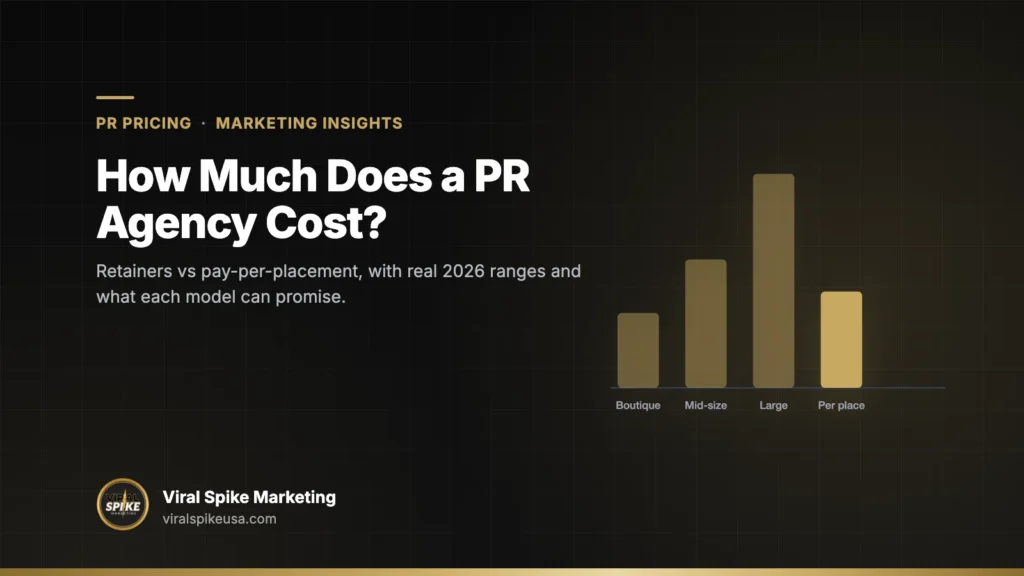
A PR agency costs anywhere from about $2,000 a month for a solo publicist to $90,000 or more a month for a large global firm, according to Everything-PR’s 2026 pricing guide. Boutique and mid-size agencies, where most brands and founders land, fall in the $3,500 to $25,000 monthly range in the same guide. The number that matters more than the retainer, though, is what you actually receive for it: a traditional retainer buys effort and access, while a pay-per-placement model charges you only when a confirmed article is published.
Key takeaways
- Monthly retainers range from $2,000 (individual publicist) to $90,000+ (large agency), per Everything-PR’s 2026 data.
- The same guide puts project fees at $10,000 to $75,000 for a 60 to 120 day engagement and senior hourly rates for crisis work at $400 to $1,000.
- A retainer pays for hours and relationships, not outcomes; no agency can guarantee earned editorial coverage.
- Pay-per-placement flips the risk: you approve the draft, pay per published feature, and get a refund if it does not run.
- Budget for hidden costs like newswire fees ($600 to $3,000 per release), content creation, and photography.
How much does a PR agency cost per month?
Monthly retainers are the default pricing model in public relations, and they scale with the size and reputation of the firm. Everything-PR’s 2026 guide lays out the ranges below.
| Agency type | Typical monthly retainer (Everything-PR, 2026) |
|---|---|
| Individual publicist or freelancer | $2,000 to $10,000 |
| Boutique agency | $3,500 to $10,000 |
| Mid-size agency | $10,000 to $25,000 |
| Large or global firm | $25,000 to $90,000+ |
The same source reports project-based work at $10,000 to $75,000 for engagements lasting 60 to 120 days, active crisis response at $25,000 to $100,000+ per engagement, and senior practitioner hourly rates of $400 to $1,000 for crisis work.
Retainers are usually contracted for six to twelve months. That commitment exists because earned media takes time to build. Axia Public Relations’ analysis of PR timelines notes that results often begin to appear within three to six months, with the most significant visibility and trust gains after a full year of sustained activity. If you want a deeper look at timelines, see the sibling guide on how long PR takes to work.
What is included in a PR retainer?
A retainer buys a block of agency hours each month, plus access to the agency’s relationships and tools. The typical deliverables are:
- Strategy and messaging: positioning, key messages, and a story calendar.
- Media relations: building target lists, pitching journalists, and following up.
- Content: press releases, bylined article drafts, and briefing documents.
- Reactive work: responding to journalist requests and newsjacking.
- Reporting: a monthly summary of pitches sent, conversations held, and coverage secured.
Notice what is missing from that list: a guaranteed number of published articles. A retainer agreement almost never promises coverage. It promises activity. Some months an agency will land three strong pieces; other months the pitches go nowhere and you still pay the full fee.
That is the nature of earned media, not a scam. But it does mean a retainer is best suited to organizations with steady news flow and the patience to invest for a year or more.
Why can’t PR agencies guarantee earned coverage?
Because the decision belongs to the journalist and the editor, not the agency. Earned editorial means a reporter chose to write about you on the merits. An agency can improve your odds with a sharper story, better timing, and warm relationships, but it cannot buy the byline. If an agency guarantees that a staff writer at a major outlet will cover you, that is a red flag, not a selling point.
There is a legitimate category of guaranteed coverage: sponsored or contracted placements. Here the publisher (or a licensed contributor or partner section) agrees in advance to run an approved article, and the piece is labeled accordingly. That is a different product with different value. Our guide to guaranteed press placements, process and pricing explains how these placements work and what the labels mean.
The distinction matters because the two models are priced and judged differently. Muck Rack’s May 2026 analysis of more than 25 million AI citations found earned media accounts for 84% of citations, while paid or advertorial content accounts for 0.3%. Sponsored placements deliver credibility, brand entity signals, and search presence; they rarely become the source an AI assistant quotes. A buyer should pay for each accordingly.
What is pay-per-placement PR and how does it work?
Pay-per-placement means you pay a fixed fee for each confirmed, published article rather than a monthly retainer for effort. The mechanics are usually the same across reputable providers:
- You choose the outlet or tier of outlets and agree on a per-placement price.
- The agency drafts (or you supply) the article, and you approve the final version before anything is submitted.
- The piece is published in the agreed outlet; confirm in writing beforehand how the article will be presented, which URL pattern it will use, and whether it will be indexed.
- You pay for the placement on publication, or you pay upfront and receive a refund if the article does not run within the agreed window.
The refund structure is the important part. A credible pay-per-placement provider offers a publish-or-refund term: if the approved article is not published, you get your money back in full. Read the contract for exclusions, such as revisions requested after approval or content that violates the publisher’s guidelines, since those are the usual ways a weak provider avoids paying out.
What pay-per-placement does not include is ongoing media relations, crisis handling, or reactive pitching. It is a placement product, not a full communications department.
Retainer vs project vs hourly vs pay-per-placement: which model fits?
| Model | What you pay for | Typical commitment | Who carries the risk | Best for |
|---|---|---|---|---|
| Monthly retainer | A block of agency hours and relationships | 6 to 12 months | You: fees are due regardless of coverage | Brands with steady news flow and a long horizon |
| Project fee | A defined scope, such as a launch or rebrand | 60 to 120 days | Shared: scope is fixed, results are not | Product launches, funding announcements, events |
| Hourly | Senior time on demand | None | You, per hour | Crisis response, advisory, media training |
| Pay-per-placement | A published, approved article in a named outlet | Per placement | Provider: publish-or-refund | Founders and brands that need specific features fast |
The right answer is often a combination. A company might run a lean retainer for ongoing relationships and buy two or three guaranteed features to anchor a launch, a fundraise, or an as-seen-in bar on the website.
The break-even framing
Here is a simple way to compare the two dominant models. Take a hypothetical mid-size agency retainer at $10,000 a month for twelve months, or $120,000. If that year yields ten strong earned placements, each cost you $12,000 and came with the journalist’s independent endorsement. If it yields two, each cost $60,000.
With pay-per-placement you know the unit cost before you sign, you approve every word, and the timeline is measured in weeks rather than quarters. The trade is that a placed article does not carry the same third-party weight as a feature a staff journalist chose to write, so ask any provider how the article will be presented and where it will live. Neither is better in the abstract. The question is whether you are buying a relationship engine or a set of specific, dated outcomes.
For a sense of what individual outlets tend to cost and how long they take, see how to get featured in major publications: costs and timelines.
What are the hidden costs of hiring a PR agency?
The retainer is rarely the whole bill. Budget for these line items, which are usually passed through at cost or marked up:
- Newswire distribution: $600 to $3,000 per release, according to Everything-PR. Wire distribution is useful for compliance and syndication, but it is not the same as a placement. The difference is covered in press placement service vs press release distribution.
- Content creation: long-form articles, op-eds, and thought leadership pieces often sit outside the retainer’s hour budget.
- Photography and video: outlets expect high-resolution images, and a professional shoot is a separate expense.
- Media monitoring and databases: some agencies bill tools like monitoring subscriptions back to the client.
- Travel and events: press tours, award entries, and conference sponsorships.
- Onboarding fees: some firms charge a one-time setup fee for the first month of research and messaging.
Ask for a sample invoice from a comparable client before you sign. The sibling article on how to choose a PR agency, questions to ask and red flags includes a full list of contract questions.
Is a PR retainer worth it for a small business?
For most small businesses, a full retainer is premature. A $5,000 a month boutique retainer is $60,000 a year, and a business without regular news, a spokesperson with time to do interviews, or a story bigger than its product will struggle to generate enough earned coverage to justify it.
A more common sequence is to start with a specific goal: one or two placements in outlets your customers recognize, used on your website, in sales decks, and in investor conversations. Once those features are producing conversions and the company has real news to share, a retainer starts to make sense. The mistake is buying the relationship engine before you have anything for it to push.
Where a placement service fits
Viral Spike Marketing works on a pay-per-placement basis rather than a retainer. Clients choose the outlet, approve the article draft before it is submitted, and pay per confirmed published feature under a publish-or-refund guarantee. Placements are guaranteed editorial features in 1,600+ outlets: you approve the draft, the publication, article format, timeline and refund terms are named in writing before you pay, the article is published and indexed on Google, and the engagement is refunded in full if it never runs. The service suits founders, executives, artists and brands that need specific features on a known timeline, and it can run alongside a traditional retainer that handles ongoing media relations. Details on outlets and process are on our public relations service page and our guaranteed PR placements page. If you would like a quote for a specific outlet, contact us and we will tell you whether it is a fit.
Decide what you are buying before you compare prices
The cheapest option is not the lowest retainer; it is the model that matches your goal. If you need a year of relationship building and steady news flow, a retainer with a firm you trust is the right tool, and you should budget for the hidden extras above. If you need specific features in specific outlets on a known timeline, pay-per-placement gives you a fixed unit cost, draft approval, and a refund if the article does not run. Many companies use both. If you want to talk through which outlets fit your budget and goals, contact Viral Spike Marketing and we will give you a straight answer.
Frequently asked questions
How much does a PR agency cost per month?
According to Everything-PR’s 2026 pricing guide, an individual publicist charges $2,000 to $10,000 a month, a boutique agency $3,500 to $10,000, a mid-size agency $10,000 to $25,000, and a large global firm $25,000 to $90,000 or more. Most retainers require a six to twelve month commitment, and results usually take several months to appear.
What is included in a PR retainer?
A retainer typically covers strategy and messaging, media list building, pitching and follow-up, press release writing, responding to journalist requests, and monthly reporting. It buys a set number of agency hours and access to relationships. It does not usually include a guaranteed number of published articles, newswire fees, photography, or long-form content creation.
What is pay-per-placement PR?
Pay-per-placement is a pricing model where you pay a fixed fee for each confirmed, published article in a named outlet instead of a monthly retainer. You approve the draft before submission, and reputable providers offer a publish-or-refund guarantee. Ask any provider to confirm in writing how the article will be presented, which URL pattern it will use, and whether it will be indexed.
Can a PR agency guarantee coverage in Forbes or Newsweek?
No agency can guarantee that a staff journalist will independently cover you; that decision belongs to the editor. Agencies can guarantee sponsored or contributor placements, which are arranged in advance and labeled as such. If a firm promises earned staff coverage for a fee, treat it as a warning sign and ask exactly which section and label the article will carry.
What hidden costs should I expect with a PR agency?
Common extras include newswire distribution at $600 to $3,000 per release (Everything-PR, 2026), content creation beyond the retainer’s hours, professional photography, media monitoring tools, travel for press events, and one-time onboarding fees. Ask for a sample invoice from a comparable client so you can see which items are billed separately before you sign.

More in Marketing Insights